Will AI Take My Job by 2026? Jobs Most at Risk
TL;DR
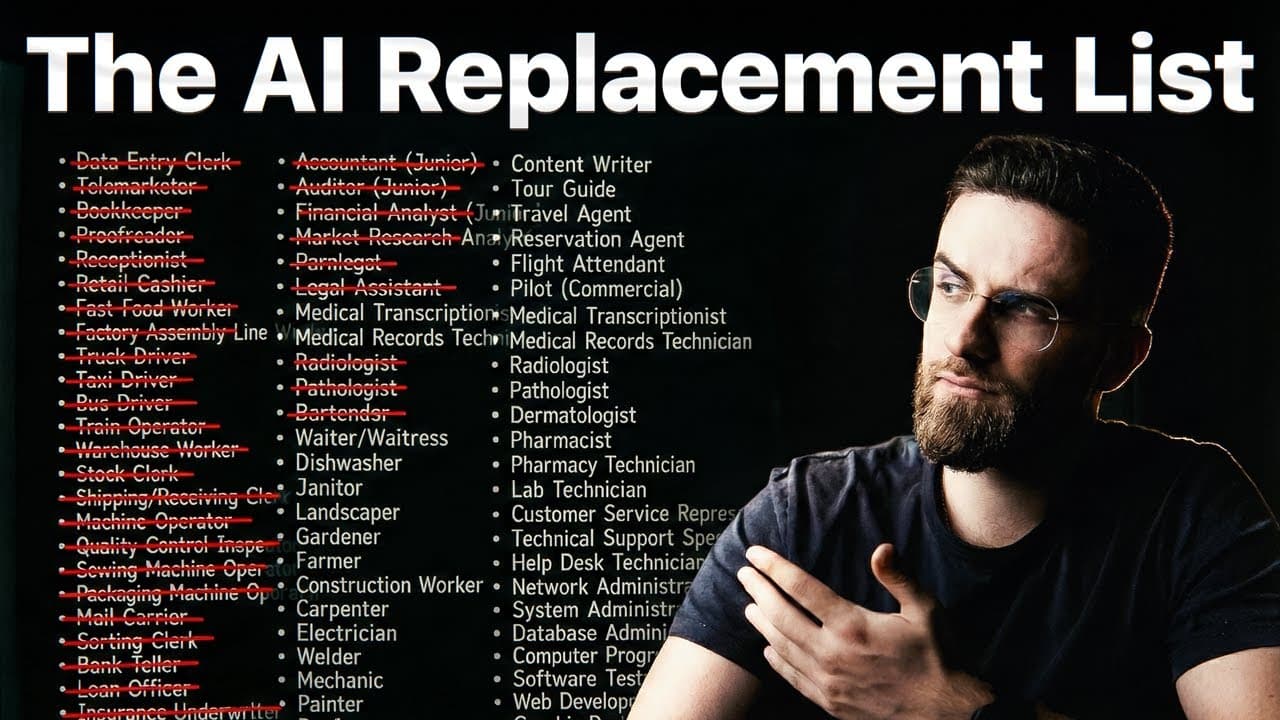
AI is more likely to transform your job by 2026 than eliminate it outright. About 80% of US workers could have at least 10% of their tasks automated, while nearly one in five could see machines handle half their duties. Clerical work, accounting, customer support, and content creation face particular disruption, but workers can stay valuable by operating AI, checking its output, and handling complex human tasks. Read on to see which roles and skills are affected.
Transcript
Did you know that about 80% of US workers could have at least 10% of their job tasks taken over by AI in the very near future? Yeah, 80%. That's basically most of us. And nearly one in five people might see half of their duties handed over to machines. Let that sink in for a second. I'm not here to scare anyone. Okay, maybe a little to wake you up.... Read More
Key Insights
- About 80% of US workers could have at least 10% of their job tasks taken over by AI in the near future, and nearly one in five people might see half of their duties handed over to machines.
- AI's impact reaches beyond factory or warehouse work into white collar fields including finance, law, and media, and even some creative work is not off limits.
- 'Disappear' rarely means everyone in a field is fired overnight; more often the role gets transformed, so nine job types may drastically change by 2026 rather than vanish.
- Clerical roles such as data entry clerks and office administrators are vulnerable because AI excels at repetitive tasks like inputting data, scanning documents, and scheduling meetings without breaks.
- Accounting is shifting toward analysis and strategy as tools like QuickBooks auto-categorize transactions and AI scans receipts, reconciles accounts, and flags unusual entries in seconds.
- Customer support is being reshaped by AI chatbots that some companies say handle 60-70% of support tickets, passing customers to humans only for complex or emotional situations.
- Content creators keep value through personal voice, regional perspective, and storytelling, using AI tools like ChatGPT and Midjourney for drafts while humans polish, fact-check, and add originality.
- Workers who learn to operate AI tools become more valuable; former office assistants in the AI Master community rebranded as automation specialists after picking up new skills.
Install to Summarize YouTube Videos and Get Transcripts
Explore YouTube Video Summarizer or Get YouTube Transcript Extractor
Questions & Answers
Q: Will AI take my job by 2026?
The video says AI is more likely to transform many jobs than eliminate entire professions overnight. About 80% of US workers could have at least 10% of their tasks automated, and nearly one in five might see machines handle half their duties. People who learn to operate AI and manage work requiring human judgment may remain valuable.
Q: Which jobs are most at risk from AI automation?
The video identifies clerical roles, bookkeeping and accounting, customer support, content creation, and design among the vulnerable areas. It says AI is also affecting white-collar fields such as finance, law, and media. These jobs may shrink or change substantially rather than disappear completely.
Q: Why are clerical and administrative jobs vulnerable to AI?
Data entry clerks and office administrators perform repetitive work such as entering numbers, scanning documents, scheduling meetings, organizing files, and sending routine emails. AI can complete many of these tasks faster and with fewer typos. As a result, one technology-skilled administrator could potentially perform work previously handled by a team.
Q: How is AI changing accounting and bookkeeping?
QuickBooks can automatically categorize transactions, while AI can scan receipts, reconcile accounts, generate basic reports, and flag unusual entries. It can also cross-check thousands of records in seconds and prepare first drafts of tax returns or financial statements. Human accountants are therefore shifting toward analysis, strategy, oversight, and creative problem-solving.
Q: What percentage of customer support tickets can AI chatbots handle?
The video says some companies report that AI chatbots handle about 60–70% of support tickets. AI is suited to repeated questions about password resets, orders, and refund policies, and it can assist 100 people simultaneously. Human agents remain important for complex or emotional cases.
Q: How can content creators use AI without being replaced?
Content creators can use ChatGPT for drafts and tools such as Midjourney or Dalle for images. Humans can then polish the output, fact-check it, and add personal voice, regional perspective, originality, and storytelling. The role becomes closer to an editor or creative director working with AI assistants.
Q: What does it mean when a job is expected to “disappear” because of AI?
The video says disappearance does not necessarily mean everyone in a profession is suddenly fired. More often, the role is transformed: a data entry clerk may supervise automation, an accountant may focus on strategy, and a support agent may handle only difficult cases. Some positions may shrink, but adapted versions of the jobs can remain.
Q: How can workers prepare for AI-driven job changes?
Workers can learn to set up AI tools, check their work, fix failures, and take responsibility for unusual or complex situations. The video says former office assistants in the AI Master community have rebranded themselves as automation specialists after developing new skills. Its central advice is to start planning and work with AI tools rather than resist them.
Summary & Key Takeaways
-
The video opens with the claim that about 80% of US workers could have at least 10% of their job tasks automated by AI, and nearly one in five could see half their duties handed to machines, spanning white collar fields like finance, law, and media.
-
It walks through job groups at risk: clerical roles doing repetitive data entry and scheduling, bookkeepers and accountants whose reconciling and reporting tasks are automated, and customer support where chatbots reportedly handle 60-70% of tickets and answer common questions 24/7.
-
Content creation and design are covered as areas where AI generates drafts and images, but human voice, storytelling, and judgment stay valuable; the recurring message is to work with AI tools rather than against them, alongside a promotion for the creator's AI Master Pro course.
Read in Other Languages (beta)
Share This Summary 📚
Summarize YouTube Videos and Get Video Transcripts with 1-Click
Try YouTube Summary with ChatGPT & Claude or YouTube Transcript Generator
Explore More Summaries from AI Master 📚





Summarize YouTube Videos and Get Video Transcripts with 1-Click
Try YouTube Summary with ChatGPT & Claude or YouTube Transcript Generator