How Does Agentic AI Differ From Generative AI?
TL;DR
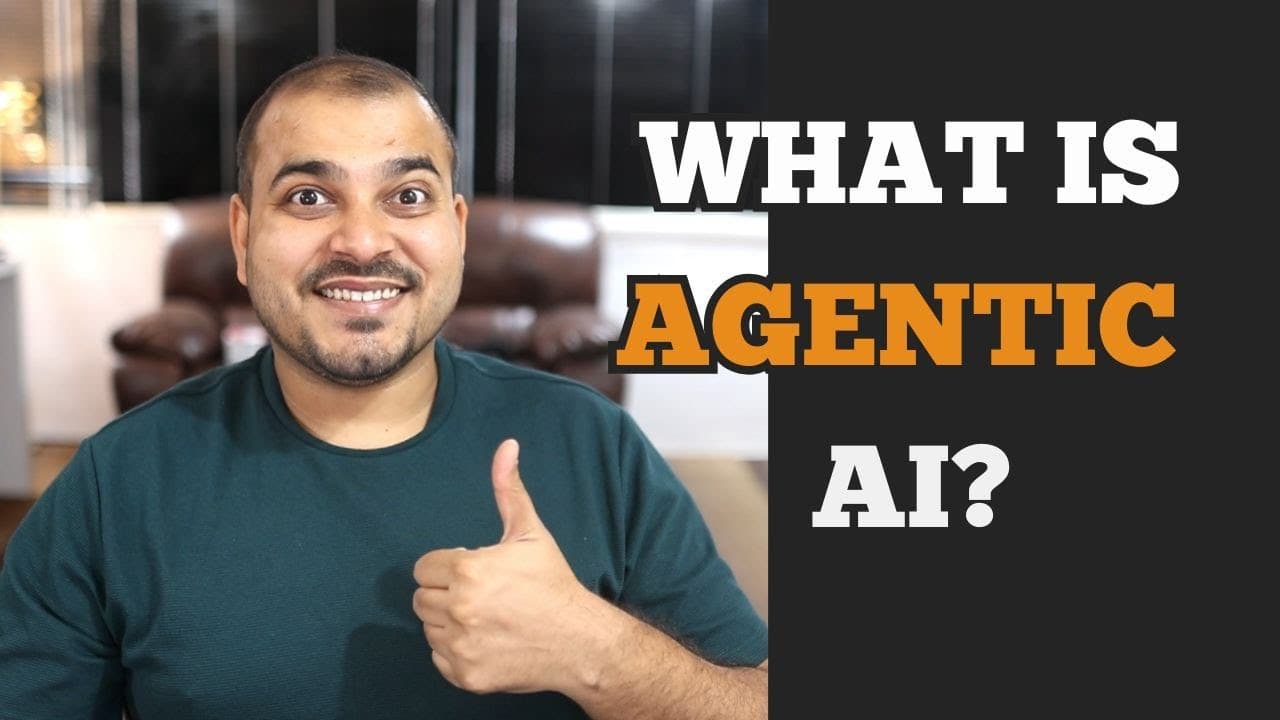
Agentic AI uses autonomous, goal-oriented systems that coordinate language models, data sources, and tools to complete tasks with minimal human intervention. Unlike conventional generative AI, which primarily responds to prompts by producing content, an agentic application can execute a complex workflow independently, pursue a defined business outcome, and improve its performance as tasks are completed.
Transcript
hello all my name is Krish naak and welcome to my YouTube channel so guys as you all know that we are towards the end of 2024 uh there are some few more days to probably uh you know complete 2024 and we are moving towards 2025 and if I talk about or give you a brief summary about this specific year with respect to the development of generative AI r... Read More
Key Insights
- Generative AI is primarily designed to create content from a user query, a language model, and a prompt that defines how the model should behave. Prompt refinement can improve the output or support a custom chatbot, but the central function remains content generation.
- Agentic AI is an autonomous AI system built to achieve a specific goal with minimal human intervention. Its work is organized around an intended business outcome, allowing the system to perform connected tasks independently instead of responding only with a single generated answer.
- External tools give language models access to information beyond their training data. The transcript cites DuckDuckGo search, Wikipedia search, and ArXiv as examples of sources that can be integrated with language model applications when current or specialized information is required.
- Retrieval and tool integration address limitations in language model training recency. A model trained periodically may not know current internet news, so an application can use an external source to retrieve relevant information before the model produces its response.
- Agentic workflows can coordinate several tools within one complex process. Instead of requiring a user to direct each individual operation, an autonomous system can work through the connected tasks needed to reach its predefined goal and complete the workflow independently.
- The distinction between generative and agentic AI is based on purpose and execution. Generative AI focuses on producing content, while agentic AI focuses on achieving a goal by interacting with tools, data sources, and a potentially complex workflow tied to a business outcome.
- Agentic systems can refine their performance while tasks are being completed. The transcript presents this ability to improve during execution as a capability that was not available in the conventional generative AI applications being compared.
- LangGraph, LangChain, Langflow, and Phidata are identified as frameworks for developing agentic AI applications. LangGraph is described as a LangChain module that supports agentic workflows, while LangChain also provides tools that developers can integrate with language model applications.
Install to Summarize YouTube Videos and Get Transcripts
Explore YouTube Video Summarizer or Get YouTube Transcript Extractor
Questions & Answers
Q: What is agentic AI?
Agentic AI refers to autonomous, goal-oriented software systems that can perform tasks with minimal human intervention. Rather than limiting their role to generating content from a prompt, these systems can interact with tools and data, organize a complex workflow, and execute connected tasks independently until they achieve a defined goal or business outcome.
Q: How does agentic AI differ from generative AI?
Generative AI primarily takes a user query and a behavioral prompt, then uses a language model to generate content such as a poem or chatbot response. Agentic AI is organized around achieving a specific goal. It can use several tools, interact with external information, and independently execute a complex workflow with minimal human intervention.
Q: Why do AI applications need external tools?
Language models may lack recent information because they are trained periodically rather than continuously on current internet data. External tools allow an application to retrieve information that the model does not already contain. The transcript gives DuckDuckGo search, Wikipedia search, and ArXiv as examples of sources that can be connected to language model applications.
Q: How does an agentic AI workflow operate independently?
An agentic workflow begins with a defined goal and uses the tools or information sources required to pursue it. The autonomous system handles the connected tasks within a potentially complex workflow instead of waiting for human direction at every step. Its operations remain focused on completing the goal and producing the intended business outcome.
Q: Which frameworks can be used to build agentic AI applications?
The transcript identifies LangChain, LangGraph, Langflow, and Phidata as frameworks or modules that can support agentic AI development. LangGraph is described as a module from LangChain for creating agentic applications. LangChain also supplies tools that connect language models to services and external sources such as search, Wikipedia, and ArXiv.
Q: How can agentic AI be used for stock comparison?
A custom agentic bot could receive a goal such as comparing Tesla and Nvidia and suggesting which stock to buy. Its workflow could retrieve stock details and performance information through YFinance, then gather recent current news from another source. The language model could process these inputs together to address the requested comparison.
Q: What role do goals play in agentic AI systems?
A specific goal gives an agentic AI system the outcome it must pursue and determines the workflow it needs to execute. The goal can reflect a business result or a user request. Tools, external sources, and individual tasks are coordinated around that outcome, allowing the system to work independently instead of merely generating isolated content.
Q: Can agentic AI improve its performance during task execution?
The transcript states that an autonomous AI system can fine-tune itself to perform better while its tasks are being completed. This is presented as a difference from the conventional generative AI applications discussed, whose main purpose is content generation through prompts. The agentic system combines improvement with independent execution of a goal-oriented workflow.
Summary & Key Takeaways
-
Generative AI applications use language models, user queries, and behavioral prompts to generate content. Developers can refine prompts, build custom chatbots, and connect external sources, but the basic objective remains producing an output in response to a request rather than independently pursuing a broader goal through a complex workflow.
-
Agentic AI consists of autonomous, goal-oriented systems that can work independently with minimal human intervention. An application may combine multiple tools and data sources, choose a workflow suited to the requested outcome, and execute its tasks until it reaches the defined business goal rather than merely generating content.
-
Frameworks such as LangChain, LangGraph, Langflow, and Phidata support the construction of agentic applications. The finance example shows how a custom bot could combine stock details from YFinance with recent news to compare Tesla and Nvidia, demonstrating how agents coordinate information sources around a specific user objective.
Read in Other Languages (beta)
Share This Summary 📚
Summarize YouTube Videos and Get Video Transcripts with 1-Click
Try YouTube Summary with ChatGPT & Claude or YouTube Transcript Generator
Explore More Summaries from Krish Naik 📚



Summarize YouTube Videos and Get Video Transcripts with 1-Click
Try YouTube Summary with ChatGPT & Claude or YouTube Transcript Generator