What Are the Best DJI Pocket 3 Alternatives?
TL;DR
The DJI Osmo Action 5 Pro is the best alternative for most people because it offers stabilized 4K video, rugged construction, long battery life, and easy wireless microphone support. The Pocket 2 better preserves the compact gimbal design, while the Canon PowerShot V1 provides greater versatility, stronger image quality, zoom, and serious photo capabilities.
Transcript
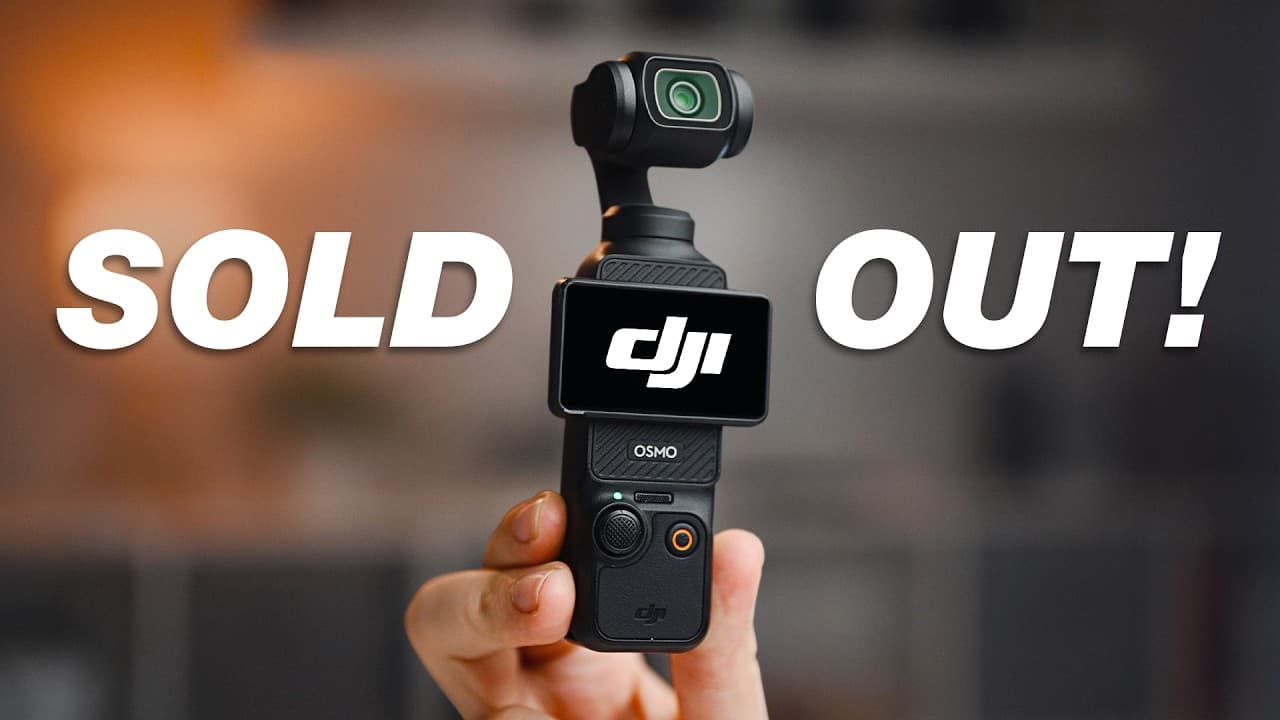
Yep, you read that right. The DJI Pocket 3 is nowhere to be found and now costs $800 thanks to recent price hikes and tariffs. Now, don't get me wrong, I think the DJI Pock is a phenomenal camera when it comes to shooting YouTube videos and vlogs, travel content, but at this new price point, it's really hard to justify it. So, in this video, I'm go... Read More
Key Insights
- The DJI Pocket 3 is difficult to find in the United States and can cost as much as $800 because of recent price hikes and tariffs. Buyers outside the United States may still be able to obtain it at a more favorable price.
- A smartphone gimbal is the lowest-cost alternative presented for achieving smooth footage. The $150 Osmo Mobile 7P can connect with the $59 DJI Mic Mini, creating a stabilized phone video and wireless audio setup for slightly more than $200.
- The Osmo Action 5 Pro is the recommended choice for most people seeking capabilities similar to the Pocket 3. It records 4K video at up to 120 frames per second, provides strong stabilization, and is smaller, simpler, and more rugged.
- The Action 5 Pro is better suited to demanding travel conditions because it is waterproof and offers four hours of battery life. Its 48 GB of built-in storage also allows recording when the user forgets to bring an SD card.
- The Action 5 Pro produces a characteristic action-camera image with a very wide view and most of the scene in focus. Its smaller sensor also delivers weaker low-light performance than the Pocket 3, so ample light is important for good results.
- The DJI Pocket 2 preserves the compact three-axis gimbal design at a lower price. It records 4K video at up to 60 frames per second and costs $280, while its $400 Creator Combo adds accessories and an older DJI wireless microphone.
- The Canon PowerShot V1 is the most versatile camera discussed because its stabilized 16–50 mm built-in zoom supports wide vlogging shots, tighter compositions, video, and photography. Its image is described as more natural-looking straight from the camera than the other options.
- The PowerShot V1 includes advanced production tools such as 10-bit recording, Canon C-Log 3, a three-stop built-in ND filter, a headphone jack, a cooling fan, and a flip-out touchscreen. Its main disadvantages are its chunky body and $899 price.
Install to Summarize YouTube Videos and Get Transcripts
Explore YouTube Video Summarizer or Get YouTube Transcript Extractor
Questions & Answers
Q: How can I find a DJI Pocket 3 when it is sold out?
Buyers in the United States can first look for a used DJI Pocket 3, but they should compare prices carefully because eBay listings may include substantial markups. Another option is to contact nearby camera or electronics stores, since a local retailer may still have inventory at an affordable price. Buyers outside the United States may encounter better availability or pricing because the described shortage and price increase primarily affect the US market.
Q: What is the best DJI Pocket 3 alternative for most people?
The DJI Osmo Action 5 Pro is the recommended alternative for most people because it covers many of the same practical uses as the Pocket 3. It captures 4K video at up to 120 frames per second, produces smooth stabilized footage, supports compatible DJI wireless microphones, and is easy to start recording with. It is also smaller, waterproof, sturdier, and capable of lasting up to four hours on one battery.
Q: Can a phone and gimbal replace the DJI Pocket 3?
A phone combined with a gimbal can provide much of the Pocket 3's flexibility when the main goal is smooth, cinematic-looking footage. The Osmo Mobile 7P costs $150 and can connect with the DJI Mic Mini, which costs an additional $59. For slightly more than $200, this combination upgrades a phone with stabilization and wireless audio while continuing to use the phone's existing camera.
Q: What are the advantages of the DJI Osmo Action 5 Pro?
The Osmo Action 5 Pro records 4K video at up to 120 frames per second and provides stabilization suitable for handheld vlogging. It is waterproof, more rugged than the Pocket 3, and easier to use in rain or underwater. Its battery lasts up to four hours, while 48 GB of built-in storage provides a backup recording option without an SD card. It can also connect to as many as two compatible DJI microphones.
Q: What are the disadvantages of the DJI Osmo Action 5 Pro?
The Osmo Action 5 Pro creates a wide action-camera look in which most of the frame remains in focus, so it does not reproduce the Pocket 3's blurred-background appearance. Its sensor is also smaller than the Pocket 3's sensor. Although its low-light performance is considered relatively good for an action camera, it still needs plenty of light to produce its best-looking footage.
Q: Is the DJI Pocket 2 still a good alternative to the Pocket 3?
The DJI Pocket 2 remains a practical choice for creators who specifically want a small camera with a three-axis gimbal. It records 4K video at up to 60 frames per second and can create smooth footage while walking or panning. It costs $280, or $400 as a Creator Combo. However, its image quality, colors, and tiny touchscreen are less refined than those of the Pocket 3.
Q: Why is the Canon PowerShot V1 more versatile than the DJI Pocket 3?
The Canon PowerShot V1 is more versatile because its stabilized built-in lens zooms from 16 mm to 50 mm, covering wide vlogging shots and tighter compositions. It handles travel videos, vlogs, YouTube production, and still photography, while the Pocket 3 and Action 5 Pro are less capable as photo cameras. The V1 also offers a large flip-out touchscreen, 10-bit recording, Canon C-Log 3, and a natural-looking image.
Q: What are the drawbacks of the Canon PowerShot V1?
The Canon PowerShot V1 is chunkier than the DJI Pocket 3, making it somewhat harder to carry as a compact point-and-shoot camera. Its $899 price is also higher than the roughly $500 to $600 budget someone might originally have planned for a Pocket 3. However, the V1 can function as a self-contained camera without requiring several extra accessories, and its broader shooting flexibility may justify the additional cost.
Summary & Key Takeaways
-
The DJI Pocket 3 has become difficult to find in the United States and can cost as much as $800 following price hikes and tariffs. Before choosing another camera, buyers can check used listings and nearby stores, although heavily marked-up eBay offers may not provide worthwhile value.
-
A phone paired with the $150 Osmo Mobile 7P and a $59 DJI Mic Mini creates a stabilized video and wireless audio setup for slightly more than $200. Dedicated alternatives include the rugged Osmo Action 5 Pro and the smaller $280 DJI Pocket 2 with its three-axis mechanical gimbal.
-
The Canon PowerShot V1 is the most versatile alternative because its stabilized 16–50 mm zoom supports vlogging, travel videos, YouTube production, and photography. It also provides 10-bit Canon C-Log 3, a three-stop ND filter, headphone monitoring, cooling fan, and flip-out touchscreen, but costs $899 and has a chunkier body.
Read in Other Languages (beta)
Share This Summary 📚
Summarize YouTube Videos and Get Video Transcripts with 1-Click
Try YouTube Summary with ChatGPT & Claude or YouTube Transcript Generator
Explore More Summaries from Think Media 📚





Summarize YouTube Videos and Get Video Transcripts with 1-Click
Try YouTube Summary with ChatGPT & Claude or YouTube Transcript Generator