Apollo Twin vs Audient ID24: Which Audio Interface Should I Choose?
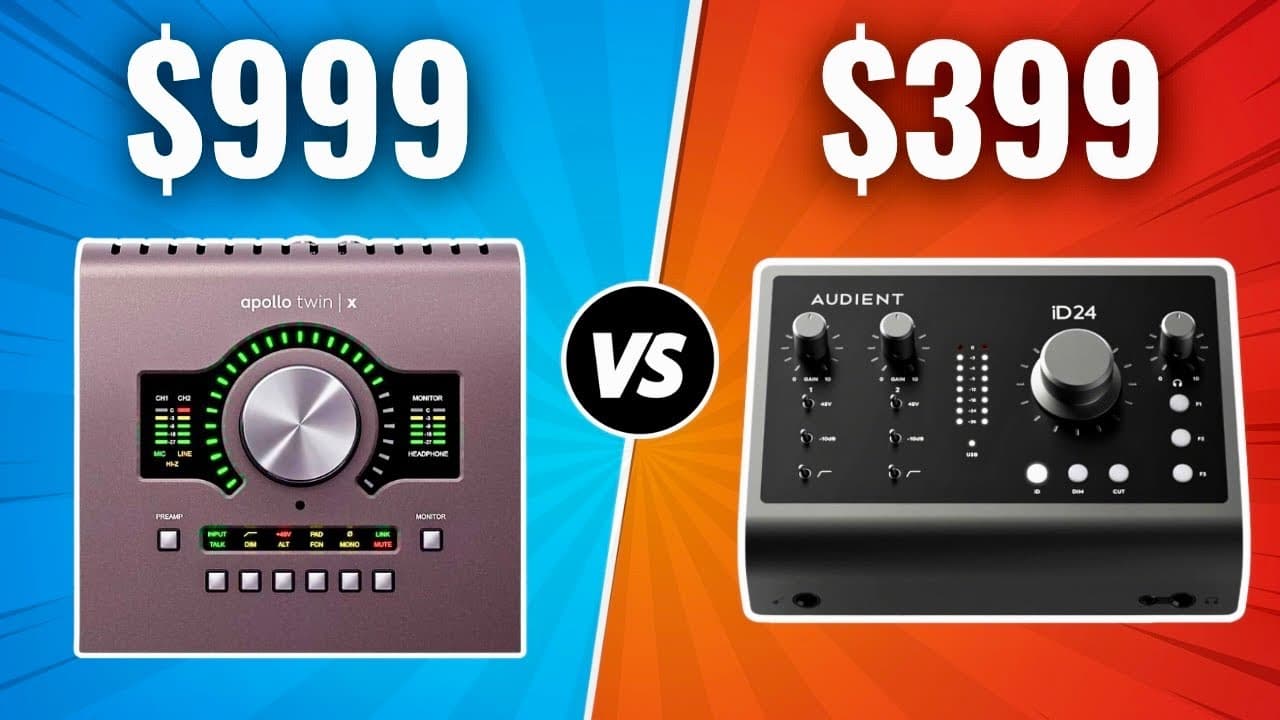
TL;DR
The Apollo Twin is priced at $999 and offers high-quality DSP processing, allowing for real-time plugin use without latency, making it ideal for professionals. In contrast, the Audient ID24 is a budget-friendly option costing $399, suitable for those who prioritize affordability and flexibility over premium features. Choose the Apollo for its superior sound quality and plugin access, or the Audient for a cost-effective solution.
Transcript
in this video I'll be comparing the Apollo twin to the audience id24 in order to help you decide which of these interfaces you should consider for your home studio first let's talk about the price because there's a huge difference here the Apollo twin retails starting at 999 dollars for the dual core and 14.99 for the quad core version and the numb... Read More
Key Insights
- 👤 The Apollo Twin's price reflects its DSP capabilities and premium plugin access, while the Audient ID24 offers an affordable alternative for budget-minded users.
- 👪 Both interfaces excel in portability and aesthetics, making them suitable for smaller home studio setups while retaining essential recording features.
- 🔊 The inclusion of high-quality plugins with the Apollo allows users to achieve professional sound without needing expensive hardware.
- 👤 The flexibility offered by Audient's mixer software caters to multi-user recording sessions, providing tailored audio mixes for different participants.
- ⌛ Understanding the unique benefits of each interface is crucial for potential buyers, particularly regarding their recording needs and preferences for real-time processing.
- 👻 The Apollo’s ability to print effects during recording can save time and effort in post-production while still allowing adjustments through the UAD Monitoring mode.
- 👂 Audio tests showcasing practical applications and sound quality illustrate the real-world performance of the interfaces in home recording scenarios.
Install to Summarize YouTube Videos and Get Transcripts
Explore YouTube Video Summarizer or Get YouTube Transcript Extractor
Questions & Answers
Q: What are the main differences in price between the Apollo Twin and Audient ID24?
The Apollo Twin retails at approximately $999 for the dual core version and $1499 for the quad core version, while the Audient ID24 is priced at $399. This substantial price gap indicates the Apollo Twin brings advanced features, especially in plugin integration and DSP processing capabilities, making it a premium offering compared to the more budget-friendly Audient ID24.
Q: What are the shared features of both audio interfaces?
Both the Apollo Twin and Audient ID24 have two channels, a headphone output, and a line input for instruments. They each support phantom power for condenser mics and include useful features like a pad switch for loud sources and a high-pass filter to eliminate low-end noise, making them appropriate for home studio recordings.
Q: How does Universal Audio's DSP technology benefit users of the Apollo Twin?
The DSP technology in the Apollo Twin allows users to run multiple plugins in real-time without putting extra strain on their computer’s processor. This feature is crucial for achieving low-latency audio monitoring while recording, as it enhances the recording experience and permits musicians to hear their effects in real time, which can positively impact their performance quality.
Q: What software is included with the Apollo Twin and what features does it have?
The Apollo Twin comes with the Console app, which provides a channel strip for inserting plugins and two recording options: UAD Record and UAD Monitoring. UAD Record allows plugins to be printed into the recording, resulting in a final sound, while UAD Monitoring lets users hear the plugins without recording them, offering flexibility for post-production adjustments.
Q: Why might someone choose the Audient ID24 over the Apollo Twin?
Choosing the Audient ID24 makes sense for users on a budget who still want quality sound. It is particularly appealing for those who do not need real-time plugin processing, prefer a one-time payment over a subscription service, or need more channels for multi-track recording by pairing it with additional interfaces, which can provide greater value than the higher-priced Apollo.
Q: What is the significance of Universal Audio's recent changes regarding plugin availability?
Universal Audio recently made their plugins available for use natively across various Digital Audio Workstations (DAWs), breaking the previous exclusivity tied to Apollo interfaces. This change enables a broader audience to utilize high-quality vintage and analog emulation plugins, regardless of the interface, making their products more accessible and competitive.
Q: What audio tests were conducted to compare both interfaces?
The video presented audio tests using the same microphone, allowing for an unbiased comparison of the preamps in both interfaces. The tests included recordings of vocals and acoustic guitar, demonstrating how each interface handles the audio quality and effects, providing viewers with a clear idea of what to expect from each setup.
Summary & Key Takeaways
-
The Apollo Twin is significantly more expensive than the Audient ID24, starting at $999 compared to $399. This price difference reflects the additional value and features offered by the Apollo, particularly its DSP capabilities and included plugins.
-
Both audio interfaces share design aesthetics and foundational features, including dual channels, headphone outputs, and power for condenser mics, making them suitable for portable setups.
-
The Apollo Twin provides unique DSP processing and access to premium plugins, enabling real-time, latency-free audio monitoring, while the Audient ID24 focuses on affordability and flexibility for those on a budget.
Read in Other Languages (beta)
Share This Summary 📚
Summarize YouTube Videos and Get Video Transcripts with 1-Click
Try YouTube Summary with ChatGPT & Claude or YouTube Transcript Generator
Explore More Summaries from Home Studio Academy 📚
Summarize YouTube Videos and Get Video Transcripts with 1-Click
Try YouTube Summary with ChatGPT & Claude or YouTube Transcript Generator