The NEW SCIENCE of Moon Formation
TL;DR
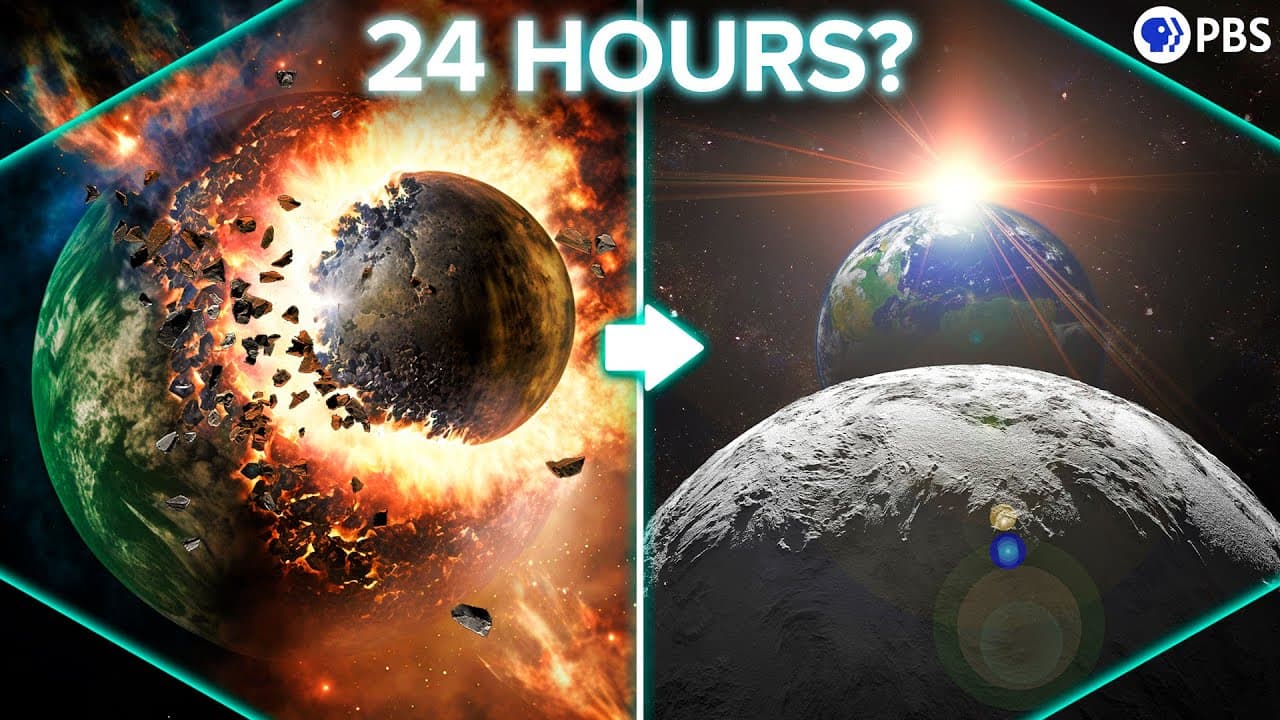
Simulations reveal new insights into the moon's formation.
Transcript
We’d like to thank Speakly for supporting PBS. Einstein once asked if “the moon exists only when I look at it?". It was rhetorical objection to the idea that measurement in quantum mechanics causes reality to become real. But there was a time when the moon didn’t exist, and then hours later suddenly did. At least, according to the latest simulation... Read More
Key Insights
- The moon's unusual size and composition suggest it formed from Earth-like material, with a small iron core and similar isotopic ratios.
- Apollo missions provided valuable data on the moon's structure, including its seismic activity and isotopic composition, which resembles Earth's crust.
- The giant impact hypothesis suggests a Mars-sized body, Theia, collided with early Earth, forming the moon from the resulting debris.
- Recent high-resolution simulations propose a two-moon scenario, where the collision initially creates two satellites, with one eventually forming the moon.
- The new simulation aligns with known moon properties, including its size, magma ocean, and low iron content, providing a plausible formation scenario.
- The impact hypothesis also explains Earth's robust iron core and tilted rotational axis, likely influenced by the Theia collision.
- While simulations offer insights, uncertainties remain about the collision's specifics, such as masses, speeds, and angles of impact.
- Future simulations with added factors like magnetic fields could further refine our understanding of the moon's formation.
Install to Summarize YouTube Videos and Get Transcripts
Explore YouTube Video Summarizer or Get YouTube Transcript Extractor
Questions & Answers
Q: What is the giant impact hypothesis?
The giant impact hypothesis suggests that the moon formed from debris after a colossal collision between early Earth and a Mars-sized body named Theia. This theory explains the moon's composition, isotopic similarities to Earth, and its small iron core, as well as Earth's robust iron core and tilted axis.
Q: How did the Apollo missions contribute to our understanding of the moon?
The Apollo missions provided essential data on the moon's structure and composition. Seismometers set up during the missions recorded moonquakes, helping to map the lunar interior. Additionally, samples returned by astronauts revealed isotopic similarities between lunar rocks and Earth's crust, supporting theories about the moon's Earth-like origins.
Q: What new insights have recent simulations provided about moon formation?
Recent high-resolution simulations revealed a new scenario where the moon forms within hours after a collision, initially creating two moons. This scenario suggests one moon stabilized into the current moon, aligning with its known properties like size and composition, and offering a refined understanding of its formation process.
Q: How does the giant impact hypothesis explain Earth's properties?
The giant impact hypothesis accounts for Earth's strong iron core and tilted rotational axis. The collision with Theia likely merged Theia's iron core with Earth's, enhancing its magnetic field. The impact also could have altered Earth's axis, explaining its current tilt, which influences climate and seasons.
Q: What challenges exist in simulating moon formation?
Simulating moon formation involves challenges like accurately modeling the collision's specifics, including the masses, velocities, and angles of impact. High-resolution simulations help refine these models, but limitations remain, such as incorporating factors like magnetic fields and achieving even higher resolution for more precise results.
Q: Why is the moon's isotopic composition significant?
The moon's isotopic composition is significant because it closely matches Earth's crust, suggesting a shared origin. This similarity supports the giant impact hypothesis, indicating that the moon formed from material ejected during a collision with Earth, rather than being captured from elsewhere in the solar system.
Q: What role do computer simulations play in understanding moon formation?
Computer simulations are crucial for testing moon formation theories, allowing scientists to model various collision scenarios and their outcomes. By adjusting parameters like impact angle and velocity, simulations help identify scenarios that produce a moon with properties similar to the actual moon, refining our understanding of its formation.
Q: How might future research further refine our understanding of moon formation?
Future research could refine moon formation theories by incorporating additional factors into simulations, such as magnetic fields and even higher resolution models. These advancements could provide more detailed insights into the collision dynamics and material interactions, narrowing down the range of plausible scenarios for the moon's origin.
Summary & Key Takeaways
-
Recent simulations challenge previous moon formation theories by suggesting a rapid creation process involving a two-moon scenario. The giant impact hypothesis remains central, positing that a collision between proto-Earth and Theia led to the moon's formation from debris.
-
The Apollo missions provided crucial data on the moon's isotopic composition and seismic activity, supporting the idea that the moon formed from Earth-like material. High-resolution simulations now offer a more detailed view of this process.
-
The new simulations suggest that the moon formed within hours after a massive collision, with one of two initial moons stabilizing into the moon we know today. This scenario aligns with the moon's known properties and offers a refined understanding of its origins.
Read in Other Languages (beta)
Share This Summary 📚
Summarize YouTube Videos and Get Video Transcripts with 1-Click
Try YouTube Summary with ChatGPT & Claude or YouTube Transcript Generator
Explore More Summaries from PBS Space Time 📚
Summarize YouTube Videos and Get Video Transcripts with 1-Click
Try YouTube Summary with ChatGPT & Claude or YouTube Transcript Generator