Making milk lactose free
TL;DR
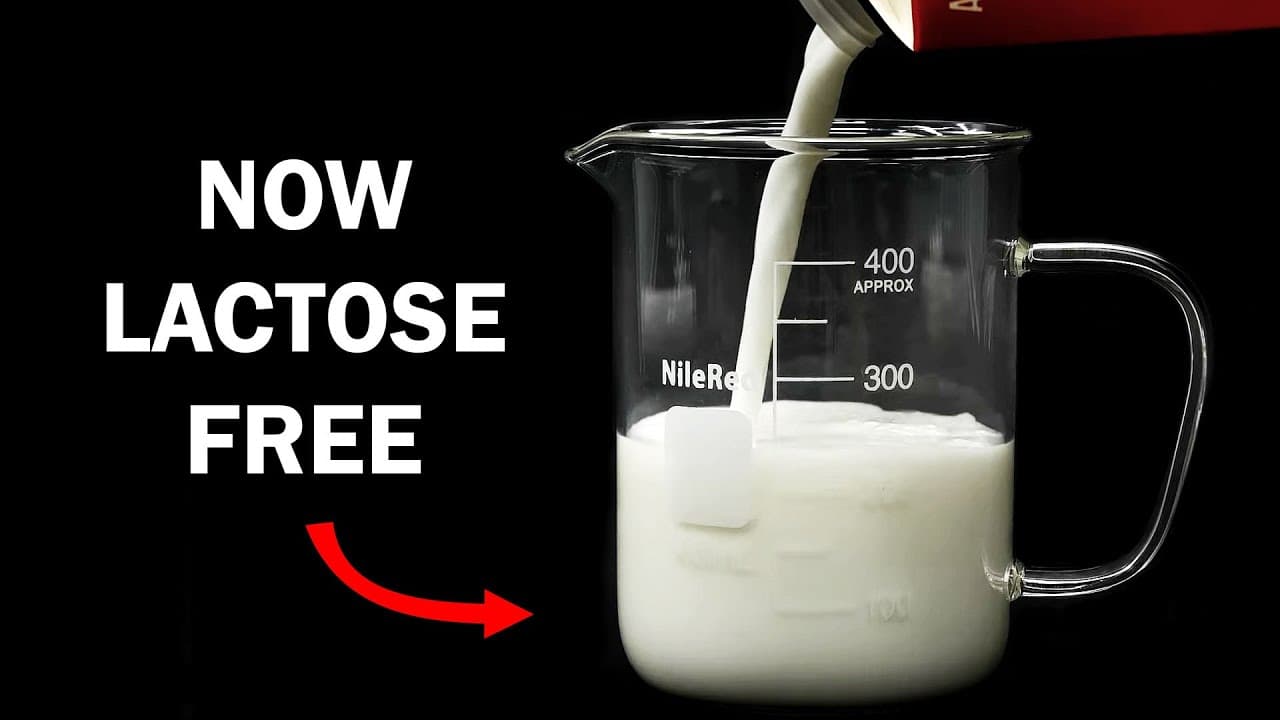
Lactase deficiency causes lactose intolerance, resulting in bloating, abdominal problems, and diarrhea. Lactose-free milk is produced using an enzyme-based approach that breaks down lactose, and there are multiple methods for doing so.
Transcript
A lot of people can't have milk or dairy products in general because they have a problem with lactose. Lactose itself can't be absorbed and it first needs to be broken down into its components: glucose and galactose. For many of us, this conversion is easily carried out by an enzyme called lactase. However, some people don't produce enough or any a... Read More
Key Insights
- ❓ Lactose intolerance results from a deficiency in the lactase enzyme, causing lactose malabsorption and digestive symptoms.
- 🥶 Lactose-free milk is produced through the selective breakdown of lactose into glucose and galactose using the lactase enzyme.
- 🍼 Two commonly used methods for making lactose-free milk involve adding lactase directly to milk or fixing the enzyme to a solid support.
- 🍼 The addition of lactase enzyme and subsequent deactivation requires pasteurization, reducing the milk's shelf life.
- 👻 Fixing the lactase enzyme to a solid support allows for enzyme recovery and reuse, but protein adhesion and microbial growth pose challenges.
- 🍼 Ultrafiltration is another method for producing lactose-free milk, where high pressure separates lactose from proteins and fats, resulting in a concentrated mixture that can be diluted to make milk.
- 🍼 Lactose-free milk produced through ultrafiltration has a lower lactose content, resulting in a milder taste closer to regular milk.
Install to Summarize YouTube Videos and Get Transcripts
Explore YouTube Video Summarizer or Get YouTube Transcript Extractor
Questions & Answers
Q: What happens to lactose in the colon of individuals with lactose intolerance?
In individuals with lactose intolerance, lactose reaches the colon undigested, where it is broken down by bacteria through fermentation. This process produces gas, leading to bloating and abdominal problems.
Q: How is lactose removed from milk to make it lactose-free?
Lactose is removed from milk by adding the lactase enzyme, which breaks it down into glucose and galactose. This enzyme-based approach selectively targets lactose without affecting the rest of the milk's composition.
Q: What are the challenges with the lactase enzyme method of producing lactose-free milk?
The lactase enzyme is expensive, making the addition and subsequent deactivation of the enzyme wasteful. The presence of other enzymes and microorganisms in the lactase source can reduce the milk's shelf life. Pasteurization is often required to deactivate the enzyme and kill the microorganisms.
Q: How does the method of fixing the lactase enzyme to a solid support work?
The lactase enzyme can be fixed to a solid support, such as calcium alginate jelly, which allows for its recovery and reuse. The enzyme is trapped in calcium alginate beads, facilitating lactose hydrolysis. However, this method requires regular washing to remove proteins and re-pasteurization to control microbial growth.
Summary & Key Takeaways
-
Lactose intolerance occurs when individuals lack the enzyme lactase to break down lactose in dairy products, leading to digestive issues.
-
Lactose-free milk is produced by adding lactase enzyme to milk, which hydrolyzes lactose into glucose and galactose.
-
Another method involves fixing the lactase enzyme to a solid support, such as calcium alginate jelly, allowing for its reuse.
Read in Other Languages (beta)
Share This Summary 📚
Summarize YouTube Videos and Get Video Transcripts with 1-Click
Try YouTube Summary with ChatGPT & Claude or YouTube Transcript Generator
Explore More Summaries from NileRed 📚


Summarize YouTube Videos and Get Video Transcripts with 1-Click
Try YouTube Summary with ChatGPT & Claude or YouTube Transcript Generator