How Does Web3 Enable Digital Ownership Rights?
TL;DR
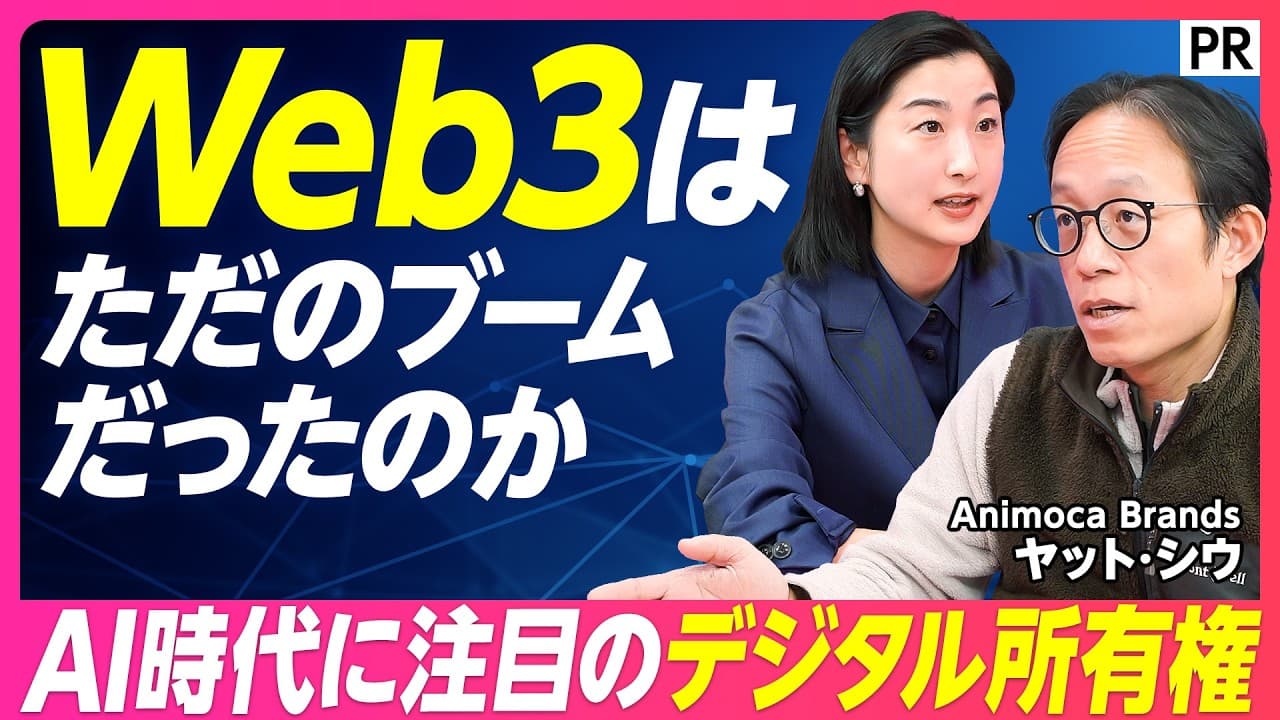
Web3 can give users ownership of their data, digital assets, and network value by recording rights on decentralized blockchains instead of company-controlled databases. Animoca Brands sees this model as a way to reduce platform dependence, connect creators directly with customers, and expand Japanese anime, manga, gaming, and other intellectual property to global audiences through tokenization.
Transcript
owning the data and all the related network effects and value through essentially blockchain and that's what it means to have digital property rights in Japan some feel the hype has g a bit web three but at the end of the day the question isn't to be asked about what is there hype the question is is it useful technology can it actually be something... Read More
Key Insights
- Web3 is presented as the web of ownership, following an early web centered on reading and a social web centered on reading and writing. Its distinguishing feature is the ability to own data, digital assets, and the network value users help create.
- Digital property rights are the foundation of Animoca Brands' vision for future economies. The company argues that digital creations and assets should be treated as property owned by creators and end users, with blockchain serving as the underlying ownership infrastructure.
- Web2 platforms control the databases to which users contribute content and behavioral data. Although users create photos, posts, attention, and social connections, the platform retains control of the resulting data, advertising value, network effects, and access to audiences.
- Likes and followers function as a form of currency because they can create social status and economic opportunities. However, users do not fully control this currency because platforms determine whether, when, and how creators can communicate with or monetize their audiences.
- Blockchain supports digital independence because its decentralized data structure is not controlled by a single company. This structure can let users hold assets and relationships directly, reducing the ability of a platform operator to unilaterally control their digital activity.
- Platform dependence can leave businesses without meaningful recourse when access is removed. Animoca Brands experienced this in 2012 when all its applications were removed from a mobile app platform without a judicial process or a clear explanation for the decision.
- Direct creator-customer relationships are a central Web3 benefit. On conventional music and social platforms, the platform knows the audience while creators often cannot identify or directly reach individual customers, leaving the platform in control of distribution and communication.
- Japanese intellectual property can reach broader global audiences through blockchain ownership and tokenization. Animoca Brands Japan aims to connect anime, manga, games, and other Japanese products with global Web3 markets while bringing international blockchain technology into Japan.
Install to Summarize YouTube Videos and Get Transcripts
Explore YouTube Video Summarizer or Get YouTube Transcript Extractor
Questions & Answers
Q: What is Web3 according to Animoca Brands?
Web3 is described as the web of ownership. The early web primarily allowed people to read information, while Web2 added the ability to write, publish, and interact through social platforms. Web3 adds ownership by using blockchain so users can control digital data, assets, and associated network value instead of leaving them entirely inside databases controlled by individual platform companies.
Q: How does blockchain enable digital property rights?
Blockchain enables digital property rights by providing a decentralized data structure that is not owned and controlled by one company. Users can hold digital assets and related rights on that shared infrastructure. According to the interview, this makes blockchain the mechanism through which creators and end users can own digital property rather than merely receiving permission to use items recorded in a platform's private database.
Q: Why does Animoca Brands consider Web2 platform dependence a problem?
Web2 platform dependence is a problem because a platform controls its database, distribution system, audience access, and operating rules. Creators and businesses may contribute valuable content and customer activity without owning the resulting relationships. A platform can also remove applications or limit audience access through its own decision-making process, leaving affected users without the protections or adjudication available in ordinary commercial disputes.
Q: What happened to Animoca Brands on a mobile app platform in 2012?
In 2012, Animoca Brands was a major developer on a mobile app platform, and the platform removed all of its applications. The company says it never received a definitive explanation and could not appeal through an independent court, judge, jury, or comparable adjudication process. The incident demonstrated how completely a developer's business could depend on rules and decisions controlled by a platform operator.
Q: How can Web3 improve relationships between creators and customers?
Web3 can allow creators to build direct, on-chain relationships with customers instead of relying entirely on an intermediary platform. Conventional music and social platforms know the identities and behavior of users, while creators may not know or freely contact their own audiences. Direct ownership of customer relationships lets creators develop their own networks, distribute products more independently, and reduce the platform's control over communication.
Q: Why are user data, likes, and followers considered valuable?
User data is valuable because it supports advertising, network effects, artificial intelligence, self-driving technology, and the business models of major technology companies. Likes and followers also operate like a currency because they convey attention, social status, and potential economic value. Users produce these resources through their time and creative work, but Web2 platforms own the databases and control how that accumulated value is accessed and monetized.
Q: What is Animoca Brands Japan's role in Japanese intellectual property?
Animoca Brands Japan serves as a gateway between Japanese intellectual property and the global Web3 ecosystem. Its goal is to help anime, manga, games, and other Japanese products reach wider international audiences through blockchain ownership and tokenization. It also seeks to bring blockchain technology and opportunities from outside Japan into the Japanese market, creating movement in both directions rather than focusing only on exports.
Q: Why does Animoca Brands see Japan as an important Web3 market?
Japan is considered important because it has a highly digital and game-friendly society, globally recognized anime, manga, gaming, and other intellectual property, and major game companies such as Nintendo, Sony, and Square Enix. The interview argues that gamers already perceive in-game items as valuable property, even when they do not legally own them, making blockchain-based ownership particularly relevant to the Japanese market.
Summary & Key Takeaways
-
Animoca Brands describes its mission as building future economies through digital property rights. Its position is that digital creations and assets should belong to their creators and end users. Blockchain provides the underlying decentralized structure, while the company supports the vision through investments in more than 620 portfolio companies across Web3, AI, and related fields.
-
Animoca Brands Japan was conceived in 2021 and put into operation in 2022, with partners including MUFG. It aims to connect Japanese anime, manga, games, and other intellectual property with the global Web3 ecosystem while also introducing international blockchain technology and opportunities into Japan through ownership models and tokenization.
-
Web2 platforms let people create content and generate valuable data, attention, likes, followers, and network effects, but the platforms control the databases and customer relationships. Web3 seeks to shift that power by enabling users and creators to own digital property, reach customers directly, and build products without complete dependence on centralized platform decisions.
Read in Other Languages (beta)
Share This Summary 📚
Summarize YouTube Videos and Get Video Transcripts with 1-Click
Try YouTube Summary with ChatGPT & Claude or YouTube Transcript Generator
Explore More Summaries from PIVOT 公式チャンネル 📚



Summarize YouTube Videos and Get Video Transcripts with 1-Click
Try YouTube Summary with ChatGPT & Claude or YouTube Transcript Generator