How AI Solved an 80-Year-Old Math Problem
TL;DR
A reasoning model developed by OpenAI managed to disprove the unit distance conjecture, an 80-year-old problem in combinatorial geometry. This achievement demonstrates the potential of AI in solving complex mathematical problems, previously thought to be out of reach. The model's success suggests that AI can significantly contribute to scientific discovery and problem-solving across various fields.
Transcript
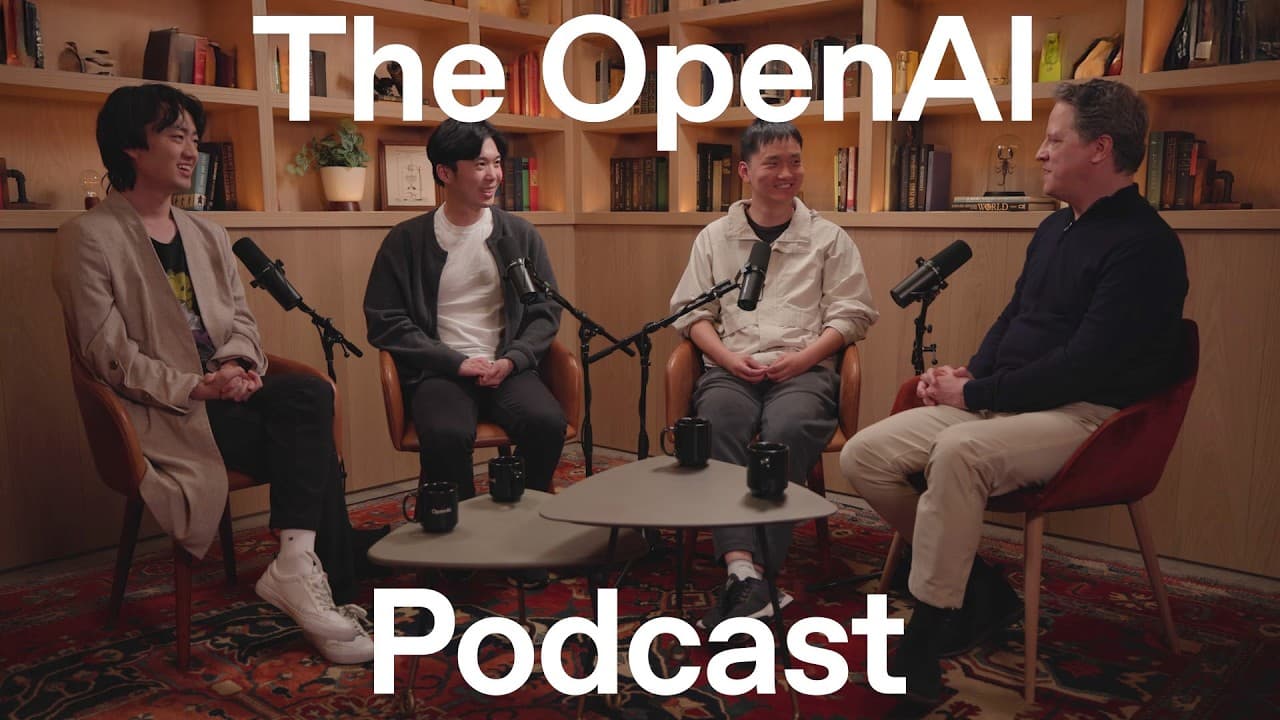
Hello, I'm Andrew Mayne, and welcome to the OpenAI Podcast. On today's episode, we're speaking with Alexander Wei, Hongxun Wu, and Lijie Chen from the reasoning research team behind a recent math breakthrough from an OpenAI model. They'll tell us the story behind the discovery and what stood out to them about the reaction. Everyone had a hard time ... Read More
Key Insights
- OpenAI's reasoning model disproved the unit distance conjecture, an 80-year-old math problem.
- The model used advanced reasoning capabilities to surpass human-level problem-solving in mathematics.
- The unit distance conjecture involved determining the maximum number of points one inch apart on a plane.
- AI models can now perform complex mathematical proofs, previously deemed too challenging for machines.
- The success of the AI model indicates a shift in how scientific problems can be approached and solved.
- The AI model was not specifically trained for math, showcasing its general reasoning capabilities.
- The model's achievement highlights the potential for AI to accelerate scientific research and discovery.
- AI's ability to connect disparate ideas could lead to breakthroughs in various scientific domains.
Install to Summarize YouTube Videos and Get Transcripts
Explore YouTube Video Summarizer or Get YouTube Transcript Extractor
Questions & Answers
Q: How did the OpenAI model solve the unit distance conjecture?
The OpenAI model solved the unit distance conjecture by employing advanced reasoning capabilities and leveraging test time compute. This allowed the model to think longer and improve its solutions, ultimately disproving the conjecture by demonstrating that a square grid arrangement was not optimal. The model utilized high-powered number theory to find a more efficient arrangement of points.
Q: What is the significance of solving the unit distance conjecture?
Solving the unit distance conjecture is significant because it was an 80-year-old open problem in combinatorial geometry, proposed by the renowned mathematician Erdős. The successful disproof by an AI model demonstrates the potential of AI to solve complex mathematical problems and suggests that AI can play a crucial role in advancing scientific research and discovery across various fields.
Q: How does test time compute improve AI model performance?
Test time compute improves AI model performance by allowing the model additional time to think and refine its solutions. Instead of providing an immediate answer, the model can explore different approaches, evaluate its reasoning, and enhance its response. This process enables the model to tackle more complex problems and achieve higher accuracy in its outputs.
Q: What are the broader implications of AI solving complex math problems?
The broader implications of AI solving complex math problems include the potential to accelerate scientific discovery and problem-solving across various fields. AI's ability to connect disparate ideas and provide novel insights can lead to breakthroughs in mathematics, physics, and other scientific disciplines. This advancement may transform how researchers approach and solve challenging problems.
Q: How was the unit distance conjecture traditionally approached?
Traditionally, the unit distance conjecture was approached by arranging points in a square grid on a plane, as proposed by Erdős. This method was believed to be optimal for maximizing the number of points exactly one inch apart. However, the OpenAI model demonstrated that this arrangement was not optimal and found a more efficient solution using advanced number theory.
Q: Can AI models generate new mathematical theories?
Currently, AI models are not yet capable of generating entirely new mathematical theories from scratch. However, they can connect ideas from different fields and provide insights that may lead to new theoretical developments. As AI continues to evolve, it may eventually contribute to the creation of novel mathematical frameworks and concepts.
Q: What role can AI play in scientific research?
AI can play a transformative role in scientific research by accelerating the pace of discovery, providing novel insights, and solving complex problems that are challenging for humans. AI models can analyze vast amounts of data, identify patterns, and propose innovative solutions, thereby empowering researchers to achieve breakthroughs across various scientific domains.
Q: How do researchers feel about AI's impact on mathematics?
Researchers have mixed feelings about AI's impact on mathematics. While some may feel concerned about AI's problem-solving capabilities, many see it as an opportunity to enhance their work. AI can empower mathematicians by providing new ideas, solving difficult problems, and enabling collaboration between AI and human researchers to advance the field further.
Summary & Key Takeaways
-
OpenAI's reasoning model recently disproved the unit distance conjecture, a significant 80-year-old problem in combinatorial geometry. This breakthrough demonstrates the model's advanced reasoning capabilities and its potential to solve complex mathematical challenges. The model's success also highlights the broader implications for AI in accelerating scientific discovery and problem-solving across various fields.
-
The unit distance conjecture, proposed by Erdős, questioned the maximum number of points that could be exactly one inch apart on a plane. OpenAI's model proved that the traditional square grid arrangement was not optimal, using high-powered number theory to find a better solution. This achievement underscores AI's ability to tackle problems previously thought to be beyond machine capabilities.
-
By leveraging test time compute, the model was able to think longer and improve its solutions, resulting in the successful disproof of the conjecture. This approach may pave the way for AI to contribute significantly to mathematics and other scientific disciplines, offering new insights and accelerating the pace of discovery.
Read in Other Languages (beta)
Share This Summary 📚
Summarize YouTube Videos and Get Video Transcripts with 1-Click
Try YouTube Summary with ChatGPT & Claude or YouTube Transcript Generator
Explore More Summaries from OpenAI 📚




Summarize YouTube Videos and Get Video Transcripts with 1-Click
Try YouTube Summary with ChatGPT & Claude or YouTube Transcript Generator