How to green the world's deserts and reverse climate change | Allan Savory
TL;DR
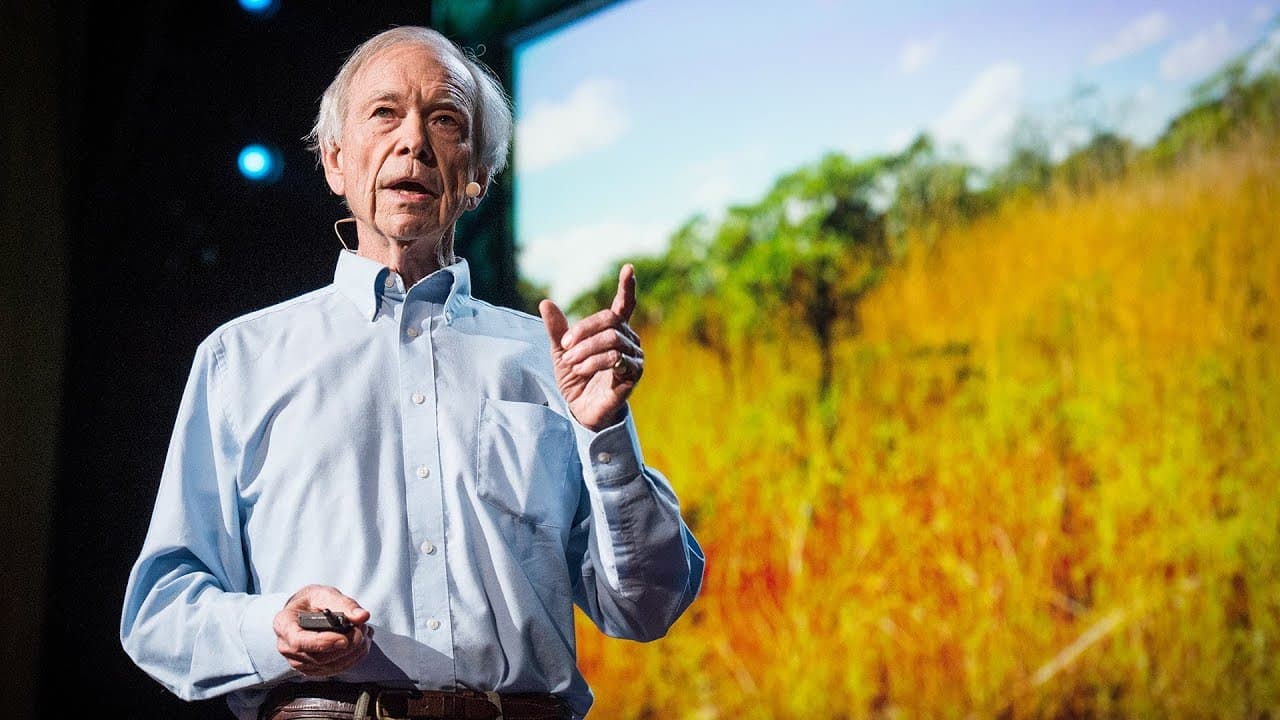
Using livestock to mimic natural grazing patterns can effectively reverse desertification and combat climate change. By managing herds in a way that restores soil health and retains water, we can increase vegetation cover and sequester carbon, offering a sustainable solution to global environmental challenges.
Transcript
Translator: Joseph Geni Reviewer: Morton Bast The most massive tsunami perfect storm is bearing down upon us. This perfect storm is mounting a grim reality, increasingly grim reality, and we are facing that reality with the full belief that we can solve our problems with technology, and that's very understandable. Now, this perfect storm that we ar... Read More
Key Insights
- 🌍 Climate change and desertification are major challenges facing the world and are caused by factors such as rising population, land degradation, and the burning of grasslands.
- 🌱 Humidity and ground cover play a crucial role in preventing desertification, as they help retain water in the soil and promote the growth of plants.
- 🐄 Livestock, such as cattle, sheep, and goats, are often blamed for desertification due to overgrazing and the release of methane gas. However, when managed properly, they can actually help restore grasslands and improve soil health.
- 🔥 The use of fire to manage grasslands is detrimental and leads to carbon release and environmental pollution. Alternative methods, such as planned grazing, should be adopted to mimic natural processes and restore degraded land.
- 🌧️ Rainfall alone is not enough to combat desertification. It is essential to incorporate holistic management practices that take into account the complexity of nature and consider social, economic, and environmental factors.
- 🌳 Successful examples of reversing desertification can be found in various regions, including Zimbabwe, Mexico, and Patagonia. By using livestock to mimic natural grazing patterns, these areas have experienced increases in vegetation cover and improved soil health.
- 💡 Embracing this holistic approach to land management has the potential to not only combat desertification but also mitigate climate change by storing carbon in grassland soils.
- 🌾 The adoption of these practices on a global scale could offer hope for future generations by restoring degraded land, reducing poverty, and ensuring food security.
Install to Summarize YouTube Videos and Get Transcripts
Explore YouTube Video Summarizer or Get YouTube Transcript Extractor
Questions & Answers
Q: What are the main factors contributing to the perfect storm of climate change?
The perfect storm of climate change is caused by a rising population, desertification, and the burning of fossil fuels.
Q: What is desertification and how does it occur?
Desertification is the process by which land turns into desert due to the creation of too much bare ground. This happens when the soil is left uncovered and leads to increased runoff and evaporation.
Q: What is the main cause of desertification?
The main cause of desertification is livestock, such as cattle, sheep, and goats, overgrazing the plants and leaving the soil bare.
Q: How can we address climate change and desertification?
The speaker suggests using livestock, bunched and moving, as a proxy for former herds and predators, and mimicking nature through planned grazing. This can prevent desertification, store carbon in the soil, and reverse the effects of climate change.
Summary
In this talk, Allan Savory discusses the issue of desertification and the role of livestock in addressing climate change. He explains that desertification occurs when bare ground is created, leading to increased runoff and evaporation. Savory emphasizes that desertification is not limited to arid areas and that livestock, particularly cattle, play a key role in causing desertification by overgrazing plants and leaving the soil bare. Savory proposes using livestock as a tool to mimic the behavior of natural herds and restore degraded grasslands. He presents examples of successful land restoration through planned grazing and holistic management techniques.
Questions & Answers
Q: What is causing the perfect storm of rising population, land turning to desert, and climate change?
The perfect storm is the result of a rising population, predicted to reach 10 billion people, combined with land turning to desert and climate change. These factors contribute to the increasing severity of the challenges we face.
Q: Can technology solve the problem of replacing fossil fuels?
While technology is crucial in replacing fossil fuels, it is not the only solution to combating climate change. Desertification, caused by factors like bare ground creation, also contributes significantly to climate change. Therefore, addressing desertification is critical in finding holistic solutions.
Q: How does desertification occur?
Desertification occurs when land becomes desert-like due to the creation of bare ground. Bare ground exposure leads to increased runoff and evaporation, which contribute to the degradation of soil and vegetation. Desertification is a significant problem affecting approximately two-thirds of the earth's land.
Q: What happens to water when it soaks into the soil?
When water soaks into the soil, it can either evaporate out again or be stored and used by plants. However, when there is too much bare ground, like in desertifying areas, much of the water evaporates before it can be effectively utilized.
Q: What is the impact of desertification on soil organic matter and carbon?
When soils are damaged by desertification, they release carbon into the atmosphere. Soil organic matter and carbon are closely linked, and their fate is tied to the health of the soil. Therefore, addressing desertification is not only critical for soil health but also for reducing carbon emissions.
Q: Is desertification limited to arid and semi-arid areas?
No, desertification is not limited to arid and semi-arid areas. Even grasslands with high rainfall can experience desertification. Bare soil and the presence of algae crusts can lead to increased runoff and evaporation, causing soil degradation.
Q: What is the traditional view on desertification's cause, and why is it incorrect?
The traditional view implicated livestock, particularly cattle, as the main cause of desertification due to overgrazing. However, this belief is flawed. Allan Savory, an ecologist, initially held this view but later discovered that it was incorrect.
Q: How did Savory's initial understanding of desertification change?
Savory's initial understanding of desertification changed through empirical evidence and real-world experience. He observed that removing hunting and drum-beating people to protect animals in national parks caused land deterioration. Additionally, reducing the number of elephants in Zimbabwe, a decision based on his research, contributed to worsening desertification.
Q: How did livestock usage exacerbate desertification?
Livestock, including cattle, contributed to desertification by overgrazing plants and leaving the soil bare. This behavior releases methane and reduces soil cover, increasing the risk of soil degradation and desertification.
Q: How did Savory come up with the idea of using livestock to address desertification?
After realizing the flaws of current understanding and the dangers of desertification, Savory began studying other professions and planning techniques. By adapting these techniques and developing holistic management and planned grazing, he proposed using livestock as a proxy for natural herds and predators to mimic nature and restore grasslands.
Q: What are the results of using livestock to mimic nature and restore grasslands?
The results of using livestock to mimic nature and restore grasslands are promising. Savory's approach has shown significant improvements in grassland health, soil fertility, water retention, and carbon sequestration. Examples from various regions, such as Zimbabwe, Mexico, and Patagonia, have demonstrated the effectiveness of planned grazing and land restoration techniques.
Summary & Key Takeaways
-
The speaker highlights the urgent problem of desertification and climate change caused by rising population and land degradation.
-
They argue that the only solution to these issues is to replace fossil fuels with technology, but emphasize that fossil fuels are not the sole cause of climate change.
-
The speaker proposes using livestock and mimicking nature through planned grazing as a way to reverse desertification and store carbon in grassland soils.
Read in Other Languages (beta)
Share This Summary 📚
Summarize YouTube Videos and Get Video Transcripts with 1-Click
Try YouTube Summary with ChatGPT & Claude or YouTube Transcript Generator
Explore More Summaries from TED 📚




Summarize YouTube Videos and Get Video Transcripts with 1-Click
Try YouTube Summary with ChatGPT & Claude or YouTube Transcript Generator