How to install end-to-end agent workflows with Journey
TL;DR
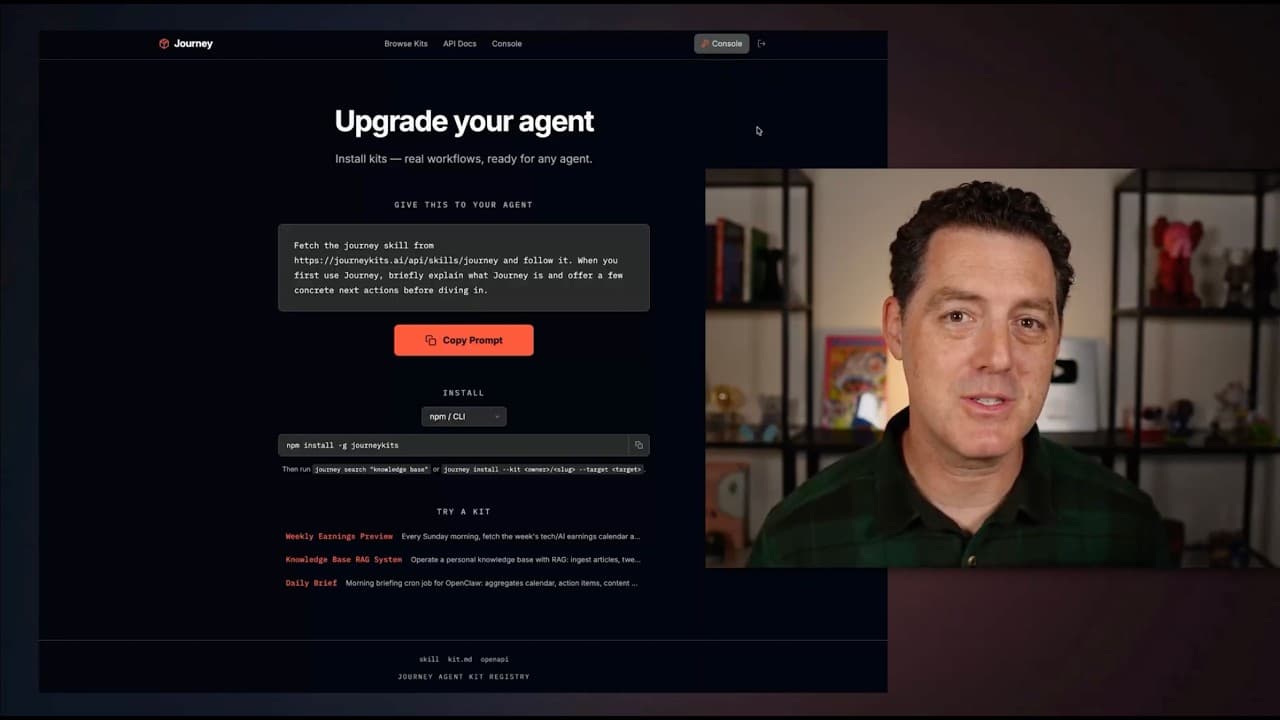
Journey is a registry and installer for end-to-end workflows called kits that you can use to empower agents. A kit bundles skills, tools, learnings, memories, services, tests and failure examples into a single installable package. It is designed to be agent-first and adapts to different environments and models.
Transcript
So, I built something. This is Journey. It's something that I've been working on for a few weeks and I wanted to tell you about it. I'm looking for feedback. So, drop it in the comments below. So, the problem that I am solving with Journey is the fact that once you've built out a workflow for an agent, it's really hard to give that to other agents.... Read More
Key Insights
- Journey is a registry for end-to-end agent workflows called kits, designed to standardize and accelerate deployment across agents and teams.
- Each kit is a complete package including skills, tools, services, learnings, memories, tests and failure examples to reduce reinventing the wheel.
- Kits specify dependencies and environment requirements like AI models, embeddings models and external services to ensure compatibility with various agent setups.
- The install process is agent-first, allowing users to install via a prompt explain how to fetch and install the kit, enabling immediate use by the agent.
- Versioning is built in, so agents can be notified of updates and choose when to upgrade without breaking current workflows.
- Learnings are intended to be crowdsourced and shared back into the kit system so future users benefit from real world experience.
- The platform supports multiple harnesses and environments, making it adaptable to OpenClaw, Nemoclaw, Claude Co-work and Cloud Code.
- There is a focus on collaboration and discovery, enabling teams to see and reuse popular kits like knowledge-based rag systems for rapid knowledge integration.
- More videos from this channel:
- More from this channel: Matthew Berman
Install to Summarize YouTube Videos and Get Transcripts
Explore YouTube Video Summarizer or Get YouTube Transcript Extractor
Questions & Answers
Q: What is Journey and what problem does it solve?
Journey is described as a registry for end-to-end workflows, called kits, aimed at solving the difficulty of sharing and replicating agent workflows. It packages everything an agent needs into a single installable kit, including skills, tools, learnings and tests, so teams can install and run a workflow with minimal setup. This reduces reinventing the wheel and makes workflows portable across agents and environments.
Q: How does a kit work in Journey?
A kit is a fully packaged workflow that contains multiple components: skills, tools (code), learnings, memories, services used, tests and failure examples. When installed, the kit configures the agent with the necessary dependencies, models and external services, and provides a markdown kit description, environment setup instructions, validations and outputs. Kits can be versioned and updated without forcing immediate changes.
Q: What can be included in a Journey kit besides code?
Besides code, a Journey kit includes learnings from past runs, memories of data and actions, the services the workflow relies on, test cases, failure examples, and a knowledge-based skill that defines how the agent should operate the knowledge base. This combination provides a complete, reusable blueprint for a workflow that an agent can execute.
Q: How do you install a Journey kit?
To install, you fetch the Journey kit from the provided URL and instruct your agent to install it. You can also install via a CLI by running npm install -g journey kits. The install process is designed to be agent-first so the kit configures the environment and adapts to the agent’s setup, enabling immediate use without manual configuration.
Q: What is a knowledge-based rag system kit shown in the video?
The knowledge-based rag system kit is an example workflow that ingests articles from various sources like Telegram into a knowledge base. It can be queried by an agent to retrieve relevant information, such as features released by a team, and used to generate video outlines or summaries. This kit demonstrates how Journey can organize and reuse information across contexts.
Q: How does Journey handle versions and updates?
Journey supports versioning of kits so agents can operate with a known configuration and receive updates when available. The system notifies users of new versions, explains what changed, and allows upgrading at the user’s discretion. This helps maintain stability while gradually adopting improvements.
Q: Can Journey work with different agent environments and models?
Yes, Journey is designed to adapt to various agent environments and models. It lists dependencies like different AI models, embeddings models and external services, and notes that a kit should adapt itself to the environment. This flexibility enables usage with OpenClaw, Nemoclaw, Claude Co-work and similar setups.
Q: What are the claimed benefits for teams using Journey kits?
Teams can share fully packaged workflows that include all necessary components, reducing onboarding time and duplication of effort. The knowledge base and learnings help improve fidelity and reliability across agents, while versioned kits provide predictable behavior and easier collaboration, enabling teams to discover, install and run effective workflows with minimal friction.
Summary & Key Takeaways
-
Journey acts as a central registry for end-to-end agent workflows, packaged as installable kits that streamline sharing and deployment across teams and environments.
-
Kits include dependencies, models, external services and failure learnings, enabling agents to operate with minimal setup and immediate capability.
-
The platform emphasizes versioning, learnings feedback, and easy installation via prompts or CLI, with a focus on accessibility for non developer users too.
Read in Other Languages (beta)
Share This Summary 📚
Summarize YouTube Videos and Get Video Transcripts with 1-Click
Try YouTube Summary with ChatGPT & Claude or YouTube Transcript Generator
Explore More Summaries from Matthew Berman 📚






Summarize YouTube Videos and Get Video Transcripts with 1-Click
Try YouTube Summary with ChatGPT & Claude or YouTube Transcript Generator