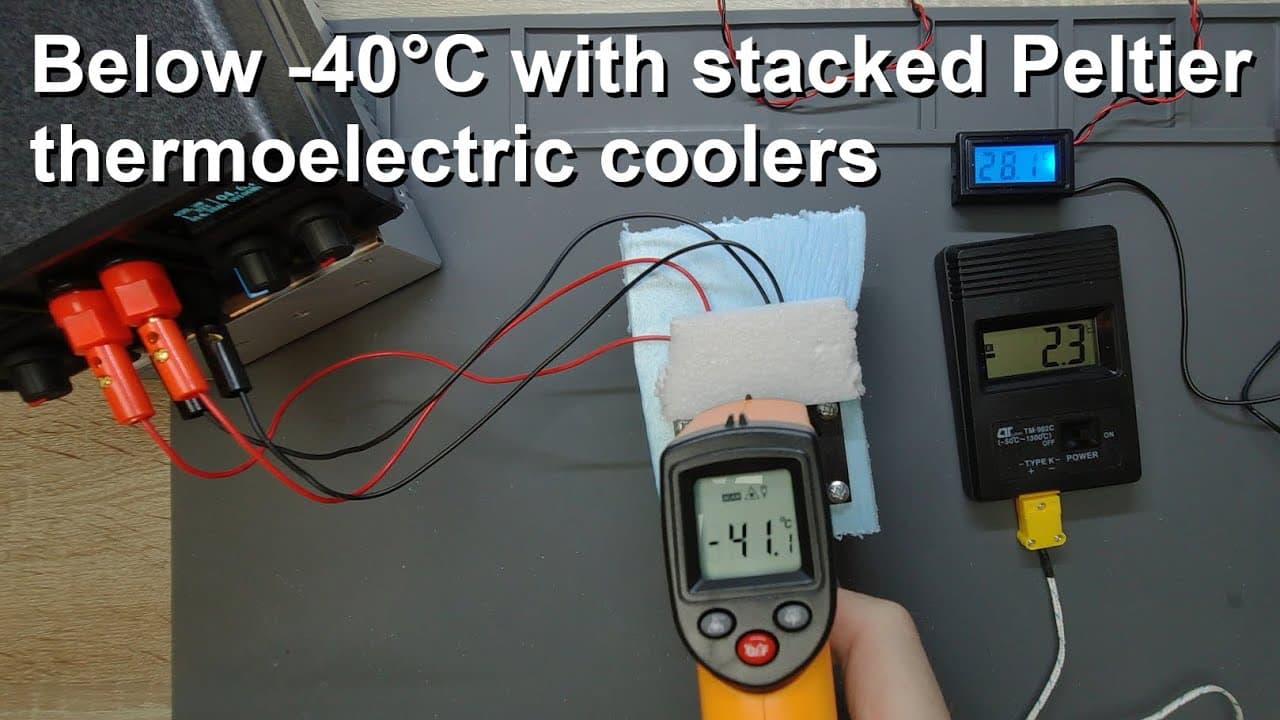
Below -40°C with stacked Peltier thermoelectric coolers
TL;DR
The experiment explored stacking thermoelectric coolers to achieve very low temperatures.
Transcript
welcome everyone in this video I'm going to play with thermoelectric cooler again so I put together to turn my electric coolers here on a water cooling block so what we can see is that we have the water cooling block and then the hot side of the bottom cooler is connected to the block and then the cold side of this is connected to the hot side of t... Read More
Key Insights
- 😘 Stacking thermoelectric coolers can enhance cooling efficiency beyond single-unit setups, achieving significantly lower temperatures.
- 🥵 Proper insulation and sealing are vital in preventing heat leakage and moisture interference while maximizing cooling performance.
- 🥵 The optimal performance of thermoelectric coolers is influenced by the balance between power inputs and the heat generated by Joule heating.
- 😎 Experimental results highlight the importance of ambient conditions, such as water temperature, in determining the cooling capability of the system.
- 🤗 This project demonstrates a hands-on approach to thermoelectric technology, providing insights for DIY enthusiasts and educators.
- ✊ Continuous measurement of temperature at various power levels helps identify optimal operating conditions for thermoelectric devices.
- 📽️ Challenges related to project sturdiness and maintaining consistent performance were noted, advocating for improved construction techniques in future projects.
Install to Summarize YouTube Videos and Get Transcripts
Explore YouTube Video Summarizer or Get YouTube Transcript Extractor
Questions & Answers
Q: What is the primary goal of this thermoelectric cooler experiment?
The primary goal is to explore the effectiveness of stacking thermoelectric coolers to achieve significantly lower temperatures, by utilizing thermal insulation and water cooling to reduce heat leakage and enhance performance.
Q: What challenges does Joule heating pose during the experiment?
Joule heating, which is the heat generated by electrical resistance as current flows through the cooler, presents a challenge by increasing the temperature on the cooler's hot side. This can reduce the overall efficiency of the cooling system and make it difficult to reach desired low temperatures.
Q: How does the setup minimize heat loss?
The setup minimizes heat loss using a combination of thermal grease for better contact between components, a polystyrene insulation block to cover exposed surfaces, and silicone sealing for moisture protection, all of which help to isolate the cooler from ambient temperature influences.
Q: What role does the water cooling system play in this experiment?
The water cooling system is crucial as it dissipates heat effectively from the thermoelectric cooler's hot side, allowing the system to maintain lower temperatures on the cold side. It helps to ensure that the temperature variations are based on the cooling performance rather than overheating due to internal resistance.
Q: What are some practical applications for the stacked thermoelectric coolers?
Stacked thermoelectric coolers can be used in applications requiring precise thermal management, such as keeping sensitive semiconductor devices at lower temperatures. However, they are not efficient for large-scale cooling systems, like air conditioning for rooms.
Q: What was the highest temperature drop observed during the experiment?
The experiment achieved temperature drops below minus 40 degrees Celsius, with specific settings allowing for temperatures around minus 35 to minus 37 degrees Celsius depending on water temperature and current adjustments made during the testing.
Summary & Key Takeaways
-
The video demonstrates a setup using thermoelectric coolers (TECs) to achieve lower temperatures by stacking one cooler on top of another, with careful thermal management.
-
The experiment aims to minimize heat leakage by using insulation and water cooling, while measuring performance specifically at different power settings.
-
Results showed the potential to reach temperatures as low as minus 40 degrees Celsius, although efficient cooling was challenged by Joule heating and environmental factors.
Read in Other Languages (beta)
Share This Summary 📚
Summarize YouTube Videos and Get Video Transcripts with 1-Click
Try YouTube Summary with ChatGPT & Claude or YouTube Transcript Generator
Explore More Summaries from Curious Scientist 📚


![Building a coil winder [Part 6] - A few improvements thumbnail](/_next/image?url=https%3A%2F%2Fi.ytimg.com%2Fvi%2F3eyxG_g2iUA%2Fhqdefault.jpg&w=750&q=75)
Summarize YouTube Videos and Get Video Transcripts with 1-Click
Try YouTube Summary with ChatGPT & Claude or YouTube Transcript Generator