Why Did Warren Buffett Invest in Alphabet?
TL;DR
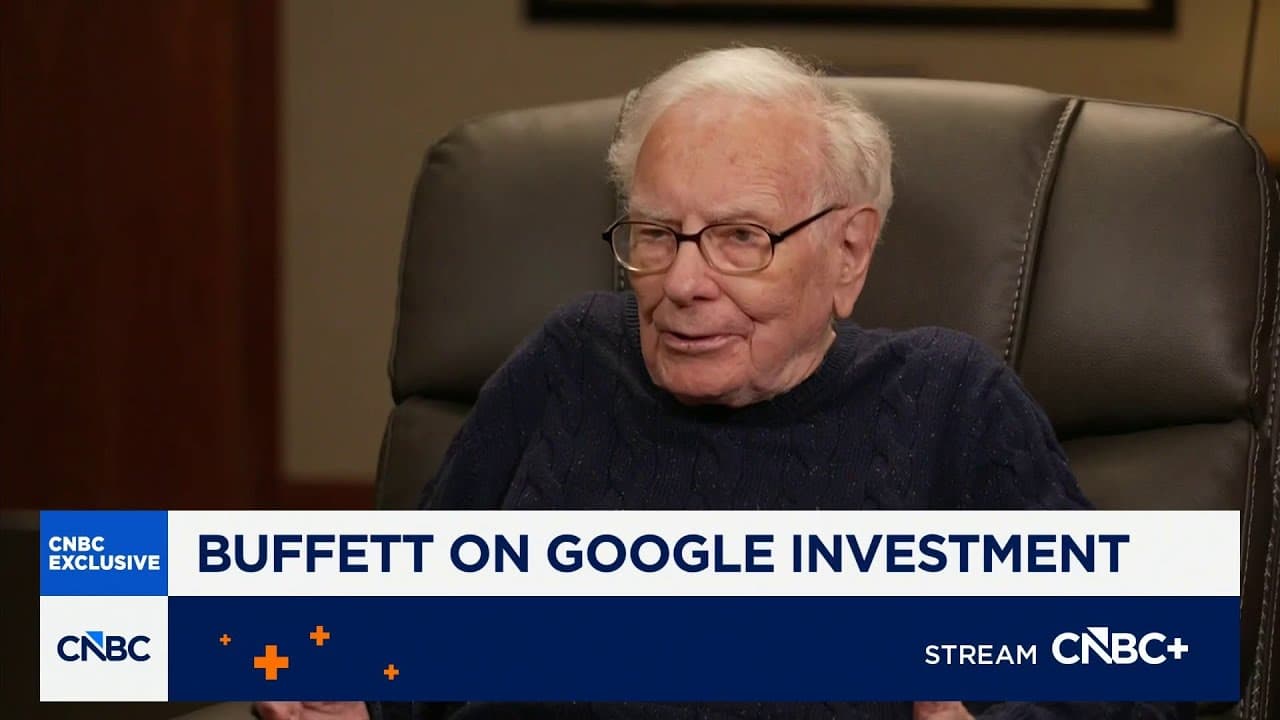
Warren Buffett initiated Berkshire Hathaway’s investment in Alphabet, while CEO Greg Abel approved it and remains the final decision-maker. Buffett views investing as choosing businesses that can earn high returns on capital for long periods, but he also recognizes that Alphabet and its AI competitors must commit enormous sums of capital to remain competitive.
Transcript
BERKSHIRE HATHAWAY NOW HOLDS A MORE THAN $31 BILLION STAKE IN ALPHABET. THAT'S A POSITION THAT THE CONGLOMERATE STARTED TO BUILD IN THE THIRD QUARTER OF 2025. BUT IT REALLY RAMPED UP THIS YEAR AFTER GREG ABEL TOOK OVER AS CEO OF BERKSHIRE. IN FACT, JUST LAST MONTH, IT ADDED $10 BILLION AS PART OF A PRIVATE STOCK PURCHASE OF THOSE ALPHABET SHARES. N... Read More
Key Insights
- Warren Buffett initiated Berkshire Hathaway’s Alphabet investment, although Greg Abel approved the decision and serves as the final decision-maker. Buffett said they talk continually, and neither acts on significant matters without the other’s approval.
- Berkshire Hathaway’s Alphabet stake exceeds $31 billion after the conglomerate began building the position in the third quarter of 2025. The holding expanded after Abel became CEO, including another $10 billion added through a private stock purchase.
- Berkshire evaluates marketable securities and wholly owned businesses through essentially the same decision framework. Buffett noted that ownership provides additional control, such as the ability to determine dividend policy, but he described those differences as generally minor.
- A good business earns high returns on capital for a long period and has prospects for continuing to outperform essentially riskless investments such as Treasury securities. Buffett considers purchase terms and management quality essential parts of that investment judgment.
- American Express demonstrates Buffett’s preferred economics because he said it earns more than 30% on capital without taking greater risk than banks earning 13% or 14%. The contrast illustrates why headline industry classifications reveal less than underlying business returns.
- Long-term compounding becomes increasingly important because later doublings apply to much larger numbers. Buffett connected Berkshire’s historical success to earning high returns over an extended period rather than relying on leverage or other financial techniques.
- Real cash generation is more important than whether a company pursues fashionable or exciting activities. Charlie Munger emphasized that an attractive business should earn or soon produce distributable cash, with even better economics when it can reinvest that cash at high returns.
- Alphabet and its AI competitors face a capital-intensive competitive game involving hundreds of billions in spending. Buffett said some companies are playing a game they may not want to play, but competitive pressure leaves them without a choice if they want to retain customers.
Install to Summarize YouTube Videos and Get Transcripts
Explore YouTube Video Summarizer or Get YouTube Transcript Extractor
Questions & Answers
Q: Who initiated Berkshire Hathaway’s investment in Alphabet?
Warren Buffett said he initiated Berkshire Hathaway’s investment in Alphabet. He also clarified that Greg Abel approved the action and is now Berkshire’s final decision-maker. Buffett described their relationship as highly collaborative, saying they talk continually, neither takes action the other disapproves of, and Abel has ultimate authority over decisions after becoming CEO.
Q: How large is Berkshire Hathaway’s Alphabet stake?
Berkshire Hathaway holds an Alphabet stake worth more than $31 billion, according to the discussion. The conglomerate began building the position in the third quarter of 2025 and increased it after Greg Abel became CEO. The total includes $10 billion added through a private purchase of Alphabet shares during the month before the interview.
Q: How does Warren Buffett evaluate a good business?
Buffett defines a good business as one capable of earning high returns on capital over a long period. Those returns should substantially exceed what could be earned from essentially riskless investments, which he identifies as Treasury securities. He also considers the purchase terms, the person running the company, genuine cash generation, and the ability to reinvest excess capital productively.
Q: Why does Buffett focus on long-term returns on capital?
Long-term returns on capital reveal whether a business can compound value across an extended period rather than merely produce attractive short-term results. Buffett said the duration matters because later doublings occur on increasingly large amounts. His objective is therefore to find businesses that can sustain high returns without relying on leverage, temporary excitement, or unusually high risk.
Q: What makes American Express attractive to Buffett?
Buffett used American Express to illustrate a business with unusually strong capital economics. He said most banks earn roughly 13% or 14% on capital, while American Express earns more than 30%. In his assessment, the company achieves that superior return without assuming more risk than those banks, making it a clear example of the characteristics he seeks.
Q: Why is Alphabet’s AI spending important to the investment?
Alphabet and other AI competitors are committing hundreds of billions to the competitive contest, making capital spending central to evaluating their future returns. Buffett contrasted this scale with the earlier, asset-light computer software model. The investment question is whether Alphabet can earn returns on its enormous expenditures that remain well above the payments available from Treasury securities.
Q: Why did Buffett invest in technology despite his past reluctance?
Buffett acknowledged that he made a mistake when he previously avoided some technology investments. His decision does not mean he now expects to profit from every technology business. He continues to avoid games he does not understand, but he believes Alphabet is more likely to emerge as a winner than most businesses promoted through Wall Street, based on its record.
Q: How does Buffett compare stocks with wholly owned companies?
Berkshire generally treats marketable securities and wholly owned businesses as competing uses of the same capital. Buffett said the objective in either case is to purchase a good business on appropriate terms and have the right person operate it. Full ownership provides added control, including dividend policy, but he characterized such distinctions as unlikely to be materially important in most evaluations.
Summary & Key Takeaways
-
Buffett said he initiated Berkshire Hathaway’s Alphabet position, resolving speculation that Greg Abel had originated the investment. The two discuss decisions continually and approve each other’s actions, but Buffett emphasized that Abel, who became CEO, is now the final decision-maker for Berkshire and its portfolio.
-
Berkshire evaluates publicly traded securities and wholly owned operations using broadly the same framework. Buffett seeks good businesses purchased on appropriate terms, led by suitable managers, and capable of earning returns substantially above Treasury securities for extended periods without depending on leverage or excessive risk.
-
Alphabet presents a difficult capital-allocation question because Google and competing AI companies are spending hundreds of billions. Buffett acknowledged his earlier mistake regarding technology investments, but he considers Alphabet more likely to succeed than most businesses promoted through Wall Street, while still ranking several Berkshire holdings above it.
Read in Other Languages (beta)
Share This Summary 📚
Summarize YouTube Videos and Get Video Transcripts with 1-Click
Try YouTube Summary with ChatGPT & Claude or YouTube Transcript Generator
Explore More Summaries from CNBC Television 📚


Summarize YouTube Videos and Get Video Transcripts with 1-Click
Try YouTube Summary with ChatGPT & Claude or YouTube Transcript Generator