How to Optimize Business Metrics With Claude Code
TL;DR
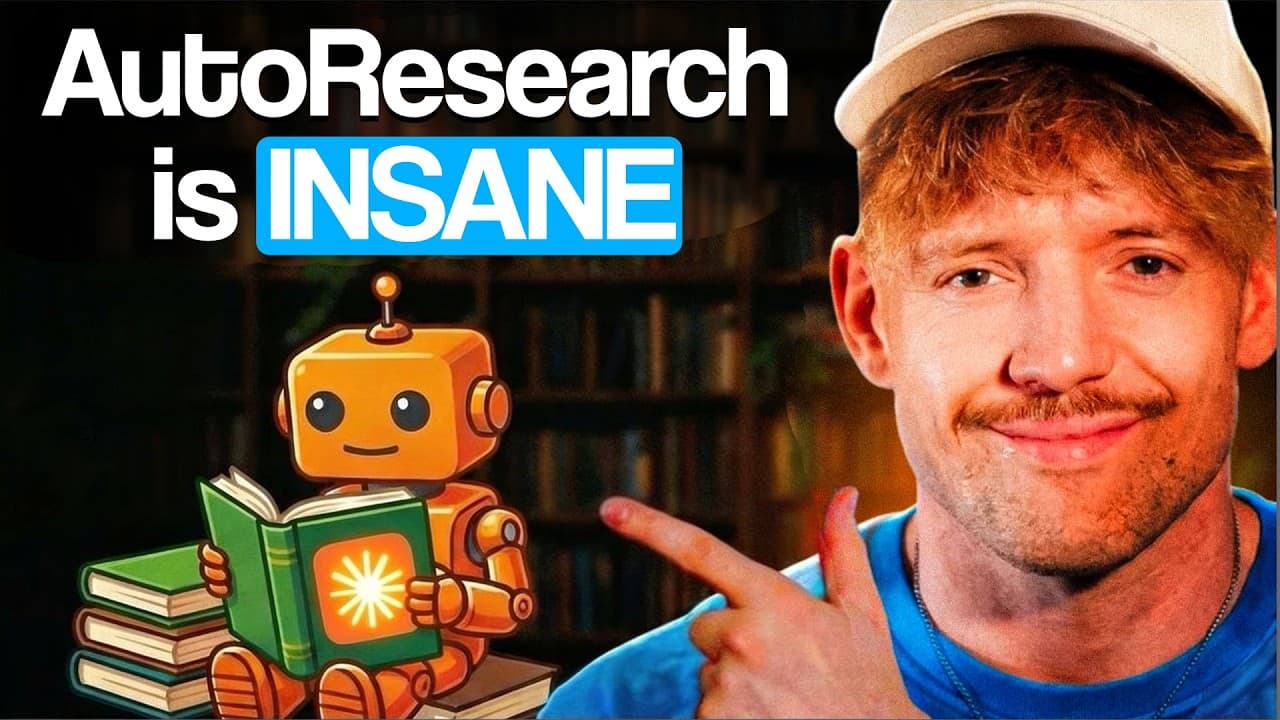
Choose one changeable element, define one objective metric, and let Claude Code repeatedly create, deploy, measure, and revise challenger variants. Each winning challenger becomes the new control, while a persistent experiment log preserves successful and unsuccessful attempts. The approach can optimize measurable assets such as landing-page copy, email subject lines, advertisements, YouTube titles, checkout flows, and chatbot scripts.
Transcript
If you're using claude code without auto research, you might be leaving money on the table. So, in this video, I'm going to show you new strategy from Andre Kapi that could not only just improve any metric in your business, but also save you hours and get you light years ahead of your competitors. And if you don't know who I am, my name is Jack Rob... Read More
Key Insights
- AutoResearch is a continuous experimentation process in which an agent generates something, deploys it, collects performance data, and produces a new experiment. The loop can run every two minutes, every day, or at another frequency chosen for the project.
- A valid optimization project requires three components: one element to change, one metric to measure, and one way to read the result. Without all three, the agent cannot consistently determine whether a new variant represents an improvement.
- Objective metrics are essential because each experiment needs an unambiguous result. Conversion rates, percentages, numbers, binary outcomes, and pass-or-fail tests provide clear evaluation criteria, while judgments based on feeling or vibe do not.
- The experiment log is a reusable asset because it records what has already been attempted and whether each attempt worked. Every new version can inherit the research and context from earlier versions, then optimize and expand that accumulated knowledge.
- A control-and-challenger structure provides a clear promotion rule for experiments. Claude Code creates a challenger variant, compares its measured performance with the baseline control, and makes the challenger the new baseline only when it produces the better result.
- Measurable business assets are candidates for repeated optimization. Examples given include landing pages, email subject lines, advertisement creative, YouTube titles and thumbnails, e-commerce checkout flows, chatbot scripts, sales scripts, website positioning, social media hooks, and community copy.
- The AutoResearch setup is intentionally small and centers on a few files. The transcript identifies prepare.py for one-time data preparation, train.py as the single file edited by the agent, and program.md as the instruction source that directs the agent.
- An API is not presented as a strict requirement for experimentation. The example focuses on improving community-page copy and measuring conversions even when the platform does not provide a direct API connection, although the transcript ends before demonstrating the complete alternative method.
Install to Summarize YouTube Videos and Get Transcripts
Explore YouTube Video Summarizer or Get YouTube Transcript Extractor
Questions & Answers
Q: How does Claude Code AutoResearch improve a business metric?
Claude Code AutoResearch improves a metric through a repeating loop. It generates a new version of a selected asset, deploys that version, gathers performance data, and uses the result to plan the next experiment. When a challenger outperforms the current control, it becomes the new baseline. Repetition lets the system build on measured successes while avoiding previously logged failures.
Q: What is needed to start an AutoResearch optimization loop?
An AutoResearch loop needs one element that can be changed, one objective metric that measures its performance, and a method for reading the result. The setup process described in the transcript is to clone the repository, write the agent instructions in program.md, define the metric, and choose how frequently the loop should run and report its findings.
Q: Which metrics work best for automated experimentation?
The best metrics are objective and leave no room for disagreement about whether the experiment succeeded. Suitable examples include conversion-rate percentages, numeric measurements, binary one-or-zero outcomes, and pass-or-fail results. Subjective criteria such as whether a version feels good or has a particular vibe are weaker because the agent lacks a consistent rule for selecting the winner.
Q: How do control and challenger variants work in AutoResearch?
The control is the current baseline version, while the challenger is a new variant created by Claude Code. Both versions are evaluated using the same objective metric. If the challenger beats the control, the challenger becomes the next baseline. Claude Code can then produce another challenger and repeat the comparison, creating an ongoing sequence of measured experiments.
Q: Why is the experiment log important in AutoResearch?
The experiment log preserves the research, context, outcomes, and failed attempts produced during earlier iterations. Version one passes its findings to version two, which optimizes and expands that knowledge before passing it onward. Because later versions know what has already been tried, the process can build a growing playbook instead of repeatedly starting over or forgetting unsuccessful approaches.
Q: What business assets can Claude Code optimize with AutoResearch?
The method can be applied to assets whose results can be measured. The transcript lists landing pages, email subject lines, advertisement creative, YouTube titles and thumbnails, e-commerce checkout flows, chatbot scripts, website copy, positioning, blogs, social media hooks, community copy, and sales scripts. Each use case still requires a specific change, an objective metric, and readable performance data.
Q: How often can an AutoResearch experiment run?
The loop can run at whatever frequency fits the experiment and its available data. The transcript gives examples ranging from every two minutes to every day. In each cycle, the system creates a variant, deploys it, harvests the resulting data, and uses measured performance to choose a new experiment. The reporting frequency is also specified by the user.
Q: Can AutoResearch work when a platform has no API?
The transcript states that the absence of an API does not have to prevent optimization. Its example involves changing community-page copy and tracking conversion performance on a platform that cannot be queried directly in the same way as an email service or GoHighLevel. However, the provided transcript ends before the promised non-API measurement strategy is fully demonstrated, so its implementation details are not available.
Summary & Key Takeaways
-
AutoResearch applies a repeated improvement cycle to measurable business or personal outcomes. The agent generates a variant, deploys it, gathers performance data, and uses the result to design another experiment. Repeating this process at a chosen frequency allows improvements and accumulated knowledge to compound instead of treating each attempt as an isolated test.
-
A suitable project needs one element that can be changed, one objective metric that can be measured, and a reliable way to read the result. Conversion percentages, numeric scores, binary outcomes, and pass-or-fail tests qualify. Subjective judgments about whether something feels good or has the right vibe are weaker candidates.
-
The practical setup begins by cloning Karpathy's AutoResearch repository, writing instructions in program.md, defining the target metric, and setting the experiment loop. A baseline control is compared with a challenger generated by Claude Code. When the challenger performs better, it becomes the next baseline, and the testing cycle continues.
Read in Other Languages (beta)
Share This Summary 📚
Summarize YouTube Videos and Get Video Transcripts with 1-Click
Try YouTube Summary with ChatGPT & Claude or YouTube Transcript Generator
Explore More Summaries from Jack Roberts 📚




Summarize YouTube Videos and Get Video Transcripts with 1-Click
Try YouTube Summary with ChatGPT & Claude or YouTube Transcript Generator