A Brief History of Credit Cards (or What Happens When You Swipe)
TL;DR
Credit cards began in the 1940s as charge cards for the wealthy, evolving into mass-market credit cards with Bank America's 1958 BankAmericard. Today, credit card transactions involve a network of players including consumers, issuing banks, and acquiring banks, with Visa and Mastercard serving as intermediaries in this process.
Transcript
I don't know about you but I haven't withdrawn money for my ATM machine and probably about a year I use credit cards for everything but what happens when you actually swipe your card and where did this whole credit card revolution come from let's go back to 70 years it started off with rich plutocrats in New York City that didn't want to have to ca... Read More
Key Insights
- 💳 Credit cards originated as charge cards for the wealthy, but Bank America's introduction of the BankAmericard paved the way for mass-market credit cards.
- 💳 Mass-market credit cards initially faced challenges due to high losses caused by extending credit without proper assessment of consumers' financial capabilities.
- 🏦 Visa and Mastercard function as central clearing functions, connecting issuing banks and acquiring banks in credit card transactions.
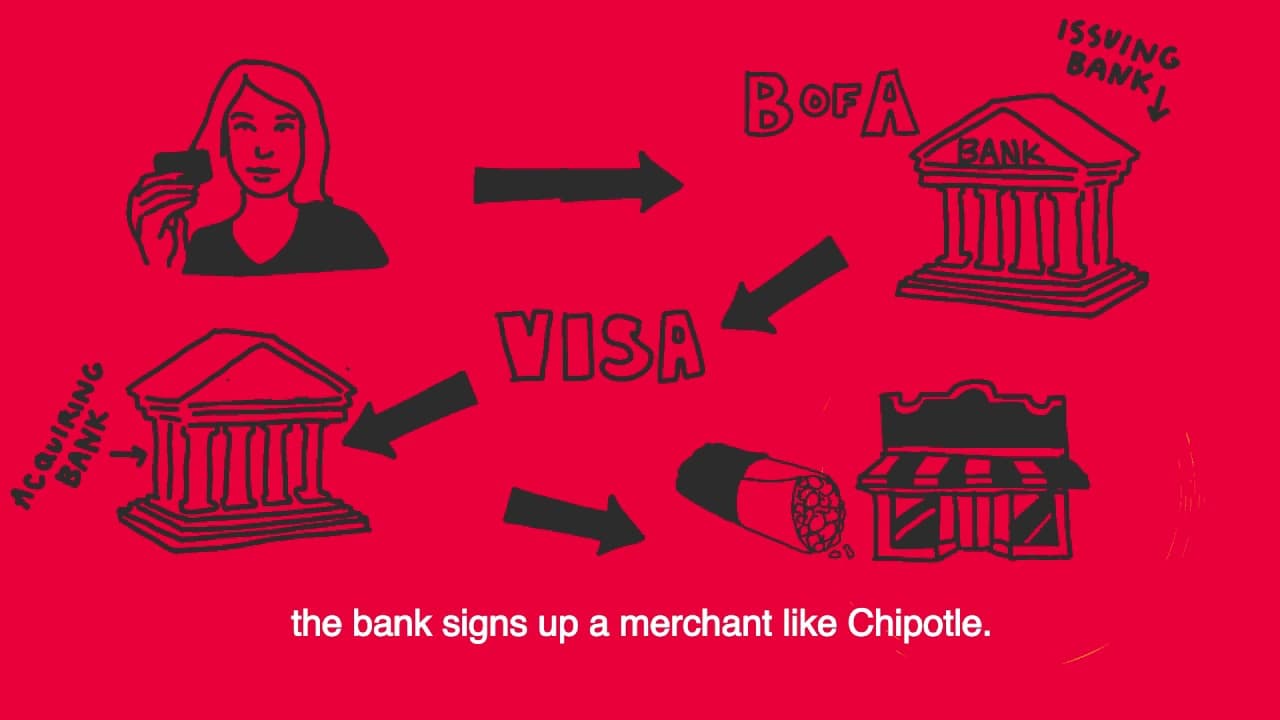
- 💳 Credit card transactions involve multiple parties, including the consumer, issuing bank, acquiring bank, credit card network, and merchant.
- 👲 Visa and Mastercard have evolved into highly profitable entities, with Visa having a market cap of over $200 billion and Mastercard over $100 billion.
- 💳 Credit card networks like Visa and Mastercard do not have direct relationships with consumers or merchants.
- 💳 The credit card transaction process involves the transmission of card information, identification of the issuer, approval by the issuing bank, and confirmation from the acquiring bank.
Install to Summarize YouTube Videos and Get Transcripts
Explore YouTube Video Summarizer or Get YouTube Transcript Extractor
Questions & Answers
Q: How did the credit card industry start?
The credit card industry began with charge cards like Diners Club, targeting affluent individuals who wanted to avoid carrying cash in the 1940s. Bank America later introduced the BankAmericard, a precursor to today's credit cards.
Q: What is the role of Visa and Mastercard?
Visa and Mastercard function as intermediaries in credit card transactions. They provide the infrastructure for issuing banks and acquiring banks to communicate and process payments, but they do not have direct relationships with consumers or merchants.
Q: How does the credit card transaction process work?
When a consumer makes a purchase, the credit card information is sent from the merchant to the acquiring bank, which then forwards it to the issuing bank for approval. If approved, the transaction goes through and a receipt is generated.
Q: Who takes on the financial risk in credit card transactions?
The issuing bank assumes the financial risk in credit card transactions. If a consumer defaults on their payments, the bank is responsible for covering the losses.
Summary
This video explores the history and workings of credit cards, starting from the first charge cards to the modern credit card networks. It explains how Bank America introduced the BankAmericard in 1958 and how it eventually evolved into Visa and MasterCard. The video also discusses the five parties involved in a credit card transaction - the consumer, the issuing bank, the network (Visa or MasterCard), the acquiring bank, and the merchant. It concludes by emphasizing that Visa and MasterCard function as central clearing functions in the credit card ecosystem and do not have direct relationships with consumers or merchants.
Questions & Answers
Q: What was the first credit card program called?
The first credit card program was called Diners Club, and it was introduced in the late 1940s in New York City. It was a charge card and not a credit card, meaning that users were required to pay off their balance in full each month. Failure to do so would result in the card being cut off.
Q: Who introduced the first mass-market credit card?
Bank America introduced the first mass-market credit card called the BankAmericard in 1958. They distributed credit cards to every man, woman, and child in Fresno, California as an experiment. This marked the beginning of widespread credit card usage.
Q: How did the BankAmericard initially perform?
The BankAmericard had mixed success in its initial rollout. While it was successful in terms of adoption and usage, the losses suffered by Bank America due to extending credit to people who couldn't afford it were catastrophic. Many people were given credit cards without any electronic infrastructure in place.
Q: What were the competing credit card networks during that time?
During the early days of credit cards, there were two competing credit card networks - Bank America's BankAmericard and a consortium called Master Charge. Master Charge eventually rebranded itself as MasterCard and became a direct competitor to Visa.
Q: When did Visa and MasterCard become for-profit companies?
Visa and MasterCard transitioned from non-profit associations to for-profit companies approximately ten years ago. Today, Visa has a market cap of over $200 billion, while MasterCard has a market cap of over $100 billion.
Q: What is the role of Visa and MasterCard in a credit card transaction?
Visa and MasterCard function as central clearing functions in the credit card ecosystem. They provide the infrastructure for issuers, acquiring banks, and merchants to communicate with each other. Visa and MasterCard do not have direct relationships with consumers or merchants but facilitate the flow of information and funds between the different parties involved.
Q: Who are the five parties involved in a credit card transaction?
The five parties involved in a credit card transaction are the consumer, the issuing bank, the network (Visa or MasterCard), the acquiring bank, and the merchant. Each party plays a crucial role in ensuring a smooth and secure transaction.
Q: What is the function of the issuing bank?
The issuing bank is the financial institution that provides the credit card to the consumer. They take on the risk of extending credit to the consumer and are responsible for collecting payment and managing the consumer's account.
Q: How does the interaction between the issuing bank and the network (Visa/MasterCard) work?
The issuing bank communicates with the network (Visa or MasterCard) when a consumer makes a credit card purchase. The network verifies the card's authenticity, identifies the issuer, and approves or declines the transaction based on the available credit.
Q: What role do acquiring banks or pseudo acquiring banks play in a credit card transaction?
Acquiring banks, or pseudo acquiring banks such as Stripe and Square, act as intermediaries between merchants and networks. They enable merchants to accept credit card payments by facilitating communication between the merchant, the network, and the issuing bank.
Q: How does the transaction process work from the consumer's perspective?
When a consumer makes a credit card purchase, they give their card to the merchant. The merchant uses a point-of-sale system to send the card information to the acquiring bank. The acquiring bank then forwards the transaction details to the network (Visa or MasterCard) for verification and approval. Once approved, the acquiring bank informs the merchant, and the transaction is completed.
Takeaways
Credit card networks like Visa and MasterCard have revolutionized the way we make payments, but their role in the transaction process is often misunderstood. They serve as intermediaries, connecting issuing banks, acquiring banks, and merchants. Consumers and merchants do not have direct relationships with these networks. Understanding the complex ecosystem of credit card operations can help us make more informed decisions about our financial transactions.
Summary & Key Takeaways
-
Credit cards emerged in the 1940s as an alternative to carrying cash, initially targeting wealthy individuals.
-
In 1958, Bank America introduced the BankAmericard, which was distributed to residents of Fresno, California, to test the concept of a mass-market credit card.
-
The BankAmericard faced initial challenges due to high losses caused by extending credit to individuals without sufficient funds.
Read in Other Languages (beta)
Share This Summary 📚
Summarize YouTube Videos and Get Video Transcripts with 1-Click
Try YouTube Summary with ChatGPT & Claude or YouTube Transcript Generator
Explore More Summaries from a16z 📚






Summarize YouTube Videos and Get Video Transcripts with 1-Click
Try YouTube Summary with ChatGPT & Claude or YouTube Transcript Generator