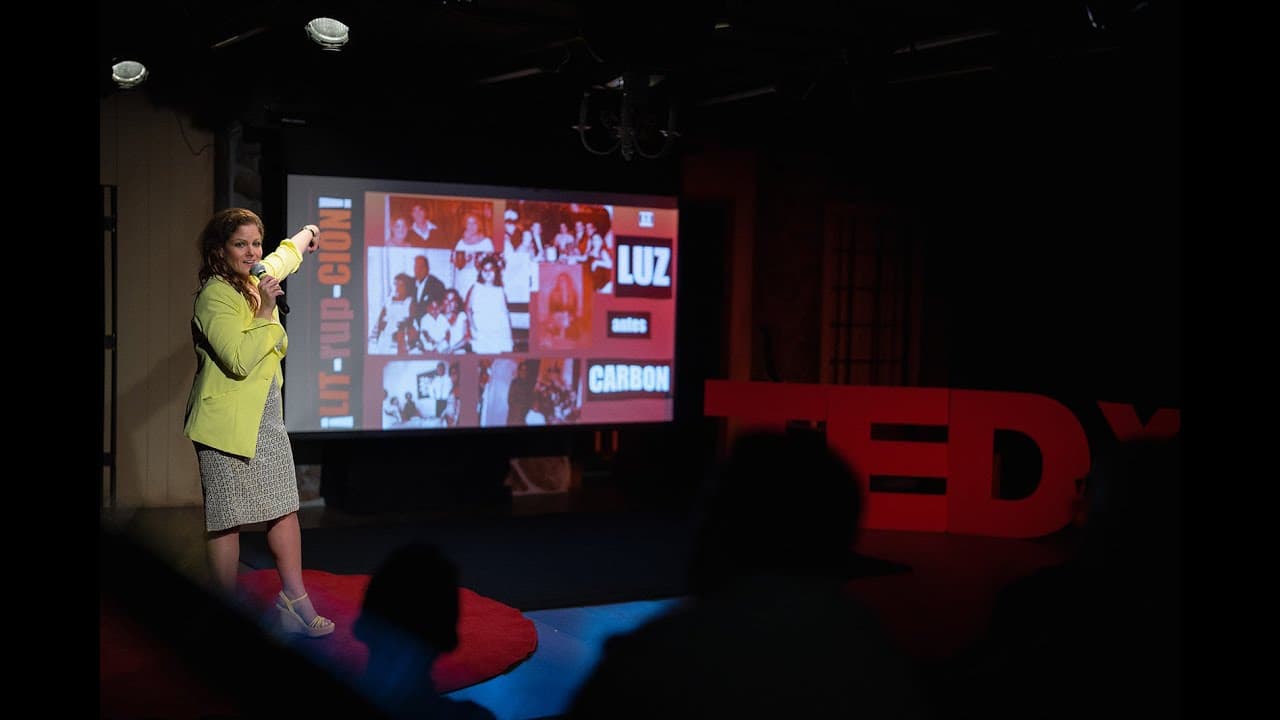
LITrupCIÓN | Nélida López-Fernández | TEDxYouth@FranklinSchoolOfInnovation
TL;DR
Bilingualism engages the brain in adapting to different languages, expectations, and cultures, which Nélida López-Fernández connects to neuroplasticity and healing. Drawing on her Cuban and Chinese family histories, she argues that disruption can create new pathways, but adaptation does not erase trauma, so immigrant and underrepresented communities still need empathy, kindness, and meaningful action.
Transcript
[Applause] foreign I love the term disruption I love doing it on the daily mostly with color like I've noticed that sometimes people are intimidated by color especially in Asheville so I like to dress like a cockatoo all right so lit eruption was not just like a random thing that I came up with it's in it's all dissected here so lit is an adjective... Read More
Key Insights
- Neuroplasticity is the brain's capacity to respond to an unexpected experience by molding itself and creating a new pathway. López-Fernández uses this process to argue that brains are capable of growth and that people are not permanently limited by a fixed measure of intelligence.
- Intelligence is not fixed, according to López-Fernández's interpretation of neuroplasticity. She rejects the childhood message that every person receives an unchanging number, emphasizing instead that intelligence can grow, brains can develop, and individuals can change through new experiences and continued adaptation.
- Bilingualism is portrayed as intensive mental work that engages advanced speech and processing across two languages. López-Fernández says the bilingual brain performs these tasks more strongly and quickly, while also acknowledging that becoming bilingual can be traumatic and frustrating for a child serving as a family translator.
- Resilience is continued survival after substantial trauma, not proof that the trauma was harmless. López-Fernández challenges the term's uncomplicated positive connotation because it can obscure the disruption, displacement, grief, and cultural adjustment that resilient people have endured while remaining standing.
- Migration is a disruption that requires people to learn new languages, customs, places, and patterns of behavior. López-Fernández connects her Cuban family's movement and her husband's family history across China, Taiwan, and Japan with continual cycles of trauma, adaptation, and neurological change.
- Cultural adaptation is difficult because ordinary behaviors can carry different meanings in different communities. López-Fernández recalls kissing people on the cheek after moving from Miami to Asheville and being misunderstood, illustrating how immigrants must continually interpret and adjust to unfamiliar social expectations.
- Language learning is described as a form of adaptation that can help the brain heal while trauma is occurring. However, López-Fernández cautions that healing may not catch up with repeated or continuing trauma, particularly among underrepresented global-majority communities that need greater kindness and empathy.
- Collective identity is central to López-Fernández's understanding of Cuban culture and family. She contrasts an individualistic separation between "you" and "I" with "nosotros," meaning "we," and concludes that shared language, family, and action can weaken the division between "us" and "them."
Install to Summarize YouTube Videos and Get Transcripts
Explore YouTube Video Summarizer or Get YouTube Transcript Extractor
Questions & Answers
Q: What does LITrupCIÓN mean?
LITrupCIÓN is Nélida López-Fernández's term for an exciting burst of action. She breaks it into "lit," slang for something excellent, "rup," which she identifies as a Latin root associated with bursting, and "ción," which she connects with action and result. The term expresses her belief that disruption can interrupt expectations, stimulate reflection, and lead people toward change and purposeful action.
Q: How does neuroplasticity respond to disruption?
Neuroplasticity responds when the brain encounters something that does not match its expectations. López-Fernández describes the brain pausing at the unfamiliar experience, recognizing that it does not compute, and then molding itself by creating a new pathway. She uses this process to explain why disruption can support adaptation and why intelligence, behavior, and human development should not be treated as permanently fixed.
Q: Why does López-Fernández say intelligence is not fixed?
López-Fernández says intelligence is not fixed because neuroplasticity shows that brains can grow and people can change. She contrasts this idea with childhood messages that assigned each person a number and treated it as a lifelong limit. Her broader point is that new experiences, languages, cultures, and challenges can prompt the brain to form pathways rather than remain confined to an unchanging intellectual identity.
Q: How does bilingualism affect the brain according to the talk?
Bilingualism requires the brain to operate across two languages and engage the systems responsible for advanced speech and processing. López-Fernández presents this work as beneficial, saying bilingual brains perform these tasks better, faster, and harder. She also links language learning with neurological healing, while stressing that acquiring another language can be frustrating and traumatic, especially when a child must translate for family members.
Q: Why can childhood translation be both difficult and valuable?
Childhood translation can be difficult because a young person must move between languages while handling responsibilities for relatives, school, work, and unfamiliar cultural expectations. López-Fernández remembers translating for her grandparents as part of her daily struggle. At the same time, she believes sustained work across languages strengthens the bilingual brain and supports adaptation, even though those neurological benefits do not cancel the emotional strain involved.
Q: What does the talk say about resilience and trauma?
Resilience means that a person has endured considerable trauma and is still standing, according to López-Fernández. She questions the word's positive connotation because praise for resilience can hide the experiences that made survival necessary. Her family stories show that migration, loss, poverty, and cultural displacement can produce adaptation and strength, but those outcomes do not erase suffering or guarantee that healing has caught up.
Q: Why is adapting to a new culture emotionally difficult?
Adapting to a new culture is emotionally difficult because language, customs, body language, and everyday social behaviors may all change at once. López-Fernández describes being misunderstood when she greeted people in Asheville with the cheek kisses customary in Miami. She also recalls trying to restrain her expressive movements at work. These adjustments require continual self-monitoring while a person is already managing displacement and cultural difference.
Q: What support do immigrant and underrepresented communities need?
Immigrant and underrepresented global-majority communities need kindness, empathy, and action because neurological adaptation may not heal trauma as quickly as new trauma accumulates. López-Fernández argues that learning languages and cultures can create pathways and support healing, but people should not assume that adaptation eliminates pain. Her idea of LITrupCIÓN calls for an exciting burst of action that strengthens connection and replaces divisions between "us" and "them" with a shared "we."
Summary
In this video, the speaker talks about the concept of "lit eruption" and how it relates to disruption and neuroplasticity in the brain. She discusses the impact of being bilingual on brain health and resilience, sharing personal stories from her own family's experiences of emigrating from Cuba. The speaker emphasizes the importance of empathy and kindness, especially towards underrepresented groups, and highlights the power of excitement and action in creating positive change.
Questions & Answers
Q: What is the meaning of "lit eruption"?
"Lit eruption" refers to an exciting burst of action. It is a term the speaker uses to describe the concept of disruption.
Q: What does neuroplasticity mean?
Neuroplasticity is the brain's ability to adapt and change in response to new experiences. It happens when the brain encounters something unexpected or unfamiliar, creating new pathways and connections.
Q: How does neuroplasticity challenge the idea of fixed IQ?
Neuroplasticity shows that IQ is not fixed and can actually grow over time. This means that people can change and grow intellectually, contrary to the idea that intelligence is stable from childhood.
Q: How does being bilingual affect the brain?
Being bilingual has positive effects on brain health. It activates and strengthens areas of the brain related to speech and language processing, making the brain more efficient and capable in these areas. It also has a healing effect, especially in the context of traumatic experiences, as the brain learns a new language while processing and healing from trauma.
Q: What was the speaker's family's experience of emigrating from Cuba?
The speaker's family emigrated from Cuba to escape the political regime of Castro. They had to leave behind their privileged lifestyle and learn a new language and culture. The speaker's grandmother even sewed valuable items into her dress to hide them during this difficult transition.
Q: How does trauma affect the brain?
Trauma creates pathways in the brain that contribute to resilience. It is not about creating new neural paths, but rather about how the brain heals itself in response to trauma. Traumatic experiences, such as emigrating to a new country, can lead to increased brain activity and healing processes.
Q: How does disruption and lit eruption relate to the speaker's personal experiences?
The speaker shares anecdotes from her own life, particularly about her struggles as a bilingual child and her experience of living in different countries. She highlights how disruption and the excitement of new experiences have shaped her own journey and the ways in which her brain has adapted and healed.
Q: Why is empathy and kindness important in underrepresented groups?
Underrepresented groups often face more trauma and challenges, which can negatively impact their mental health. Therefore, showing empathy and kindness towards these groups is crucial for their healing and well-being. It is a way to provide support and create positive change.
Q: How does laughter contribute to disruption?
Laughter is seen as a form of disruption in a positive sense. It is a way to break the norm and create joy and excitement. The speaker mentions that laughter is good for the brain and can be a form of healing and release.
Q: What is the significance of the phrase "light before carbon becomes a diamond"?
The phrase is a loose translation of a Jose Marti poem and represents the idea of growth and transformation. It symbolizes the process of going through challenges and disruptions to ultimately become something valuable and strong, like a diamond.
Takeaways
Living outside of one's language and customs can be challenging. However, these experiences can also lead to growth and resilience. Neuroplasticity allows the brain to heal and adapt, showing that change is possible. The speaker emphasizes the importance of empathy, kindness, and embracing disruption in creating positive change.
Summary & Key Takeaways
-
Nélida López-Fernández defines her coined term "LITrupCIÓN" as an exciting burst of action. She connects disruption with neuroplasticity, describing how the brain responds to something unexpected by adapting and creating a new pathway. This capacity supports her central argument that intelligence can grow, brains can change, and people can change.
-
Her Cuban family experienced displacement, cultural transition, language learning, and trauma after leaving Cuba. Her grandmother carried a dress made by her great-grandmother in 1952 and concealed valuables inside it to help the family survive. López-Fernández interprets such adaptation as evidence of resilience while emphasizing the suffering hidden within that label.
-
Bilingualism is presented as both demanding and beneficial, especially for children who must translate for relatives while navigating unfamiliar cultures. López-Fernández says learning another language can support healing, but healing may not keep pace with continuing trauma. She therefore calls for kindness, empathy, collective identity, and action within underrepresented global-majority communities.
Read in Other Languages (beta)
Share This Summary 📚
Summarize YouTube Videos and Get Video Transcripts with 1-Click
Try YouTube Summary with ChatGPT & Claude or YouTube Transcript Generator
Explore More Summaries from TEDx Talks 📚
Summarize YouTube Videos and Get Video Transcripts with 1-Click
Try YouTube Summary with ChatGPT & Claude or YouTube Transcript Generator