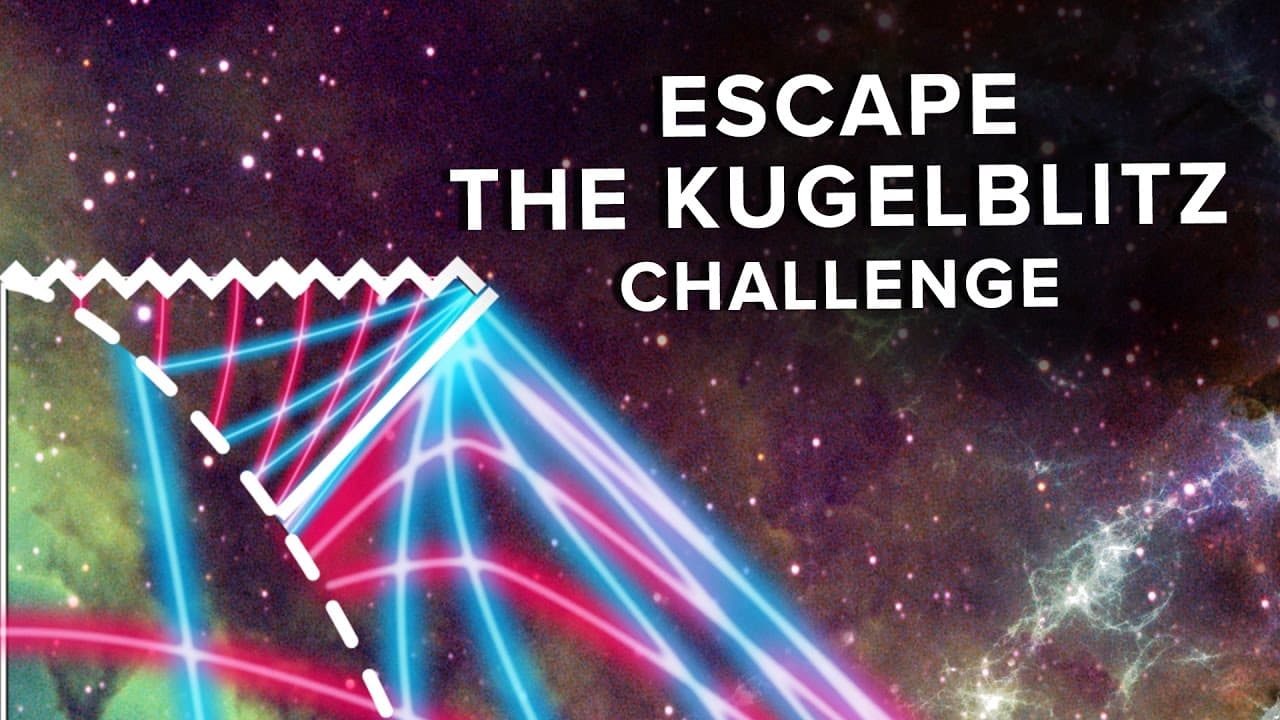
Escape The Kugelblitz Challenge
TL;DR
Explore theoretical defenses against an alien kugelblitz attack.
Transcript
[MUSIC PLAYING] In last week's episode, we looked at an extremely powerful tool for understanding the strange space-time both in and around black holes. This is the Penrose diagram. It compactifies our representation of the dimensions of space and time, allowing us to fit onto the one diagram the infinitely stretched space-time in the vicinity of a... Read More
Key Insights
- The Penrose diagram is a crucial tool for understanding the space-time structure around black holes, compactifying infinite space-time onto a single diagram.
- A Schwarchild black hole is an idealized, non-rotating, and uncharged black hole, which never grows or leaks, unlike real astrophysical black holes.
- The formation of a black hole begins when a massive star's core collapses under gravity, forming an event horizon if it shrinks below its Schwarchild radius.
- Inside a black hole, space and time switch roles, with all space funneling towards the singularity faster than light, creating a region of no return.
- A kugelblitz is a hypothetical black hole formed entirely from light, with a gravitational pull equivalent to its mass-energy, capable of engulfing Earth.
- Two defense plans proposed against a kugelblitz: a Dyson sphere to absorb the light pulse or a reflective satellite shield to deflect it.
- Newton's shell theorem suggests that within a spherically symmetric mass shell, like a kugelblitz, no gravitational force is felt until the shell collapses.
- Theoretical defense strategies against cosmic threats highlight the importance of understanding advanced physics concepts and their practical applications.
Install to Summarize YouTube Videos and Get Transcripts
Explore YouTube Video Summarizer or Get YouTube Transcript Extractor
Questions & Answers
Q: What is the purpose of the Penrose diagram in understanding black holes?
The Penrose diagram is a powerful tool for understanding the complex space-time structure around black holes. It compactifies infinite dimensions of space and time onto a single diagram, allowing us to visualize the limits of access to the universe, particularly how light and matter interact with the event horizon and singularity.
Q: How does a Schwarchild black hole differ from real astrophysical black holes?
A Schwarchild black hole is an idealized model with no electric charge or rotation, and it is eternal, meaning it neither grows nor leaks. In contrast, real astrophysical black holes form from collapsing stars, have finite lifespans, and can possess charge and angular momentum, influencing their gravitational effects and interactions with surrounding matter.
Q: What is a kugelblitz and how does it threaten Earth?
A kugelblitz is a theoretical black hole formed entirely from concentrated light energy. Its mass-energy equivalence gives it a gravitational pull capable of engulfing Earth. If an alien civilization were to create a kugelblitz, its event horizon could form around the planet, leading to Earth's eventual consumption by the singularity within seconds of detection.
Q: What are the proposed defense plans against the kugelblitz attack?
Two defense plans are proposed: Plan A involves constructing an infinitely-strong Dyson sphere to absorb the incoming light pulse, converting it into energy. Plan B suggests launching a reflective satellite shield to deflect the light outwards. Both plans aim to prevent the kugelblitz from forming around Earth, though their feasibility depends on advanced technology and precise execution.
Q: What role does Newton's shell theorem play in the kugelblitz scenario?
Newton's shell theorem states that within a spherically symmetric shell of mass or energy, no gravitational force is felt from the shell itself. In the kugelblitz scenario, this means that space inside the collapsing light shell remains unaffected until the shell overtakes it, allowing Earth a brief period of normalcy before the event horizon forms and the singularity consumes it.
Q: How does the episode encourage viewer engagement?
The episode engages viewers by presenting a hypothetical cosmic threat and challenging them to analyze and choose between two defense strategies using their understanding of Penrose diagrams and astrophysics. It invites viewers to submit their solutions for a chance to win a prize, fostering interactive learning and application of complex scientific concepts.
Q: What is the significance of understanding advanced physics concepts in this context?
Understanding advanced physics concepts, such as those related to black holes and space-time, is crucial for developing theoretical defense strategies against cosmic threats like a kugelblitz. This knowledge enables us to explore potential solutions, assess their feasibility, and appreciate the complexities of the universe and our place within it.
Q: How does the episode blend educational content with entertainment?
The episode blends education with entertainment by using a fictional alien attack scenario to explore real astrophysical concepts. It presents complex ideas like Penrose diagrams and kugelblitzes in an engaging narrative, encouraging viewers to apply scientific knowledge creatively while maintaining a sense of urgency and excitement about the potential cosmic threat.
Summary & Key Takeaways
-
The episode discusses the use of Penrose diagrams to understand black holes, particularly focusing on the Schwarchild black hole as an idealized model. It contrasts this with real astrophysical black holes, explaining their formation from collapsing stars and the resulting space-time dynamics.
-
A hypothetical scenario is presented where an alien civilization attempts to destroy Earth using a kugelblitz, a black hole formed from light. The episode explores the gravitational effects of such an event and the potential strategies to avert this cosmic threat.
-
Two defense plans are proposed: constructing a Dyson sphere to absorb the incoming light pulse or deploying a satellite network to reflect it. The episode invites viewers to analyze these plans using Penrose diagrams and choose the most feasible solution to save Earth.
Read in Other Languages (beta)
Share This Summary 📚
Summarize YouTube Videos and Get Video Transcripts with 1-Click
Try YouTube Summary with ChatGPT & Claude or YouTube Transcript Generator
Explore More Summaries from PBS Space Time 📚
Summarize YouTube Videos and Get Video Transcripts with 1-Click
Try YouTube Summary with ChatGPT & Claude or YouTube Transcript Generator