How does the Composite Leading Indicator signal points
TL;DR
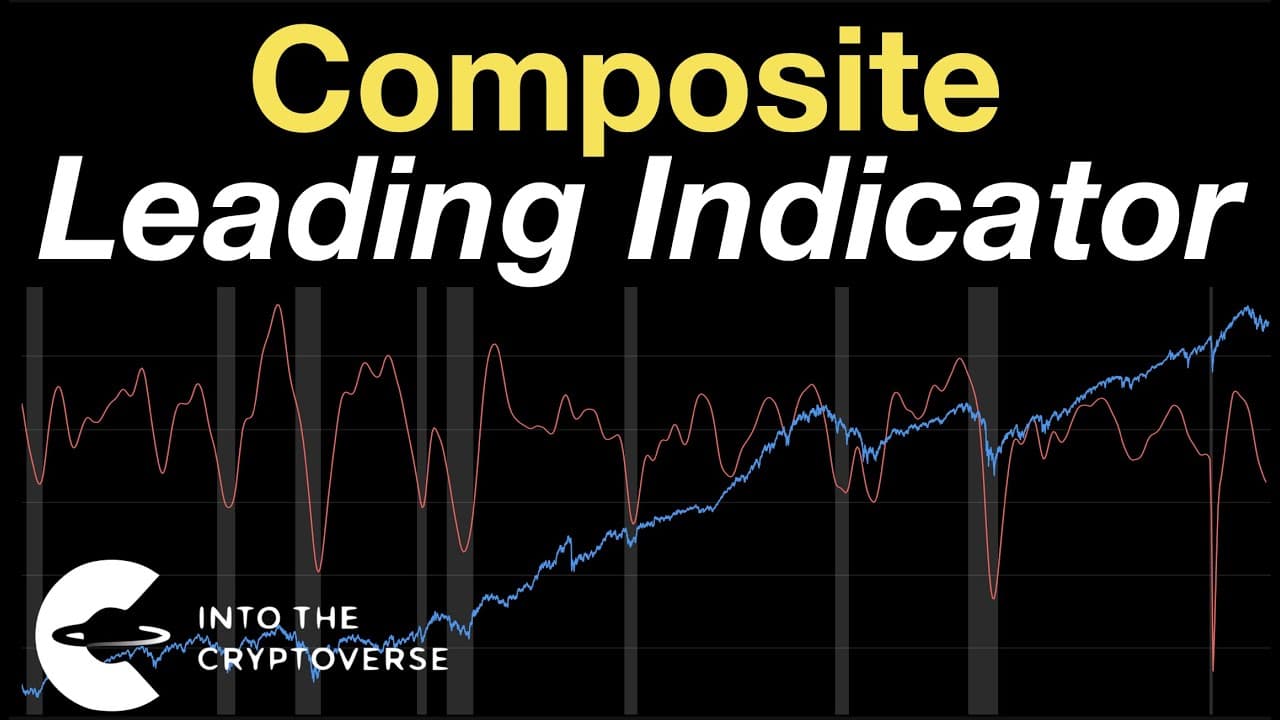
The CLI is an early warning tool that turns up to signal a potential bottom in the economy and stock market. It combines sentiment, confidence, and production data to forecast activity and warns when the economy looks sick. Right now the indicator is declining, suggesting caution until a clearer bottom forms.
Transcript
hey everyone and thanks for jumping back into the macroverse today we're going to talk about the composite leading indicator or CLI if you guys like the content make sure you subscribe to the channel give the video a thumbs up and check out into the cryptoverse premium at into the cryptiverse.com the composite leading indicator is a good metric to ... Read More
Key Insights
- The CLI is composed of sentiment, confidence, and production indicators which together forecast economic activity. The turning up of the CLI is interpreted as a sign the bottom may be near or in. The indicator is not a perfect predictor but offers early warning signals to traders and policymakers.
- Historical analysis shows the CLI has signaled turning points close to market bottoms in several cycles, including prior recessions, though there are notable exceptions influenced by external factors like geopolitical events.
- The rate of change of the CLI matters; a slower decline or a reacceleration to the upside can indicate improving momentum and potential stabilization in the economy and equity markets.
- In downturns, a downward CLI warns that the economy is sick and impacts are likely felt in the stock market. Conversely, a rising CLI has historically preceded gains and new highs in some periods.
- The CLI does not replace other recession indicators; it should be used with a broader toolkit to interpret macro risk and guide investment decisions.
- The video emphasizes the difference between stock market and economy dynamics, noting markets often recover before recessions end and that inverted yield curves are not always a reliable recession predictor.
- Viewing the CLI alongside historical peaks helps traders assess whether a top in equities is near and if a downturn may escalate, though exact timing remains uncertain.
Install to Summarize YouTube Videos and Get Transcripts
Explore YouTube Video Summarizer or Get YouTube Transcript Extractor
Questions & Answers
Q: What is the Composite Leading Indicator and what does it combine?
The Composite Leading Indicator is a tool used to forecast future economic activity and identify turning points in business cycles. It combines several indicators such as sentiment, consumer confidence, and industrial production to create a normalized signal that can point toward potential changes in the economy.
Q: Why is the CLI considered an early signal for turning points?
The CLI is viewed as an early signal because it aggregates multiple inputs that tend to respond to economic shifts before they appear in broader measures. Its movements can hint at a bottom or recovery before a recession officially ends, giving traders and policymakers time to react.
Q: How have past CLI readings related to market bottoms?
Historically, when the CLI starts turning back up, it often coincides with the bottom forming or nearing in the stock market. While not guaranteed, this pattern has been observed in various cycles, suggesting that improving CLI momentum can precede market stabilization and potential highs.
Q: What does a declining CLI indicate for the economy and markets?
A declining CLI signals that the economy is weakening and that negative momentum is building. This often translates into caution in the stock market, as downside risks increase. The rate of change can also indicate whether the decline is accelerating or slowing.
Q: Did the CLI always correctly predict the top or bottom in past cycles?
No, the CLI does not always perfectly predict tops or bottoms. There are exceptions where external factors, such as geopolitical events, can influence markets beyond what the CLI suggests. It remains a useful indicator but should be used with other analyses.
Q: What is the relationship between the CLI and recessions according to the video?
The video explains that a decline in the CLI is often seen as a warning of a potential downturn and can signal a recession ahead. However, the CLI alone is not sufficient to predict a recession and should be corroborated with other data.
Q: How does the CLI relate to the yield curve in the discussion?
The video notes that while the yield curve is a predictor of recession when inverted, its behavior during inversion and subsequent uninversion has different implications. The CLI adds another dimension by showing turning points in the business cycle that may align with or diverge from yield curve signals.
Q: What practical use does the CLI have for investors in the current context?
For investors, the CLI provides an early signal of potential bottoming behavior in the economy, helping to gauge when risk is shifting. Watching the rate of change and the turning point can guide timing for equity exposure and risk management while broader recession indicators are considered.
Summary & Key Takeaways
-
The Composite Leading Indicator (CLI) combines several indicators like sentiment, confidence, and industrial production to forecast future economic activity and identify turning points in business cycles. It provides early signals for potential bottoms or tops in the market. Historical patterns show turning points often precede market turning points, though not perfectly.
-
When the CLI turns back up, it historically signals that the bottom is in or close, often hinting at a move to new highs while acknowledging exceptions such as the 2000-2001 period and external geopolitical events. Monitoring the rate of change adds nuance to the signal.
-
Current readings show the CLI still in decline with a slowing rate of change, which may indicate the economy is not yet turning up. Investors are advised to watch for a bottom carving out, which could mark a near term recovery signal for equities.
Read in Other Languages (beta)
Share This Summary 📚
Summarize YouTube Videos and Get Video Transcripts with 1-Click
Try YouTube Summary with ChatGPT & Claude or YouTube Transcript Generator
Explore More Summaries from Benjamin Cowen 📚






Summarize YouTube Videos and Get Video Transcripts with 1-Click
Try YouTube Summary with ChatGPT & Claude or YouTube Transcript Generator