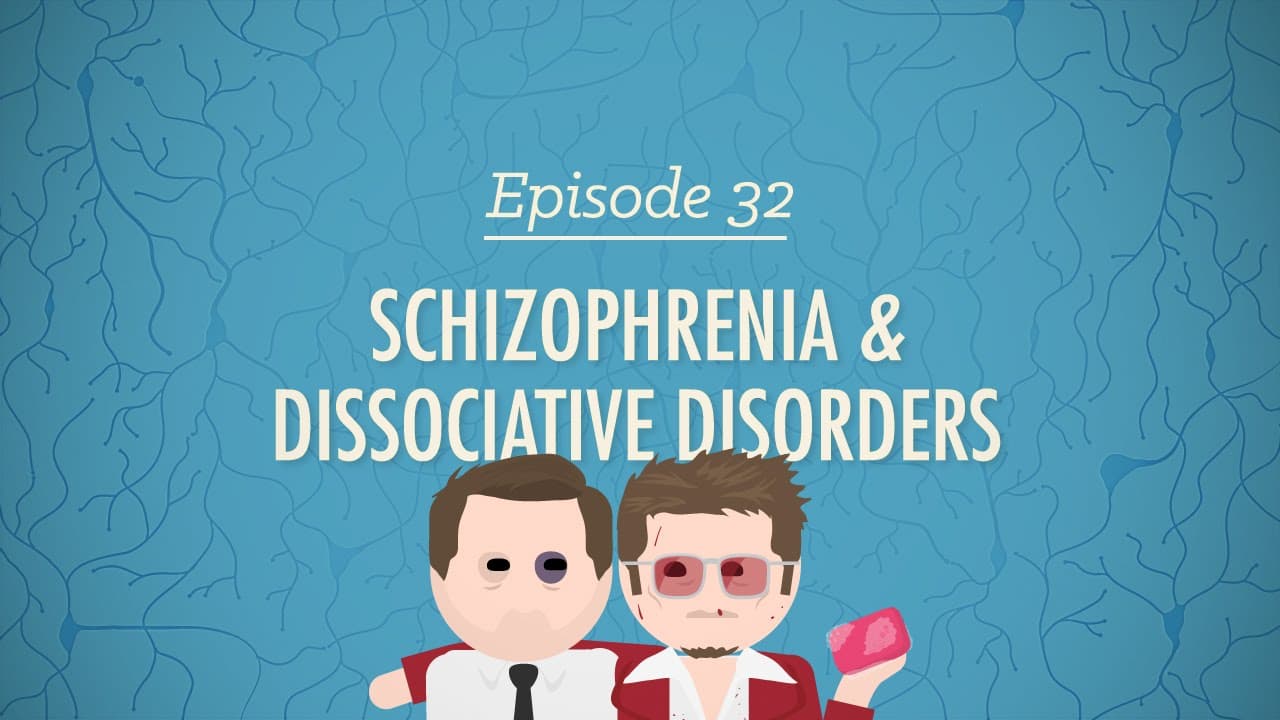
Schizophrenia and Dissociative Disorders: Crash Course Psychology #32
TL;DR
Explores misconceptions and realities of schizophrenia and dissociative disorders.
Transcript
It's perhaps the most stigmatized and misunderstood psychological disorder of them all, even among psychologists. Maybe because it's pretty rare, affecting about 1% of the population, schizophrenia causes more anxiety in the media, in the public, and even in doctors' offices than any other mental illness. As a result, its sufferers have often been ... Read More
Key Insights
- Schizophrenia affects approximately 1% of the population and is often misunderstood, leading to stigma and misconceptions.
- Schizophrenia is characterized by a 'split from reality,' involving symptoms like delusions, hallucinations, and disorganized thinking.
- Dissociative Identity Disorder (DID), formerly Multiple Personality Disorder, involves alternating identities and is surrounded by controversy.
- The 'diathesis-stress model' suggests schizophrenia arises from genetic vulnerability and environmental stressors.
- Brain abnormalities in schizophrenia include excess dopamine receptors and unusual activity in areas like the thalamus and amygdala.
- Schizophrenia symptoms are categorized into positive, negative, and disorganized symptoms, affecting behavior and cognitive functions.
- DID's legitimacy is debated, with some cases like 'Sybil' possibly being fabricated, yet some evidence suggests distinct physiological states.
- Proper treatment can help individuals with schizophrenia manage symptoms and contribute creatively to society.
Install to Summarize YouTube Videos and Get Transcripts
Explore YouTube Video Summarizer or Get YouTube Transcript Extractor
Questions & Answers
Q: What is a common misconception about schizophrenia?
A common misconception about schizophrenia is that it involves multiple personalities. In reality, schizophrenia is characterized by a 'split from reality,' involving symptoms such as delusions, hallucinations, and disorganized thinking. The term 'schizophrenia' literally means 'split mind,' but it does not refer to a split personality.
Q: How do genetic factors influence the risk of developing schizophrenia?
Genetic factors significantly influence the risk of developing schizophrenia. The likelihood increases from 1% in the general population to nearly 10% if a person has a parent or sibling with the disorder. For identical twins, the risk is about 50%, even if raised apart, indicating a strong genetic component.
Q: What are the three categories of symptoms in schizophrenia?
Symptoms of schizophrenia are categorized into three types: positive, negative, and disorganized. Positive symptoms add experiences such as hallucinations and delusions. Negative symptoms involve a reduction in normal functions, like lack of emotion. Disorganized symptoms include jumbled thoughts and speech, affecting communication and cognitive processes.
Q: What role does dopamine play in schizophrenia?
Dopamine plays a crucial role in the symptoms of schizophrenia. Many patients have extra dopamine receptors, and this neurotransmitter is involved in regulating emotions and pleasure centers in the brain. Overactive dopamine systems may contribute to hallucinations and other positive symptoms by amplifying brain activity and blurring internal and external stimuli.
Q: What is the diathesis-stress model in relation to schizophrenia?
The diathesis-stress model explains schizophrenia as a result of genetic and biological vulnerabilities (diathesis) combined with environmental stressors (stress). This model suggests that while genetic predisposition increases risk, environmental factors like stress or trauma can trigger the onset of symptoms, although they cannot cause the disorder alone.
Q: How is Dissociative Identity Disorder (DID) viewed in the psychological community?
Dissociative Identity Disorder (DID) is controversial within the psychological community. Some question its validity due to cases like 'Sybil,' which may have been fabricated. However, studies showing distinct physiological states between identities suggest it may be a real disorder, potentially serving as a coping mechanism for stress or trauma.
Q: What are some treatment options for schizophrenia?
Treatment options for schizophrenia often involve antipsychotic medications that block dopamine receptors to reduce symptoms like hallucinations. Therapy, including cognitive-behavioral therapy, can help patients manage symptoms and improve functioning. Supportive services and community programs also play a crucial role in helping individuals lead fulfilling lives.
Q: What impact did the 'Sybil' case have on the perception of DID?
The 'Sybil' case significantly impacted the perception of DID by popularizing the disorder through a book and mini-series. It led to a dramatic increase in reported cases of multiple personalities. However, the eventual revelation that the story was largely fabricated cast doubt on the disorder's legitimacy and highlighted the need for cautious diagnosis.
Summary & Key Takeaways
-
Schizophrenia is a misunderstood disorder characterized by a 'split from reality,' involving symptoms like hallucinations and delusions. It affects about 1% of the population and is often stigmatized. Understanding the disorder can lead to greater compassion and improved treatment outcomes for those affected.
-
Dissociative Identity Disorder (DID) involves alternating identities and is controversial due to cases like 'Sybil,' which may have been fabricated. Despite skepticism, some studies indicate distinct physiological differences between identities, suggesting DID may be a response to stress or trauma.
-
The diathesis-stress model explains schizophrenia as resulting from genetic predisposition and environmental stressors. Brain abnormalities, such as excess dopamine receptors, play a role in symptom manifestation. Treatment and understanding are crucial for managing symptoms and reducing societal stigma.
Read in Other Languages (beta)
Share This Summary 📚
Summarize YouTube Videos and Get Video Transcripts with 1-Click
Try YouTube Summary with ChatGPT & Claude or YouTube Transcript Generator
Explore More Summaries from CrashCourse 📚




Summarize YouTube Videos and Get Video Transcripts with 1-Click
Try YouTube Summary with ChatGPT & Claude or YouTube Transcript Generator