What Is a CPU and How Does It Work?
TL;DR
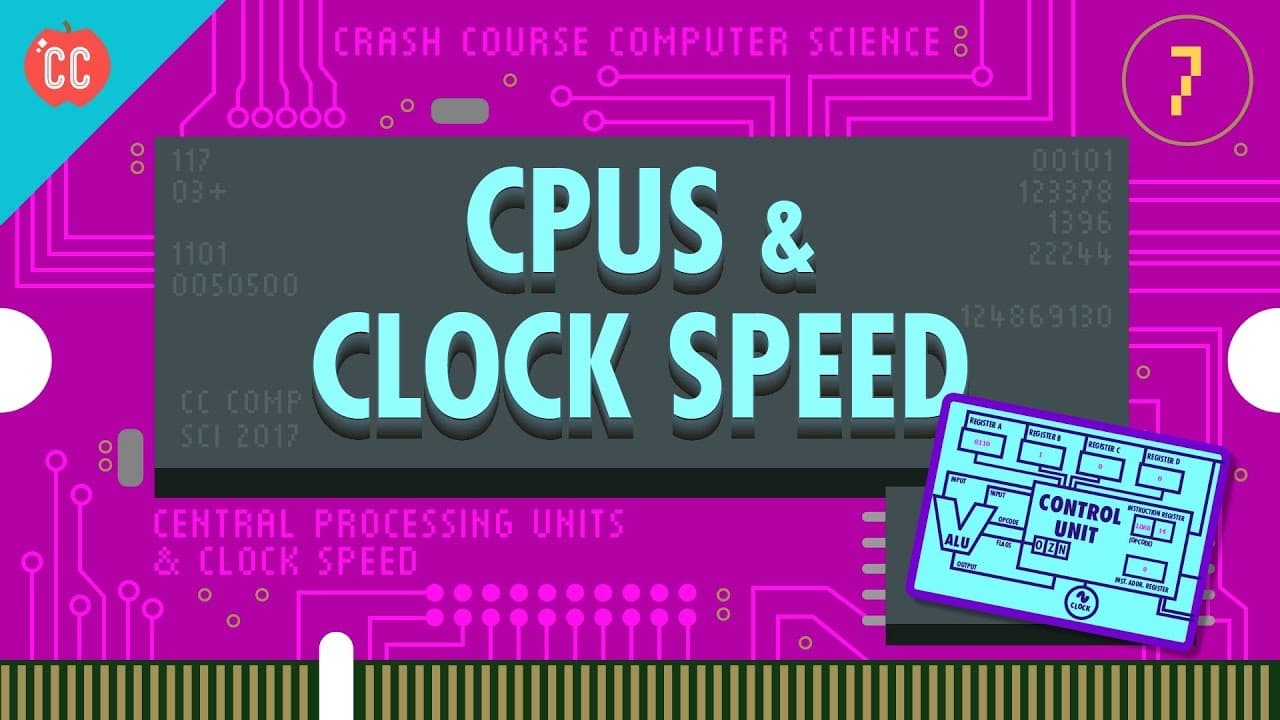
A Central Processing Unit (CPU) executes programs by performing fetch-decode-execute cycles. It retrieves instructions from memory, decodes them using a control unit, and carries out operations with an Arithmetic and Logic Unit (ALU). The CPU's efficiency is influenced by its clock speed, which measures how quickly it processes instructions.
Transcript
Hi, I’m Carrie Anne, this is Crash Course Computer Science, and today, we’re talking about processors. Just a warning though - this is probably the most complicated episode in the series. So once you get this, you’re golden. We’ve already made a Arithmetic and Logic Unit, which takes in binary numbers and performs calculations, and we’ve made two t... Read More
Key Insights
- 🎯 The Central Processing Unit (CPU) is the heart of a computer and its main job is to execute programs by following a series of instructions.
- 🧠 Programs are made up of individual instructions that tell the computer what to do, such as mathematical calculations or memory operations.
- 💾 Memory is essential for storing both data and instructions. A CPU requires memory registers and RAM to store and manipulate values.
- 📥 Instructions have an operation code (opcode) that specifies the type of instruction and the data it should work with, either from registers or memory addresses.
- 🔁 A CPU goes through a fetch-decode-execute cycle to process instructions. In the fetch phase, an instruction is retrieved from memory and stored in the instruction register.
- ⚙️ A control unit made of logic gates decodes instructions and configures the CPU's components to perform the specified action.
- ➕ The CPU can perform mathematical operations using an Arithmetic and Logic Unit (ALU) integrated into the CPU. ⏰ A clock provides a regular signal that advances the internal operation of the CPU. Clock speed is measured in Hertz and determines how fast a CPU can carry out each step of the fetch-decode-execute cycle.
Install to Summarize YouTube Videos and Get Transcripts
Explore YouTube Video Summarizer or Get YouTube Transcript Extractor
Questions & Answers
Q: What are the main functions of a CPU in a computer?
The main functions of a CPU in a computer are to execute programs, perform mathematical and logical operations, interact with memory, and control the flow of instructions and data.
Q: What is the role of the Control Unit in a CPU?
The Control Unit in a CPU is responsible for decoding instructions, configuring the CPU's components, selecting registers, and directing the flow of data and instructions during the execution phase.
Q: How does the CPU fetch instructions from memory?
The CPU fetches instructions from memory by using the Instruction Address Register (IAR) to access the memory address where the instruction is stored and copying it into the Instruction Register (IR).
Q: What is the significance of clock speed in a CPU?
Clock speed refers to the speed at which a CPU can carry out each step of the fetch-decode-execute cycle. A higher clock speed allows the CPU to perform more instructions per second, resulting in faster processing.
Q: How does underclocking and overclocking affect a CPU?
Underclocking slows down the CPU's clock speed, saving power and reducing heat generation. Overclocking speeds up the clock speed, which can increase performance but may lead to overheating or instability if done excessively.
Q: How do modern processors adjust their clock speed based on demand?
Modern processors use dynamic frequency scaling, which allows them to increase or decrease their clock speed based on the workload or power requirements, optimizing performance and power consumption.
Summary & Key Takeaways
-
A CPU's job is to execute programs, which are made up of a series of instructions that tell the computer what to do.
-
The CPU consists of various components like registers, memory, and a control unit, which work together to perform instructions.
-
The fetch-decode-execute cycle is repeated to fetch instructions, decode them, and execute them using the ALU and control unit.
Read in Other Languages (beta)
Share This Summary 📚
Summarize YouTube Videos and Get Video Transcripts with 1-Click
Try YouTube Summary with ChatGPT & Claude or YouTube Transcript Generator
Explore More Summaries from CrashCourse 📚




Summarize YouTube Videos and Get Video Transcripts with 1-Click
Try YouTube Summary with ChatGPT & Claude or YouTube Transcript Generator