What If Space is NOT Empty?
TL;DR
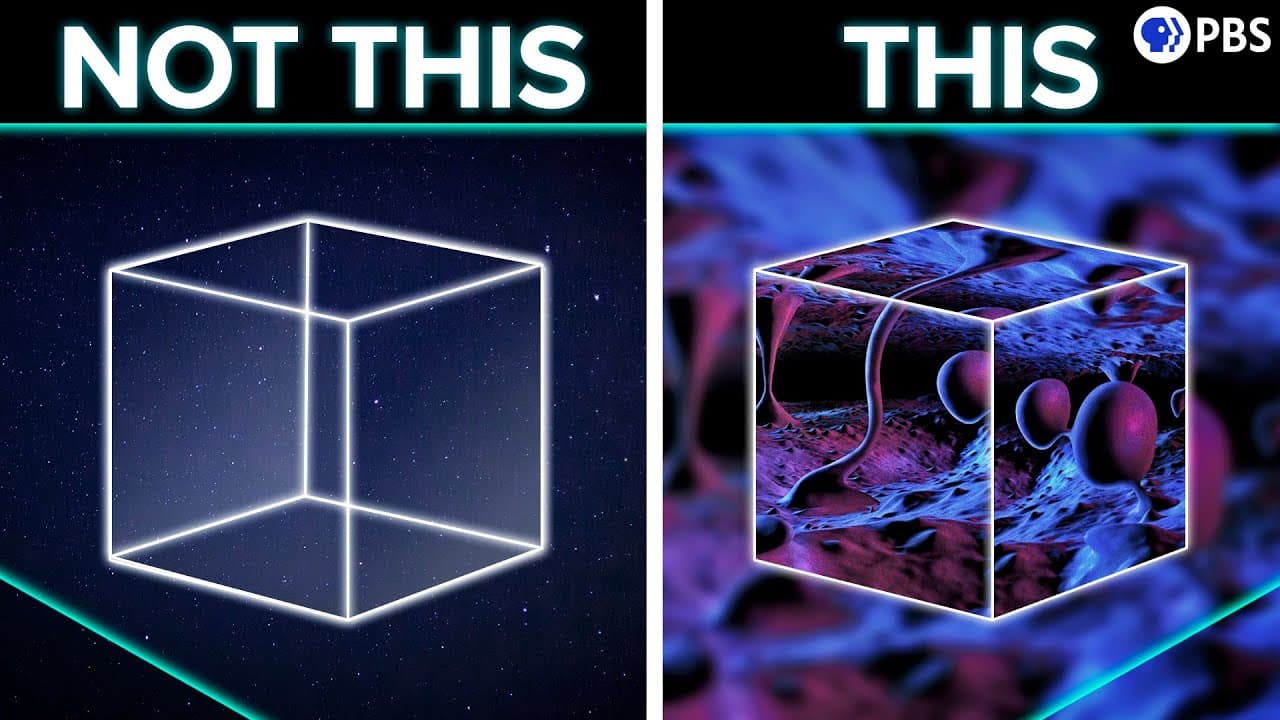
Spacetime at tiny scales is a foamy ocean of quantum fluctuations.
Transcript
Thank you to Surfshark VPN for supporting PBS. Spacetime on its smallest scales is a seething ocean of black holes and wormholes flickering into and out of existence—or so many physicists think has to be the case. But why should we take this spacetime foam seriously if we’ve never seen any evidence of it? A while ago we started talking about the... Read More
Key Insights
- Spacetime foam is a concept where spacetime at the smallest scales is filled with transient black holes and wormholes, as proposed by physicist John Archibald Wheeler.
- The conflict between general relativity and quantum mechanics suggests that spacetime is not smooth but rather foamy at the Planck scale.
- The Heisenberg uncertainty principle plays a crucial role in the concept of spacetime foam, linking uncertainty in position and momentum to spacetime geometry.
- Quantum fluctuations in spacetime are complex, leading to a superposition of many possible geometries at the Planck scale, resulting in a foamy structure.
- Testing spacetime foam involves observing the effects on light from distant objects, such as quasars, to detect shifts caused by the foamy nature of spacetime.
- Current observations using the Hubble Space Telescope have ruled out certain strong spacetime foam models, but more sensitive instruments are needed for definitive evidence.
- The interaction between quantum field theory and general relativity suggests that even in a vacuum, energy fluctuations can lead to complex spacetime geometries.
- Indirect evidence of spacetime foam could be observed through diffraction patterns of light from distant objects, potentially affected by the foam's influence.
Install to Summarize YouTube Videos and Get Transcripts
Explore YouTube Video Summarizer or Get YouTube Transcript Extractor
Questions & Answers
Q: What is spacetime foam?
Spacetime foam is a theoretical concept proposed by physicist John Archibald Wheeler, suggesting that at the smallest scales, spacetime is filled with transient black holes and wormholes. This idea arises from the conflict between general relativity and quantum mechanics, indicating that spacetime is not smooth but rather foamy at the Planck scale.
Q: How does the Heisenberg uncertainty principle relate to spacetime foam?
The Heisenberg uncertainty principle is central to understanding spacetime foam. It links uncertainties in position and momentum to the geometry of spacetime. As we measure more precisely, uncertainties in spacetime geometry increase, leading to the concept of spacetime being foamy at the Planck scale, where geometry becomes highly variable.
Q: How can we test for spacetime foam?
Testing for spacetime foam involves observing light from distant objects, like quasars, to detect shifts caused by the foamy nature of spacetime. By analyzing diffraction patterns of light, scientists can look for variations that suggest the presence of spacetime foam. Current observations have ruled out certain strong models, but more sensitive instruments are needed.
Q: What role does quantum field theory play in spacetime foam?
Quantum field theory, particularly the standard model of particle physics, describes all matter and forces as excitations in quantum fields. These fields permeate space, and due to the time-energy uncertainty principle, energy fluctuations occur even in a vacuum. These fluctuations contribute to the complex geometries of spacetime, supporting the concept of spacetime foam.
Q: What is the significance of the Planck scale in spacetime foam?
The Planck scale is significant because it is the scale at which the effects of quantum gravity become prominent, and spacetime is theorized to be foamy. At this scale, spacetime geometry is highly variable, with transient black holes and wormholes appearing. The Planck length sets the limit for our ability to pinpoint objects in space, crucial for understanding spacetime foam.
Q: What are the challenges in detecting spacetime foam?
Detecting spacetime foam is challenging because its effects become significant only at the Planck scale, far smaller than current direct probes of spacetime structure. Indirect tests, such as observing diffraction patterns of light from distant objects, are possible but require highly sensitive instruments. Current observations are close but not yet sufficient for definitive evidence.
Q: How do quantum fluctuations affect spacetime geometry?
Quantum fluctuations lead to complex and ever-changing spacetime geometries. These fluctuations occur due to the uncertainty in energy and time, causing variations in the mass-energy content of spacetime. As a result, the geometry of spacetime is also uncertain, contributing to the concept of spacetime foam where many possible geometries exist simultaneously at the Planck scale.
Q: What is the potential impact of spacetime foam on our understanding of the universe?
Spacetime foam could significantly impact our understanding of the universe by providing insights into the nature of spacetime at the smallest scales. It challenges the classical view of smooth spacetime and suggests a more dynamic and complex structure. Understanding spacetime foam could bridge the gap between quantum mechanics and general relativity, offering a unified theory of quantum gravity.
Summary & Key Takeaways
-
Spacetime foam is a theoretical concept suggesting that at the smallest scales, spacetime is filled with transient black holes and wormholes. This idea arises from the conflict between general relativity and quantum mechanics, indicating that spacetime is not smooth but rather foamy at the Planck scale.
-
The Heisenberg uncertainty principle is central to understanding spacetime foam, linking uncertainties in position and momentum to the geometry of spacetime. Quantum fluctuations lead to a superposition of many possible geometries at the Planck scale, resulting in a foamy structure.
-
Testing for spacetime foam involves observing light from distant objects, like quasars, for shifts caused by the foamy nature of spacetime. Current observations have ruled out certain strong models, but more sensitive instruments are needed for conclusive evidence.
Read in Other Languages (beta)
Share This Summary 📚
Summarize YouTube Videos and Get Video Transcripts with 1-Click
Try YouTube Summary with ChatGPT & Claude or YouTube Transcript Generator
Explore More Summaries from PBS Space Time 📚
Summarize YouTube Videos and Get Video Transcripts with 1-Click
Try YouTube Summary with ChatGPT & Claude or YouTube Transcript Generator