Worked example: separable differential equation (with taking log of both sides) | Khan Academy
TL;DR
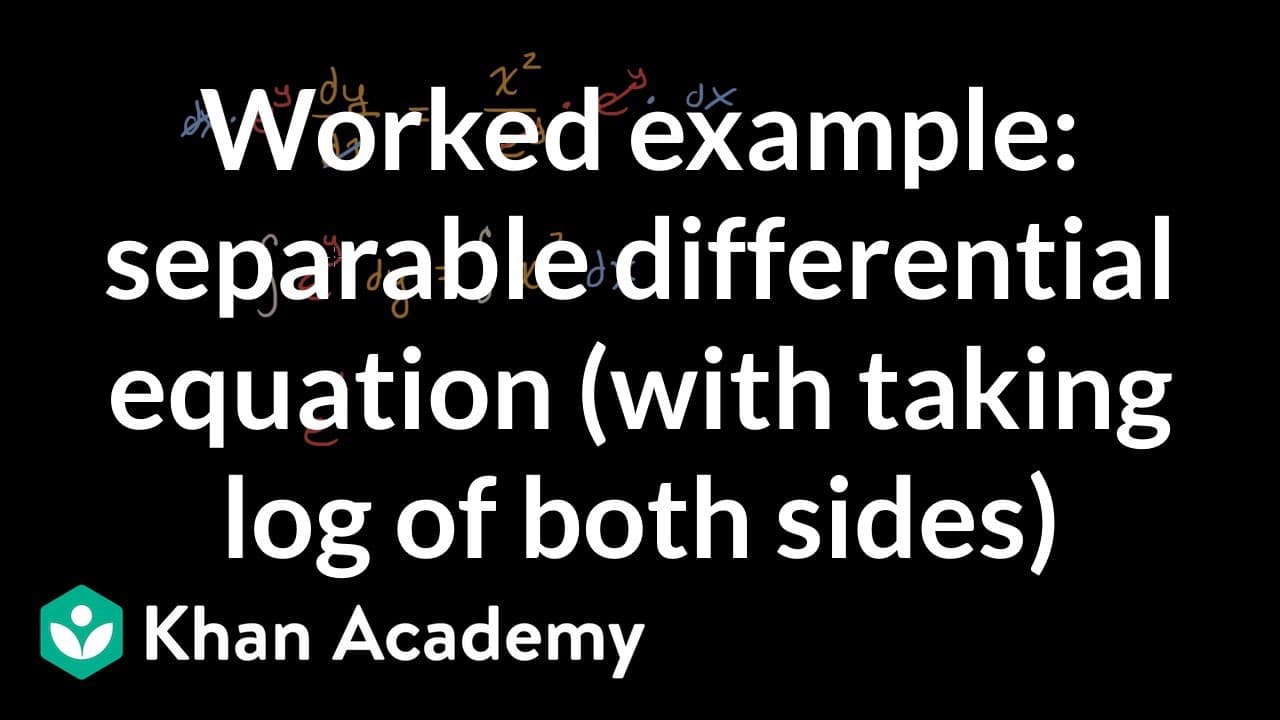
Learn how to solve a separable differential equation by integrating both sides and simplifying the expressions, resulting in an explicit function for y in terms of x.
Transcript
- [Instructor] Let's say we need to find a solution to the differential equation that the derivative of y with respect to x is equal to x squared over e to the y. Pause this video and see if you can have a go at it, and I will give you a clue. It is a separable differential equation. All right, now let's do this together. So, whenever you do any di... Read More
Key Insights
- ❣️ Solving a differential equation involves determining if it is separable, bringing all y and x terms to respective sides.
- 🔋 Multiplying both sides by suitable terms, such as e to the power of y and dx, assists in isolating variables.
- 🙃 Integrating both sides simplifies the equation by finding antiderivatives.
- 🔋 The integral of e to the power of y with respect to y is e to the power of y.
- ☺️ The indefinite integral of x squared with respect to x is x to the power of 3 over 3.
- 🙃 Adding a constant, represented by c, is necessary when integrating both sides.
- 🥘 Taking the natural logarithm allows for obtaining an explicit function for y in terms of x.
Install to Summarize YouTube Videos and Get Transcripts
Explore YouTube Video Summarizer or Get YouTube Transcript Extractor
Questions & Answers
Q: How do you determine if a differential equation is separable?
A differential equation is separable if you can isolate all the terms involving y on one side of the equation and all the terms involving x on the other side, with the differentials dy and dx on their respective sides.
Q: Why is it necessary to multiply both sides by e to the power of y and dx?
Multiplying both sides by e to the power of y eliminates the y term on the right side, allowing for separation of variables. Multiplying by dx gets rid of the dx on the left side and brings it together with the x squared term on the right side.
Q: What is the integral of e to the power of y with respect to y?
The integral of e to the power of y with respect to y is simply e to the power of y. This is possible because the derivative of e to the power of y with respect to y is also e to the power of y.
Q: How is the explicit function for y in terms of x obtained?
By taking the natural logarithm of both sides of the equation, the exponential e is canceled out from e to the power of y, resulting in y. Solving for y gives y = natural log (x to the power of 3 over 3) + c, where c represents an arbitrary constant.
Summary & Key Takeaways
-
The video explains how to solve a separable differential equation, where the derivative of y with respect to x is equal to x squared over e to the power of y.
-
To make the equation separable, both sides are multiplied by e to the power of y and dx, leading to e to the power of y dy = x squared dx.
-
Integrating both sides allows for simplification, with the integral of e to the power of y with respect to y being e to the power of y.
-
The indefinite integral of x squared with respect to x is x to the power of 3 over 3.
-
Taking the natural logarithm of both sides results in y = natural log (x to the power of 3 over 3) + c, with c representing the constant.
Read in Other Languages (beta)
Share This Summary 📚
Summarize YouTube Videos and Get Video Transcripts with 1-Click
Try YouTube Summary with ChatGPT & Claude or YouTube Transcript Generator
Explore More Summaries from Khan Academy 📚



Summarize YouTube Videos and Get Video Transcripts with 1-Click
Try YouTube Summary with ChatGPT & Claude or YouTube Transcript Generator