How to Use Apostrophes for Plural Possession
TL;DR
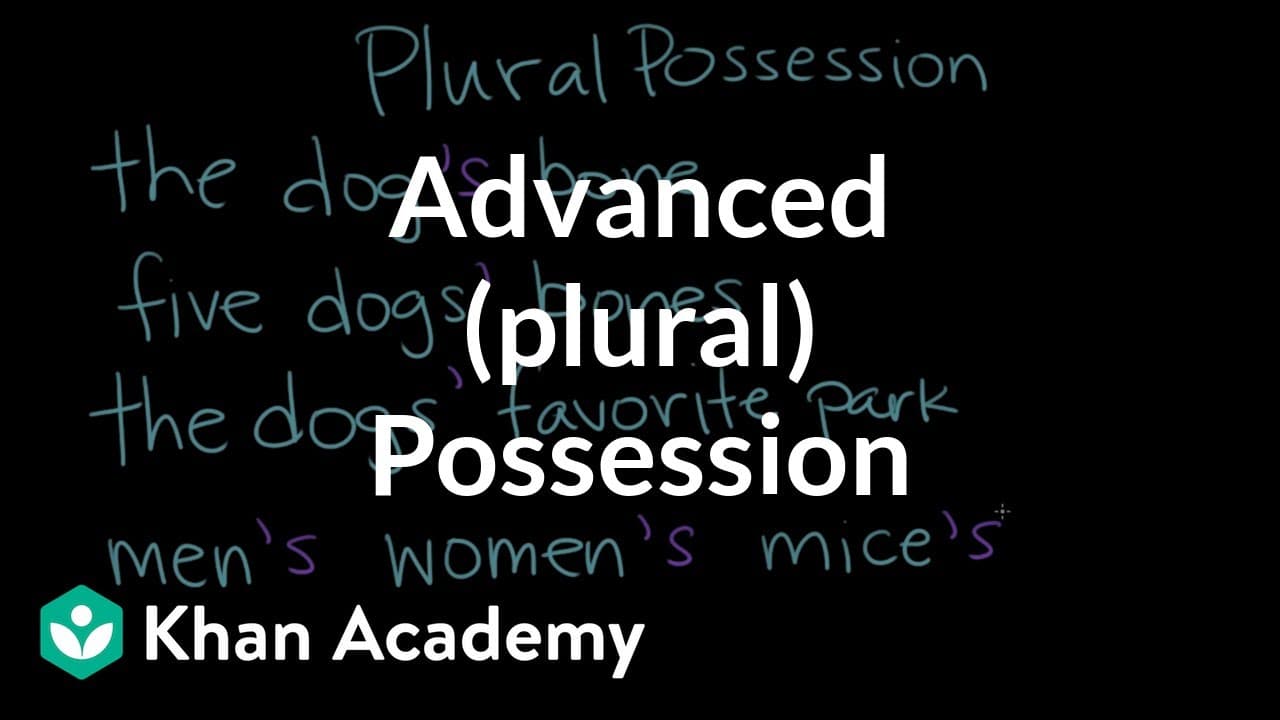
To use apostrophes for plural possession, if a noun is plural and ends in 's,' simply add an apostrophe (e.g., dogs' bones). For irregular plurals that don’t end in 's,' add apostrophe 's' (e.g., men's section). Family names that end in 's' can be pluralized by adding 'es' and then using an apostrophe for possession (e.g., the Burnses' house).
Transcript
- [Paige] Hello grammarians, hello David. - [David] Hello Paige. - [Paige] So today we're gonna talk about Plural Possession. Meaning when more than one person, or thing, or animal, owns something else. And this, like most other types of possession, tends to involve apostrophes. - [David] Makes sense, checks out. - [Paige] Yeah, cool. - [David] So ... Read More
Key Insights
- 📢 Plural possession involves using apostrophes, but the rules vary depending on whether the possessive noun is singular or plural.
- ❤️🩹 Plural possessive nouns that end in "S" only require an apostrophe, without adding an extra "S."
- 🎅 Irregular plural nouns still require apostrophe, S for plural possession.
- 🇸🇷 Family names ending in "S" can be made plural by adding "ES" and then using an apostrophe for possession.
- ✍️ Understanding the rules for plural possession helps maintain grammatical correctness in writing and communication.
- 🪜 Adding apostrophes correctly in plural possession avoids confusion and ensures clarity in conveying ownership.
- 💁 Plural possessive forms provide information about the relationship between multiple owners and the thing they possess.
Install to Summarize YouTube Videos and Get Transcripts
Explore YouTube Video Summarizer or Get YouTube Transcript Extractor
Questions & Answers
Q: When do we use apostrophe, S, for plural possession?
Apostrophe, S is used for singular possessive nouns, meaning when one person, thing, or animal owns something. For example, the dog's bone.
Q: How do we express plural possession without using apostrophe, S?
Plural possession is expressed by adding an apostrophe after the plural noun. For example, five dogs' bones.
Q: What about irregular plural nouns like mice or men?
Irregular plurals still require apostrophe, S for possession. For example, the mice's cheese or the men's section.
Q: How are family names with "S" at the end made plural in possessive form?
Family names ending in "S" become plural by adding "ES" at the end. For example, the Burnses' house or the Joneses' car.
Summary & Key Takeaways
-
Plural possession involves using apostrophes when more than one person, thing, or animal owns something.
-
Apostrophe, S, is used for singular possessive nouns, while plural possessive nouns that end in "S" only require an apostrophe.
-
Irregular plurals, like men, women, and mice, still require apostrophe, S for possession, while family names ending in "S" can be made plural by adding "ES" and then using an apostrophe for possession.
Read in Other Languages (beta)
Share This Summary 📚
Summarize YouTube Videos and Get Video Transcripts with 1-Click
Try YouTube Summary with ChatGPT & Claude or YouTube Transcript Generator
Explore More Summaries from Khan Academy 📚



Summarize YouTube Videos and Get Video Transcripts with 1-Click
Try YouTube Summary with ChatGPT & Claude or YouTube Transcript Generator