#31 AI for Good Specialization [Course 1, Week 3, Lesson 1]
TL;DR
Using neural networks to enhance sensor data estimation, improving accuracy significantly.
Transcript
in the last exercise you saw how coming up with a very simple scheme for estimated missing values based on sensor measurements from nearby sensor allowed you to establish a baseline for this task you saw that in some cases this method actually works pretty well but in other cases it doesn't work so well and overall it allowed you to make estimates ... Read More
Key Insights
- 🧑🏭 Data exploration uncovers patterns in pollutant levels based on various factors.
- 🥺 Neural networks can capture nuanced correlations in data, leading to improved estimation accuracy.
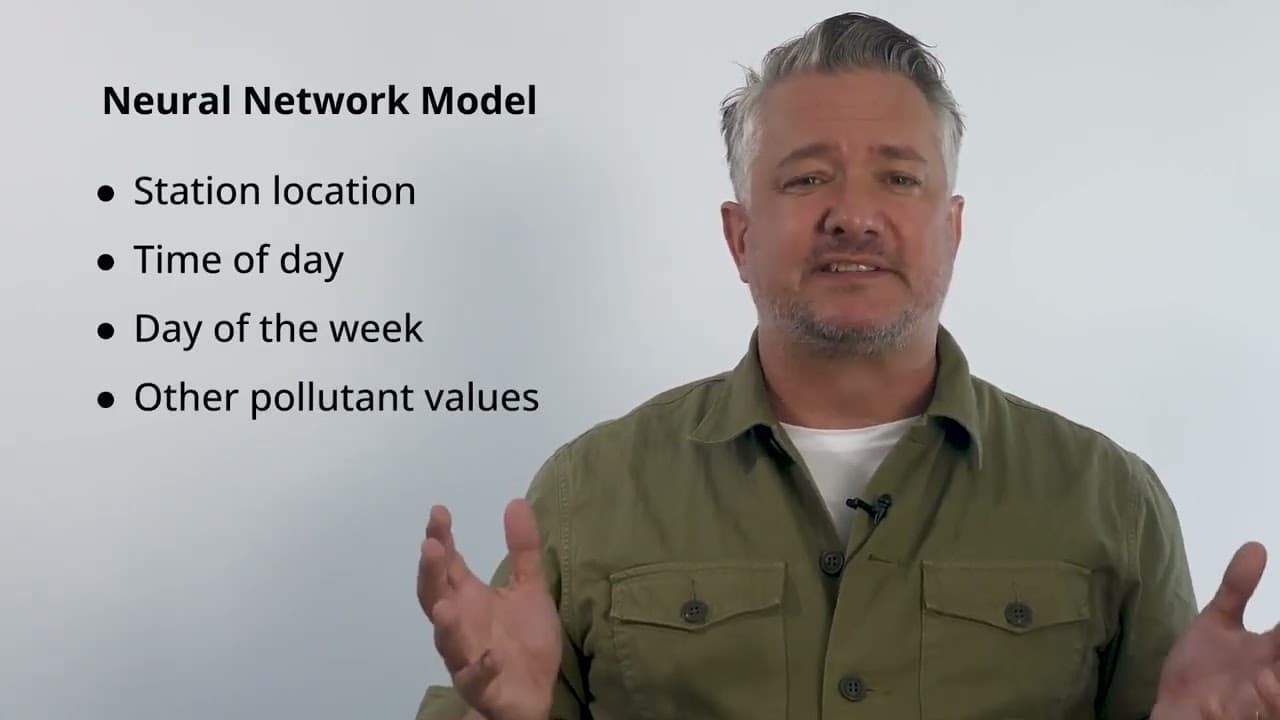
- 🧑🏭 Consideration of multiple factors, such as time and sensor location, enhances estimation accuracy.
- ⌛ Neural networks iterate and learn to make better predictions over time.
- 🐿️ Simple linear interpolation can be used to estimate missing non-PM 2.5 pollutant values.
- 🎏 Flagging estimated values helps differentiate between original sensor measurements and model estimates.
- 🦻 Visualization tools aid in understanding and validating the accuracy of estimation results.
Install to Summarize YouTube Videos and Get Transcripts
Explore YouTube Video Summarizer or Get YouTube Transcript Extractor
Questions & Answers
Q: How does the nearest neighbor method work for estimating missing sensor values?
The nearest neighbor method estimates missing values by using data from nearby sensors. It shows varying accuracy but serves as a baseline for the task.
Q: What insights can be gained from exploring pollutant level data?
Exploring the data reveals patterns in pollutant levels based on time, day, and correlations between pollutants, providing valuable insights for estimation improvement.
Q: What role does machine learning, specifically neural networks, play in enhancing sensor data estimation?
Neural networks can learn complex correlations in the data, considering multiple factors like time, sensor location, and other pollutant values to make more accurate estimations than simple rule-based methods.
Q: How does the neural network model improve upon the nearest neighbor baseline method in terms of accuracy?
The neural network model significantly reduces mean absolute error compared to the nearest neighbor method, showcasing the effectiveness of machine learning in improving sensor data estimation accuracy.
Summary & Key Takeaways
-
Simple nearest neighbor scheme gives baseline estimation for missing sensor values.
-
Data exploration reveals patterns in pollutant levels based on time and day.
-
Utilizing neural networks enhances accuracy by considering various factors for better estimates.
Read in Other Languages (beta)
Share This Summary 📚
Summarize YouTube Videos and Get Video Transcripts with 1-Click
Try YouTube Summary with ChatGPT & Claude or YouTube Transcript Generator
Explore More Summaries from DeepLearningAI 📚





Summarize YouTube Videos and Get Video Transcripts with 1-Click
Try YouTube Summary with ChatGPT & Claude or YouTube Transcript Generator