What Is Bresenham's Line Algorithm and How Does It Work?
TL;DR
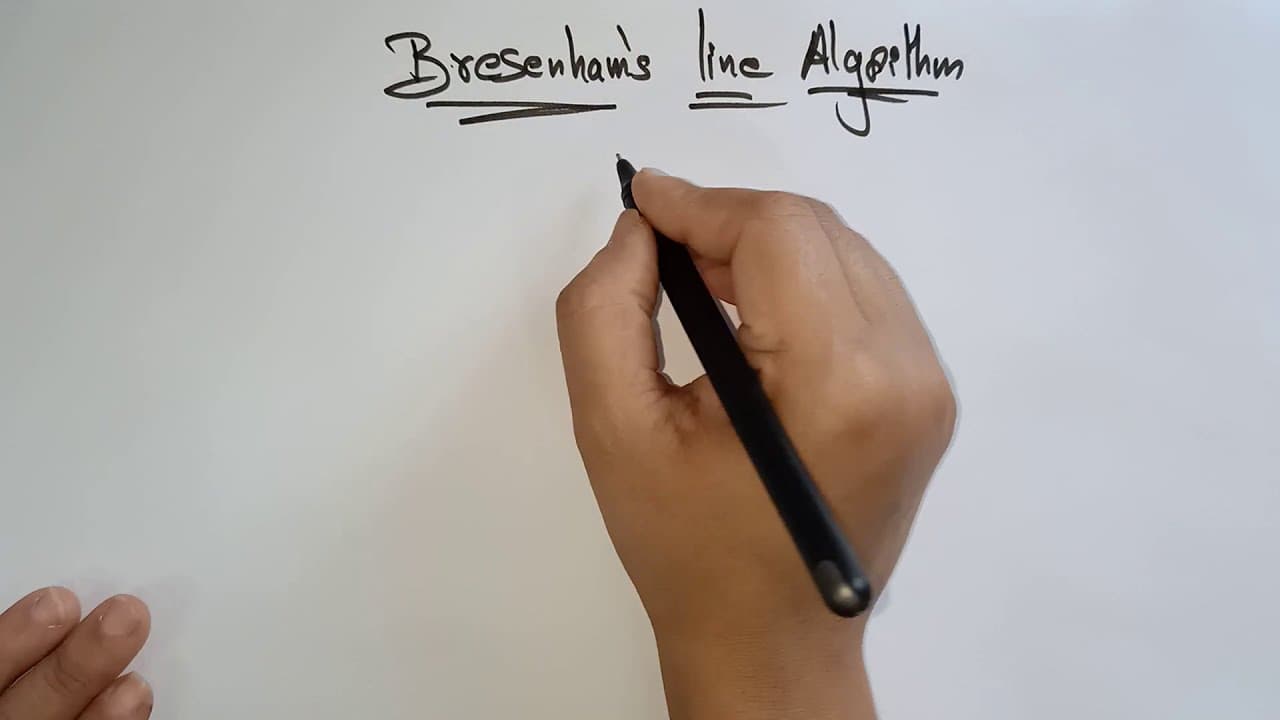
Bresenham's line algorithm finds the closest pixel positions on a raster grid to approximate a straight line between two points using only integer arithmetic. By calculating decision parameters, it determines which pixels to select, allowing for quick and efficient line rendering on screens. This approach is faster than the Digital Differential Analyzer (DDA) algorithm, making it ideal for computer graphics.
Transcript
hi students welcome back coming to the next concept in uh computer graphics is the present hams line algorithm so what is the use of this bresenham sline algorithm in the previous videos i explained about the dda one of the line algorithm is the dda the another type is the bresen hams so what exactly this brazen hamster is doing it determines let m... Read More
Key Insights
- 🫥 Bresenham's line algorithm is an essential technique in computer graphics for rendering straight lines on raster displays.
- ❓ The algorithm minimizes computational complexity by utilizing only basic integer operations, enhancing performance.
- 🫥 It approximates lines effectively using decision parameters that guide which raster points to select.
- 🫥 By using integer addition, subtraction, and multiplication, the algorithm delivers rapid line generation, ensuring smooth graphics rendering.
- ❓ Optimization in calculating decision parameters contributes significantly to the overall efficiency of the algorithm.
- ❓ Understanding the conditions of decision parameters is crucial for implementing the algorithm correctly.
- 🫥 The algorithm is versatile and can be adapted for various applications beyond line drawing, including polygon rasterization.
Install to Summarize YouTube Videos and Get Transcripts
Explore YouTube Video Summarizer or Get YouTube Transcript Extractor
Questions & Answers
Q: What is the primary purpose of Bresenham's line algorithm?
The primary purpose of Bresenham's line algorithm is to determine which points on a raster grid should be selected to create a close approximation of a straight line connecting two specified points. By calculating which pixels are closest to the theoretical line, the algorithm ensures that graphics can be rendered accurately and efficiently.
Q: How does Bresenham's algorithm differ from the Digital Differential Analyzer (DDA)?
Bresenham's algorithm differs from the DDA primarily in its approach to calculations. While DDA uses floating-point arithmetic, Bresenham's relies solely on integer arithmetic, which significantly speeds up the computation process. This makes Bresenham’s algorithm more suitable for real-time rendering scenarios in computer graphics.
Q: What are the key steps involved in applying Bresenham's line algorithm?
The key steps include calculating the differences (delta x and delta y) between the starting and ending coordinates, determining the initial decision parameter based on these differences, and then iteratively calculating subsequent points based on the decision parameter until the endpoint is reached, requiring careful observation of its values to update coordinates.
Q: Why is integer arithmetic preferred in Bresenham's algorithm?
Integer arithmetic is preferred in Bresenham's algorithm because it allows for faster calculations, reducing the processing load compared to floating-point operations. This efficiency is critical in computer graphics where rendering speed is essential, making the algorithm suitable for interactive applications like video games and computer-aided design.
Summary & Key Takeaways
-
The Bresenham's line algorithm identifies pixel positions on a raster grid to form a close approximation of a straight line between two specified points.
-
It operates using integer-based arithmetic for faster performance compared to the Digital Differential Analyzer (DDA) algorithm, allowing quick rendering of lines on screens.
-
The algorithm employs decision parameters to determine the nearest pixel positions, repeating calculations until the endpoint is reached.
Read in Other Languages (beta)
Share This Summary 📚
Summarize YouTube Videos and Get Video Transcripts with 1-Click
Try YouTube Summary with ChatGPT & Claude or YouTube Transcript Generator
Explore More Summaries from Education 4u 📚
Summarize YouTube Videos and Get Video Transcripts with 1-Click
Try YouTube Summary with ChatGPT & Claude or YouTube Transcript Generator