What Are Pass Transistors and How Do They Work in Logic Circuits?
TL;DR
Pass transistors, including NMOS and PMOS types, function as switches in digital logic circuits based on specific input voltages. Their efficiency allows for implementing logical functions with fewer transistors, but the threshold voltage can limit output swings, affecting the quality of logic levels. Understanding these factors is crucial for designing effective digital circuits.
Transcript
hi everyone in this video you are going to learn about past transistor logical cost transistor we know there are two types of pass transistor nmos transistor and pmos transistor and most transistor can be acting as a pass transistor by giving the input as 1. see here first transistor can be either nmos or pmos if nmos device is used as a pass trans... Read More
Key Insights
- 🔡 NMOS transistors conduct when given a high input, while PMOS transistors conduct upon receiving a low input.
- ⚡ Threshold voltage affects output quality, often causing voltage drops and less than ideal logic levels in practical circuits.
- 🧭 Pass transistor logic simplifies the implementation of complex logical functions with fewer components than traditional transistor logic.
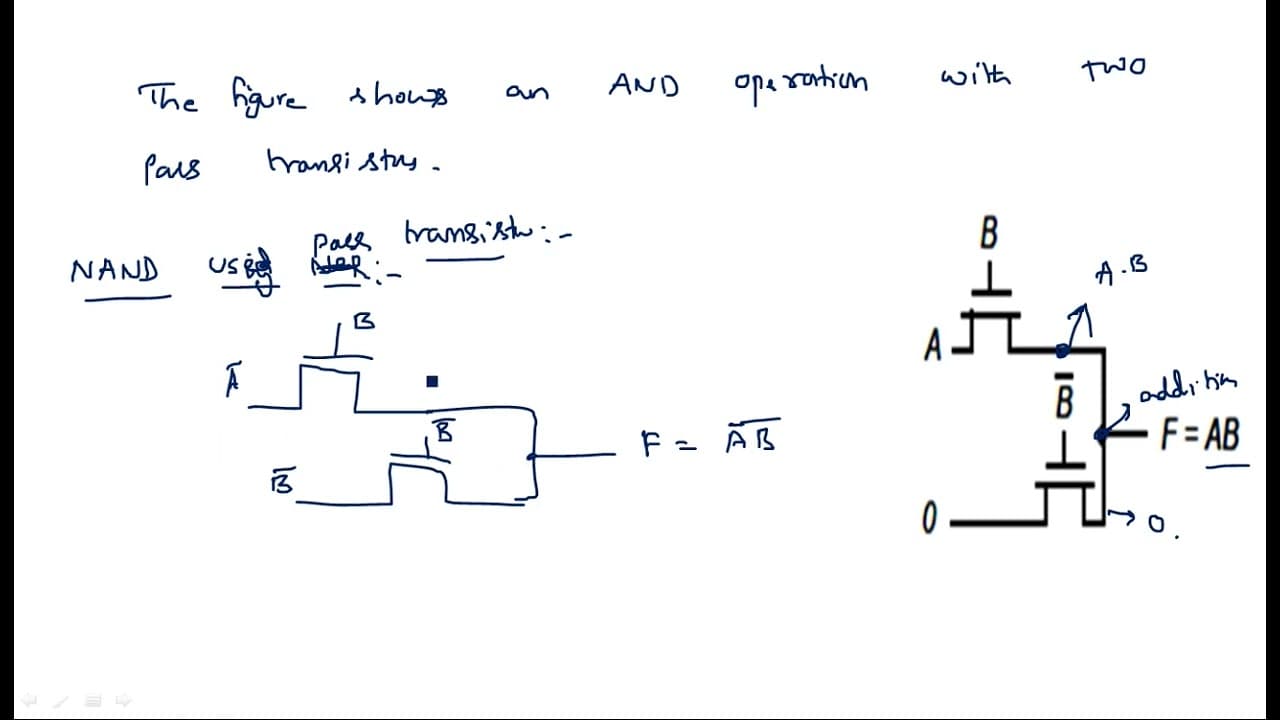
- ❓ NMOS and PMOS can be utilized in various configurations to realize fundamental operations like AND, OR, NAND, and NOR.
- 😌 The efficiency of pass transistors lies in their capacity to perform logical operations with minimal physical components.
- ⚡ In practice, the inversing logic of PMOS and NMOS transistors requires careful handling of control voltages to achieve desired outputs.
- ⚡ Understanding the voltage swing limitation is critical for the practical design of digital logic circuits.
Install to Summarize YouTube Videos and Get Transcripts
Explore YouTube Video Summarizer or Get YouTube Transcript Extractor
Questions & Answers
Q: What are the two types of pass transistors discussed in the video?
The video discusses NMOS and PMOS transistors as the two primary types of pass transistors. NMOS transistors typically turn on when the input is high (logic 1), allowing current to pass through, while PMOS transistors turn on when the input is low (logic 0). Understanding how they operate is crucial for their implementation in logical circuits.
Q: How does threshold voltage affect the output of a pass transistor?
Threshold voltage plays a significant role in determining the output of a pass transistor. For NMOS transistors, the output is often expressed as V_out equals V_in minus the threshold voltage. This indicates that the output does not equal the input and always has some voltage drop. In contrast, for PMOS transistors, the negative threshold means V_out can be expressed as V_in plus the threshold voltage, affecting the expected output in logical applications.
Q: Why are pass transistors advantageous in logical circuit design?
Pass transistors are advantageous because they can implement logical functions using fewer transistors compared to traditional methods. This leads to reduced complexity in circuit design, making them efficient for creating intricate digital logic systems. Moreover, their ability to simplify circuits allows them to occupy less space in integrated environments.
Q: Can you explain how to construct an AND operation using pass transistors?
To construct an AND operation using pass transistors, two NMOS transistors can be arranged with corresponding control inputs. By connecting these transistors appropriately - one receiving the input A and the other receiving the input B - the resulting output reflects the multiplication of the control inputs. This configuration allows the output energy only to flow through when both inputs are high, effectively implementing the AND logic.
Q: What issues can arise when using pass transistors in circuits?
One significant issue with pass transistors is the inability to achieve full voltage swing due to the presence of threshold voltage. This results in outputs that are not equal to the expected logic levels (e.g., 5V for high). Consequently, this can lead to degraded logical signals and inaccuracies in the circuit's function, especially when dealing with precise digital applications.
Q: How can an OR operation be implemented using pass transistors?
An OR operation can be implemented by arranging PMOS and NMOS transistors effectively. You can connect the respective inputs to the gates of the transistors, creating paths so that if either transistor is activated by a high logic level, the output will be high. This reflects the inclusive condition of OR logic, where the output is true if at least one input is true.
Summary & Key Takeaways
-
The video clarifies the roles of NMOS and PMOS transistors as pass transistors, detailing how their outputs depend on specific input logic levels.
-
It highlights the concept of threshold voltage, explaining how it affects the output voltage in practical applications and results in voltage swings not reaching expected levels.
-
The content guides viewers on constructing logical functions using pass transistors and emphasizes their efficiency in minimizing the number of transistors needed for implementation.
Read in Other Languages (beta)
Share This Summary 📚
Summarize YouTube Videos and Get Video Transcripts with 1-Click
Try YouTube Summary with ChatGPT & Claude or YouTube Transcript Generator