Rectangular Wave guide | Propagation of TM waves | Part-3/3 | Microwave Engineering | Lec-11
TL;DR
An explanation of TM wave propagation derivations in rectangular waveguides.
Transcript
hi everyone so from the last two videos I have been explaining the derivation of this propagation of TM Wheels in rectangular waveguide okay so we have obtained this boundary conditions one two and three in the previous video so whatever the boundary condition we have obtained that immediately needs to be submitted in the latest equation after that... Read More
Key Insights
- 👋 TM waves are characterized by a magnetic field component that is perpendicular to the direction of propagation.
- 👋 Boundary conditions play a crucial role in determining the characteristics of propagating waves in waveguides.
- 📳 The equations derived through boundary conditions reveal the relationship between waveguide dimensions and permissible frequency modes.
- 👋 Understanding the propagation of TM waves in waveguides is essential for applications in microwave engineering and telecommunications.
- 👋 The derivation process includes multiple steps where mathematical rigor is applied to extract physical insights about wave behavior.
- 👋 Using the separation of variables method aids in systematically tackling complex wave equations under defined boundary conditions.
- 👋 The interaction of electric and magnetic fields in waves illustrates fundamental principles in electromagnetism, relevant in various technologies.
Install to Summarize YouTube Videos and Get Transcripts
Explore YouTube Video Summarizer or Get YouTube Transcript Extractor
Questions & Answers
Q: What are the key boundary conditions discussed for TM waves in the rectangular waveguide?
The key boundary conditions include the condition where the electric field component, E_z, is equal to zero along specific boundaries of the rectangular waveguide. These conditions dictate the behavior of electromagnetic waves and are crucial for determining the possible modes of propagation within the waveguide.
Q: How does the fourth boundary condition influence the derivation of wave equations?
The fourth boundary condition, which states that E_z equals zero on the boundary, leads to specific eigenvalue equations when substituted into the existing wave equations. This helps to find the allowable modes of propagation by establishing the relationships between the waveguide's dimensions and the frequency of the waves propagating through it.
Q: Can you explain the significance of the constants in the derived equations?
The constants in the derived equations represent the amplitudes of the electric and magnetic fields in each mode of propagation. They play a crucial role in defining the strength and characteristics of the resultant electromagnetic wave and are determined through boundary conditions and characteristic equations based on the specific geometry of the waveguide.
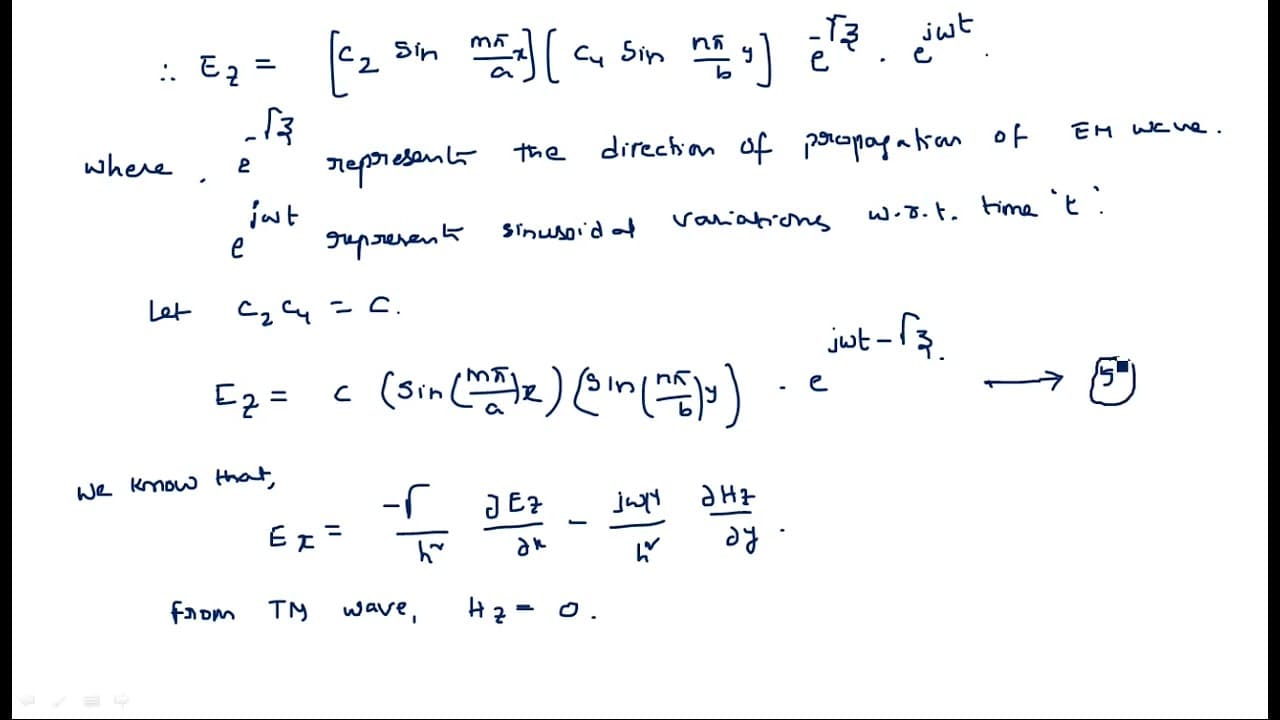
Q: What role does the equation E_z = C sine(M π/a) * sine(N π/b) play in wave propagation?
This equation describes how the electric field component E_z varies with respect to the positions X and Y within the waveguide. It encapsulates the spatial distribution of the electric field, allowing for visualization of how the TM modes behave inside the rectangular waveguide, thereby influencing wave propagation and resonance characteristics.
Summary & Key Takeaways
-
The video elaborates on the derivation process for the propagation of transverse magnetic (TM) waves in rectangular waveguides, focusing on boundary conditions and their implications on wave equations.
-
The fourth boundary condition is detailed, which specifies that the electric field component E_z equals zero along the boundary of the waveguide, influencing the wave equations to be derived subsequently.
-
Final equations for electric and magnetic field components are presented, showing a detailed analysis of how changes in boundary conditions affect wave behavior inside the waveguide.
Read in Other Languages (beta)
Share This Summary 📚
Summarize YouTube Videos and Get Video Transcripts with 1-Click
Try YouTube Summary with ChatGPT & Claude or YouTube Transcript Generator