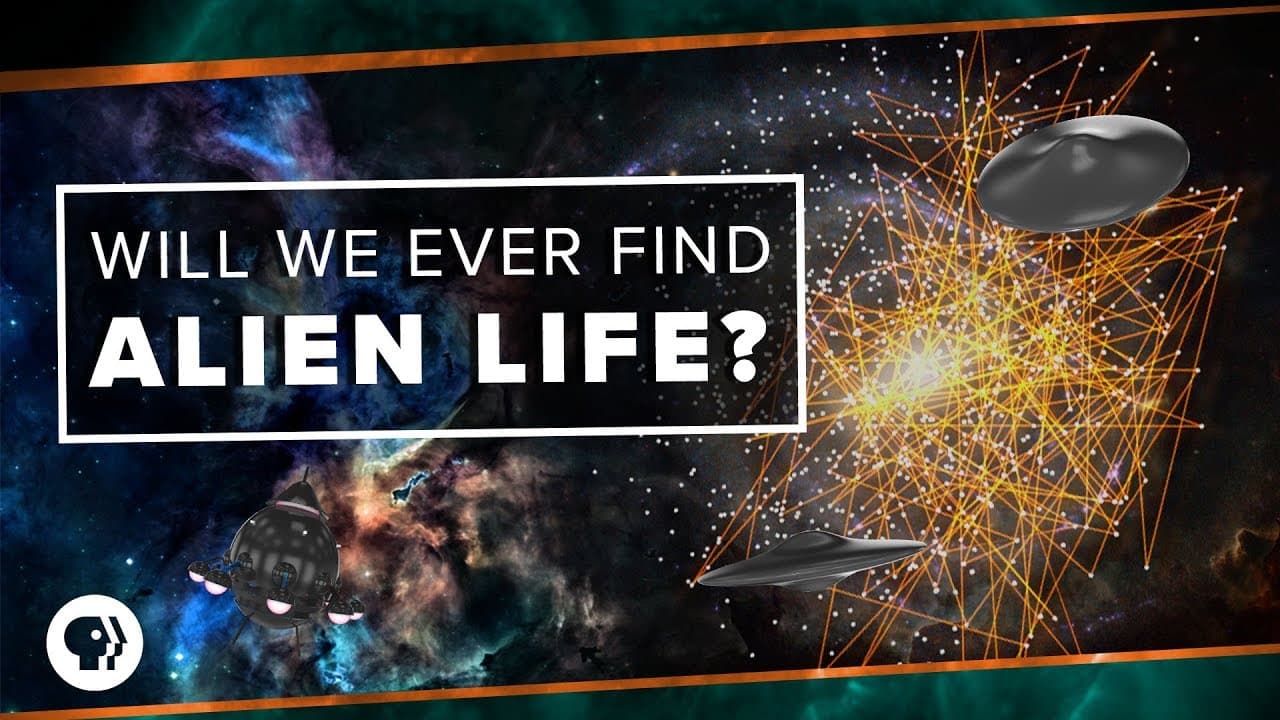
Will We Discover Alien Life in the Milky Way?
TL;DR
Despite the vast number of potentially habitable planets in the Milky Way, we have not yet detected any signs of advanced civilizations. Recent astronomical surveys suggest that while planets capable of supporting life are abundant, the development of intelligent life may be extremely rare. This absence of evidence could point to a 'great filter' that limits the emergence of technologically advanced species.
Transcript
Thanks to curiosity stream for supporting PBS Digital Studios. The Silence of the galaxy and the resulting Fermi paradox Has perplexed us for over half a century But our most recent surveys of the Milky Way Finally allow us to draw scientific conclusions about this depressingly persistent absence of aliens When Enrico Fermi uttered the words "Where... Read More
Key Insights
- The Fermi Paradox questions why we haven't detected alien civilizations despite the vast number of stars and planets.
- Recent surveys show the abundance of potentially habitable planets, yet no signs of advanced civilizations.
- The Kepler telescope has discovered over 2,600 alien worlds, indicating most stars have planets.
- The James Webb Space Telescope may help detect life by analyzing planetary atmospheres.
- A Dyson swarm could indicate advanced civilizations, but none have been detected so far.
- The Drake Equation helps estimate the number of communicative civilizations by considering various factors.
- Astronomers suggest a 'great filter' might limit the development of advanced civilizations.
- Technological civilizations might self-destruct before they can leave a mark on the galaxy.
Install to Summarize YouTube Videos and Get Transcripts
Explore YouTube Video Summarizer or Get YouTube Transcript Extractor
Questions & Answers
Q: What is the Fermi Paradox?
The Fermi Paradox refers to the apparent contradiction between the high probability of extraterrestrial life in the universe and the lack of evidence for, or contact with, such civilizations. Despite the vast number of stars and potentially habitable planets, we have not observed any signs of advanced alien life, leading to questions about why this is the case.
Q: How many habitable planets are in the Milky Way?
Astronomical surveys estimate there are approximately 40 billion potentially habitable planets in the Milky Way. These planets are rocky and situated at the right distance from their stars to potentially support liquid water, a key ingredient for life. However, the presence of life on these planets remains unconfirmed.
Q: What role does the Drake Equation play in understanding alien life?
The Drake Equation is a probabilistic formula used to estimate the number of active, communicative extraterrestrial civilizations in the Milky Way. It considers factors like star formation rates, the fraction of stars with planets, the likelihood of life developing, and the potential for intelligent life to communicate across interstellar distances. It helps frame discussions about the likelihood of finding alien life.
Q: What is a Dyson swarm and how does it relate to detecting alien civilizations?
A Dyson swarm is a hypothetical structure consisting of numerous solar power satellites orbiting a star to capture its energy. It would significantly alter the star's light output, making it detectable from Earth. Detecting such structures could indicate the presence of advanced alien civilizations, but no such evidence has been found so far.
Q: What is the 'great filter' theory?
The 'great filter' theory suggests there is a significant barrier that prevents the emergence of advanced civilizations capable of interstellar communication. This filter could be a biological or sociological factor that makes the development of intelligent life extremely rare. It might explain why we have not detected any signs of alien civilizations despite the vast number of potentially habitable planets.
Q: How might gamma-ray bursts affect the development of life?
Gamma-ray bursts are intense bursts of radiation from exploding stars that could sterilize planets by stripping away their atmospheres and causing mass extinctions. Such events could significantly hinder the development of life on affected planets, serving as a potential 'great filter' that limits the emergence of advanced civilizations in the galaxy.
Q: What are the implications of not finding alien civilizations?
The absence of detected alien civilizations could imply that intelligent life is extremely rare or that advanced civilizations tend to self-destruct before they can make their presence known. It raises questions about the factors that limit the development of advanced life and whether humanity has already surpassed such barriers or is yet to face them.
Q: Could technological civilizations self-destruct, explaining the Fermi Paradox?
Yes, one hypothesis is that technological civilizations may self-destruct due to the development of cataclysmic technologies, such as nuclear weapons or engineered viruses. This 'wacko factor' suggests that civilizations might not survive long enough to leave a detectable mark on the galaxy, contributing to the Fermi Paradox by explaining the lack of evidence for extraterrestrial life.
Summary & Key Takeaways
-
The Fermi Paradox highlights the contradiction between the high probability of extraterrestrial life and the lack of evidence for it. Recent astronomical surveys have revealed many potentially habitable planets, yet no advanced civilizations have been detected. This suggests that intelligent life may be rarer than previously thought.
-
The Kepler telescope's discoveries indicate that nearly all stars have planets, with an estimated 40 billion habitable planets in the Milky Way. However, the development of intelligent life capable of interstellar communication remains uncertain. The upcoming James Webb Space Telescope may provide more insights into the presence of life on other planets.
-
The concept of a 'great filter' suggests a significant barrier to the development of advanced civilizations. This could be a biological or sociological factor that prevents the emergence of technologically advanced species. Alternatively, civilizations may self-destruct due to access to cataclysmic technology, explaining the persistent absence of evidence for alien life.
Read in Other Languages (beta)
Share This Summary 📚
Summarize YouTube Videos and Get Video Transcripts with 1-Click
Try YouTube Summary with ChatGPT & Claude or YouTube Transcript Generator
Explore More Summaries from PBS Space Time 📚



Summarize YouTube Videos and Get Video Transcripts with 1-Click
Try YouTube Summary with ChatGPT & Claude or YouTube Transcript Generator