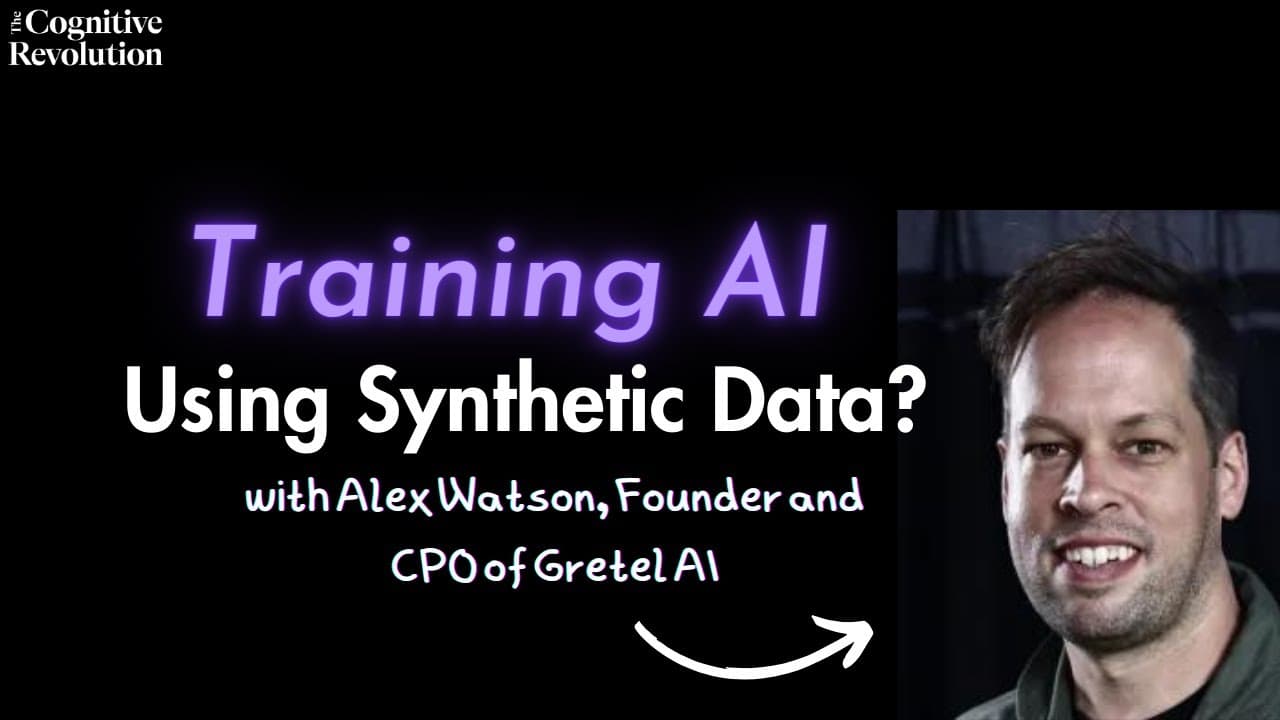
Synthetic Data with Alex Watson, Founder of Gretel AI
TL;DR
Exploring synthetic data's role in AI with Gretel AI's Alex Watson.
Transcript
your data is messy it has gaps in it I can't create new additional examples it's too expensive or there's no way to go back to it so we really focused our efforts on first and foremost helping you build better data that's been the kind of the The Guiding Light that's what we're really um aiming for you know no llm today can generate a 100,000 or a ... Read More
Key Insights
- Synthetic data is crucial for privacy and enhancing machine learning models, especially in domains with limited or sensitive data.
- Gretel AI focuses on creating synthetic data that maintains statistical realism while preserving privacy, using techniques like differential privacy.
- The new tabular LLM by Gretel AI is trained on diverse datasets to generate synthetic data on a zero-shot basis, enhancing machine learning training sets.
- Challenges in synthetic data include ensuring data quality and avoiding model memorization of sensitive information.
- Gretel AI uses a combination of LLMs and agents to handle large data generation tasks, optimizing when to use code versus LLM outputs.
- Reinforcement learning is applied to generate more diverse and representative synthetic data, addressing issues like class imbalance.
- AI regulation and privacy concerns are key considerations in synthetic data generation, with a focus on enabling safe data sharing.
- The future of AI may involve a mix of specialized models for specific tasks, rather than solely relying on large, general-purpose models.
Install to Summarize YouTube Videos and Get Transcripts
Explore YouTube Video Summarizer or Get YouTube Transcript Extractor
Questions & Answers
Q: Why is synthetic data important in AI?
Synthetic data is crucial in AI for enhancing model training, especially in domains with limited or sensitive data. It allows for the creation of additional examples to address class imbalances and improve detection, such as in rare disease datasets. Additionally, synthetic data enables data sharing while preserving privacy, making it valuable in regulated industries like healthcare.
Q: How does Gretel AI ensure synthetic data maintains statistical realism?
Gretel AI ensures statistical realism by training models to recreate real-world data distributions. They use validators to detect unrealistic outputs and employ techniques like differential privacy to prevent memorization of sensitive information. This approach allows for the generation of high-quality synthetic data that can be confidently used for analysis and machine learning training.
Q: What role does differential privacy play in synthetic data generation?
Differential privacy plays a key role in synthetic data generation by ensuring that models do not memorize sensitive information. It involves adding noise to the data during training, which prevents the model from learning specific details about individual records. This technique allows for the creation of synthetic data with mathematical guarantees of privacy, enabling safe data sharing.
Q: How does Gretel AI's tabular LLM differ from other language models?
Gretel AI's tabular LLM is specifically designed to handle tabular data, trained on diverse datasets to generate synthetic data on a zero-shot basis. Unlike traditional language models that focus on text, this LLM is optimized for mixed modality data, including numerical and categorical fields. It addresses challenges like limited context window size and provides a tailored solution for generating synthetic datasets.
Q: What challenges does synthetic data face in AI development?
Challenges in synthetic data include ensuring data quality, avoiding model memorization of sensitive information, and maintaining statistical realism. Additionally, there is a need to balance privacy concerns with the utility of synthetic data. Addressing these challenges requires advanced techniques like differential privacy and careful validation of generated data.
Q: How does Gretel AI balance privacy and data utility in synthetic data?
Gretel AI balances privacy and data utility by employing differential privacy techniques to prevent memorization of sensitive information. They focus on creating synthetic data that accurately reflects real-world distributions while ensuring privacy. This approach allows for the safe sharing of data without compromising its utility for analysis and machine learning training.
Q: What potential does synthetic data have for AI regulation and safety?
Synthetic data has significant potential for AI regulation and safety by enabling safe data sharing and preserving privacy. It provides a way to comply with regulatory requirements while still allowing for the development and training of AI models. Additionally, synthetic data can help improve model robustness and address issues like class imbalances, contributing to safer and more reliable AI systems.
Q: How might the future of AI involve specialized models rather than large general-purpose models?
The future of AI may involve a mix of specialized models for specific tasks, rather than solely relying on large, general-purpose models. Specialized models can provide more efficient and targeted solutions, addressing specific needs in areas like synthetic data generation. This approach allows for greater control and flexibility, enabling the development of AI systems that are both powerful and safe.
Summary & Key Takeaways
-
Alex Watson, founder of Gretel AI, discusses the importance of synthetic data in AI, focusing on privacy and improving machine learning models. Gretel AI's new tabular LLM generates synthetic data on a zero-shot basis, trained on diverse datasets to enhance model training. The conversation covers privacy techniques, AI regulation, and the potential of specialized models.
-
Gretel AI's synthetic data platform aims to enable data sharing while preserving privacy, using techniques like differential privacy to prevent LLM memorization of sensitive data. Watson emphasizes the role of synthetic data in addressing class imbalances and improving model robustness, with applications in healthcare and other regulated industries.
-
The episode explores the challenges and opportunities in synthetic data, including the balance between statistical realism and privacy, the impact of AI regulation, and the future of AI involving specialized models. Watson highlights the importance of user feedback in iterating Gretel AI's offerings and the potential of lightweight models compared to massive LLMs.
Read in Other Languages (beta)
Share This Summary 📚
Summarize YouTube Videos and Get Video Transcripts with 1-Click
Try YouTube Summary with ChatGPT & Claude or YouTube Transcript Generator
Explore More Summaries from Cognitive Revolution "How AI Changes Everything" 📚






Summarize YouTube Videos and Get Video Transcripts with 1-Click
Try YouTube Summary with ChatGPT & Claude or YouTube Transcript Generator