How Are Humanoid Robots Breaking Skill Barriers in AI Shocks Again, With China’s Human AI Robots, Google TurboQuant, and the OpenClaw Robot?
TL;DR
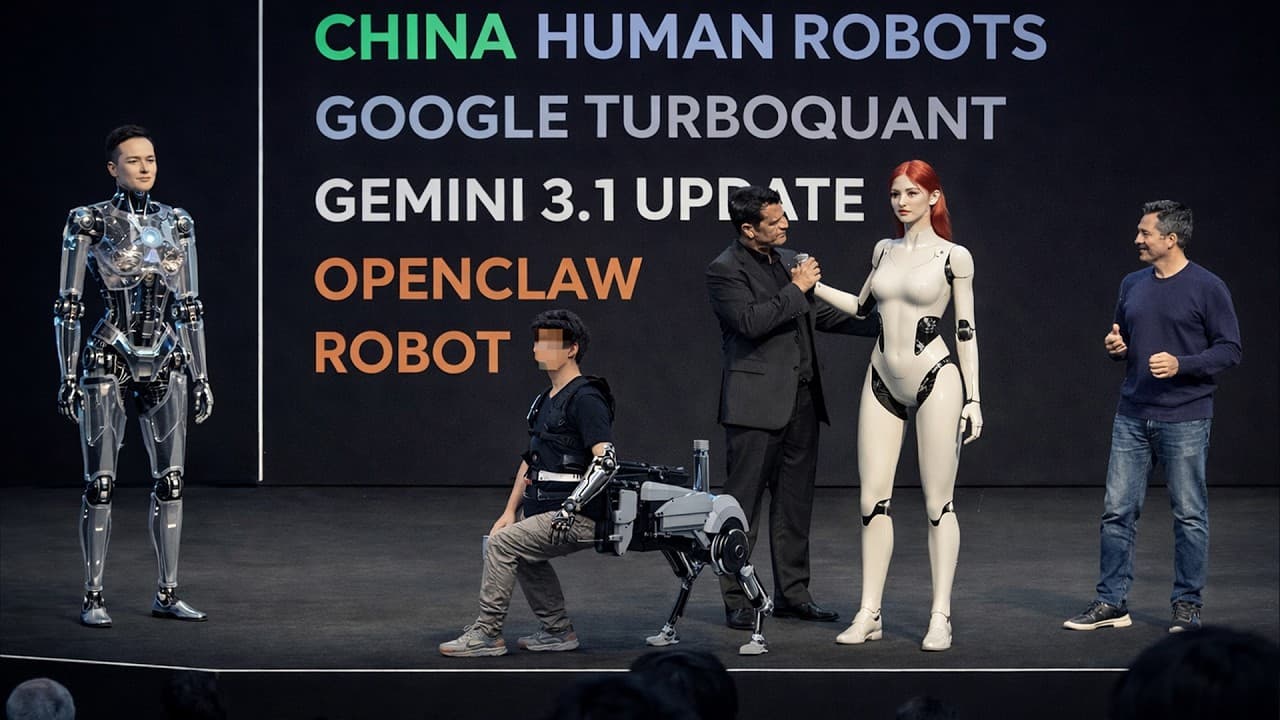
Humanoid robots are breaking skill barriers by combining custom actuators, human motion data, reinforcement learning, and hardware-aware simulation. KIST’s V0.7 runs at about 12 km/h, while a Unitree G1 trained through Leighton achieved a peak 96.5% tennis success rate. Read on to see what these demonstrations reveal about athletic performance, remote exploration, bio-hybrid movement, and deployment risks.
Transcript
AI crossed some serious lines this month. China unveiled robots that just broke the human skill barrier, dropped a one trillion parameter model that shocked open AI, and introduced a centaur robot that gives humans super strength. Sam Alman declared the death of Transformers, hinting that chat GPT's entire foundation could be getting replaced. At t... Read More
Key Insights
- KIST’s V0.7 humanoid is an athletic 75 kg robot that can run at about 12 km/h, climb steps higher than 30 cm, jump, shoot a soccer ball, and perform dance movements while appearing faster and more balanced than many conventional humanoid demonstrations.
- V0.7’s movement quality is supported by custom motors, motor drivers, gearboxes, quasi-direct drive actuation, and a compact compound planetary gearbox. Deep reinforcement learning, human motion data, and motor operating-region modeling help transfer smooth behaviors from simulation to the physical machine.
- Wanderbot is a low-cost, modular, fully 3D-printed robot that converts wind into locomotion through a Savonius turbine and Jansen linkage. Its repairable construction targets long missions in deserts, polar regions, and extraterrestrial environments where battery consumption and replacement parts create major constraints.
- Public robot deployment is vulnerable to environmental constraints that controlled demonstrations may not reveal. A restaurant service robot knocked dishes from tables after moving too close to diners, creating particular concern because boiling hot-pot containers were nearby, even though the restaurant said the robot had not malfunctioned.
- Leighton is a training system that teaches humanoid robots tennis from imperfect amateur motion data. It separates tennis into reusable actions, builds a latent action space, and combines reinforcement learning with large-scale simulation so a Unitree G1 can react to balls while retaining natural movement.
- Humanoid sprinting is approaching elite human performance in controlled demonstrations. The full-size Bolt robot reportedly reaches 10 m/s, while Unitree’s founder predicted that humanoids could eventually complete 100 meters in under 10 seconds, although balance, force, sensing, timing, and generalization remain unresolved challenges.
- Ostrobot is a fish-inspired bio-hybrid robot powered by engineered skeletal muscle tissue that trains itself through opposing contractions during development. The trained system reached 467 mm per minute and drove flexible tails more than three times faster than versions using standard muscle tissue.
- Generalization is the central obstacle for embodied AI because robots that perform polished behaviors under controlled conditions can struggle when surroundings become crowded or unpredictable. The restaurant incident and the limitations acknowledged by robotics developers show that impressive task performance does not automatically produce robust real-world operation.
Install to Summarize YouTube Videos and Get Transcripts
Explore YouTube Video Summarizer or Get YouTube Transcript Extractor
Questions & Answers
Q: How are humanoid robots breaking human skill barriers?
Researchers are combining specialized hardware, human motion data, deep reinforcement learning, and large-scale simulation to teach robots dynamic movements. KIST’s V0.7 can run, jump, kick, dance, climb large steps, and cross uneven terrain, while a Unitree G1 trained through Leighton can complete multi-shot tennis rallies.
Q: How does KIST’s V0.7 humanoid robot move naturally?
V0.7 uses high-torque motors, low gear ratios, quasi-direct drive actuation, and a custom 3K compound planetary gearbox for fast, smooth reactions. Deep reinforcement learning, human motion data, and motor operating-region modeling help transfer natural-looking behaviors from simulation to the physical robot.
Q: What can KIST’s V0.7 humanoid robot do?
The 75 kg humanoid can run across a soccer pitch, jump, shoot on goal, moonwalk, and climb steps over 30 cm high. It runs at about 12 km/h on flat ground and can handle uneven terrain using proprioception without depending on cameras.
Q: How does Wanderbot move using wind power?
Wanderbot captures wind through a Savonius turbine and converts it into walking motion with a Jansen linkage. The design addresses missions where movement alone can consume around 20% of a robotic system’s battery.
Q: Why is Wanderbot fully 3D printed and modular?
Its low-cost, modular construction is intended to make repairs practical in deserts, polar regions, and extraterrestrial settings. Broken components could theoretically be replaced on site instead of requiring an expensive resupply mission, although the prototype still needs effective turning control.
Q: How did Leighton teach a Unitree G1 to play tennis?
Researchers divided tennis into reusable actions such as forehands, backhands, shuffles, and crossover steps. They collected about five hours of amateur motion data, created a latent action space, and used reinforcement learning with large-scale simulation to train reactive, natural movement.
Q: How successful was the Unitree G1 at robotic tennis?
The Unitree G1 completed multi-shot rallies with people from forecourt and backcourt positions. Across 10,000 trials, it reached a peak 96.5% success rate, though it still relied on motion capture during real-world operation and was not ready for full competitive play.
Q: Why do impressive robot demonstrations not guarantee safe public deployment?
Controlled demonstrations do not fully represent unpredictable public environments. At a hot-pot restaurant, a service robot moved too close to diners and knocked dishes from tables, raising particular concern because boiling hot-pot containers were nearby, even though the restaurant said the robot had not malfunctioned.
Summary & Key Takeaways
-
Definition: KIST’s V0.7 is an athletic humanoid combining custom actuators, learning-based control, and human motion data for smoother movement.
-
Number: V0.7 weighs about 165 lbs or 75 kg and stands around 5'5.
-
Number: V0.7 runs at about 12 km/h on flat ground and climbs steps over 30 cm high.
-
Tool: A custom 3K compound planetary gearbox provides substantial reduction in a compact single-stage design.
-
Number: V0.7’s knee actuator reaches 320 Newton meters of peak torque.
-
Definition: Wanderbot converts wind into walking motion through a Savonius turbine and Jansen linkage.
-
Number: Movement consumes around 20% of the battery in many robotic systems.
-
Tool: Wanderbot’s modular, fully 3D-printed construction could allow broken parts to be replaced on site.
-
Number: Leighton used about five hours of amateur motion data to teach reusable tennis movements.
-
Number: A Unitree G1 achieved a peak 96.5% success rate across 10,000 trials.
-
Compare: Ostrobot swam more than three times faster with trained engineered muscle tissue than versions using standard muscle tissue.
-
Definition: Public deployment remains difficult because robots that perform well in controlled demonstrations can still struggle around unpredictable people and objects.
Read in Other Languages (beta)
Share This Summary 📚
Summarize YouTube Videos and Get Video Transcripts with 1-Click
Try YouTube Summary with ChatGPT & Claude or YouTube Transcript Generator
Explore More Summaries from AI Revolution 📚




Summarize YouTube Videos and Get Video Transcripts with 1-Click
Try YouTube Summary with ChatGPT & Claude or YouTube Transcript Generator