Analogy instructions & movement coordination
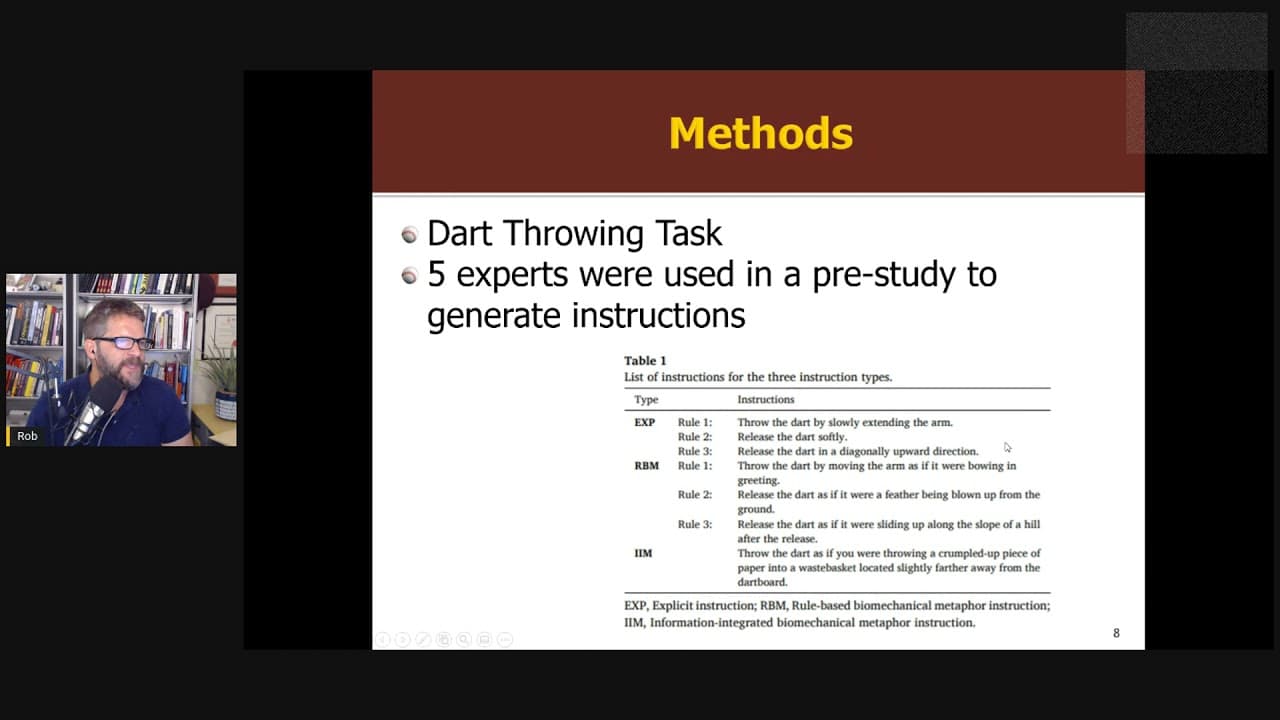
TL;DR
Analogy-based learning may improve movement skills and joint coordination.
Transcript
hi everyone this is rob gray from asu in the perception in action podcast back with another article review today i want to look at the topic of learning by analogy and this is something i covered way back in episode 16 for the first time and again i talked a little bit about some more recent research in episode 146. for those that don't know learni... Read More
Key Insights
- Learning by analogy uses metaphors to teach movement skills, potentially simplifying instructions and reducing cognitive load.
- The study contrasts rule-based and integrated analogy instructions with explicit instructions to assess effectiveness in skill acquisition.
- Rule-based analogy involves separate metaphors for each movement, while integrated analogy uses a single metaphor for the entire movement.
- Integrated analogy instruction showed potential benefits in reducing errors and improving joint coordination in novice dart learners.
- The research highlights the need for detailed analysis of instructional methods beyond broad comparisons of analogy versus explicit instructions.
- Joint coordination analysis showed changes only in the integrated analogy group, suggesting potential benefits in movement efficiency.
- The study's design included pre-tests, training, and transfer tests to evaluate performance and coordination changes.
- Further research is needed to assess the functional benefits of joint coordination changes observed in the integrated analogy group.
Install to Summarize YouTube Videos and Get Transcripts
Explore YouTube Video Summarizer or Get YouTube Transcript Extractor
Questions & Answers
Q: What is learning by analogy?
Learning by analogy is a method of teaching movement skills using metaphors instead of explicit instructions. This approach aims to simplify the learning process by reducing cognitive demands, allowing learners to grasp complex movements through relatable imagery or analogies, such as imagining reaching for a cookie jar to teach a basketball free throw.
Q: What was the study's main focus?
The study focused on comparing the effectiveness of different types of analogy instructions—rule-based and integrated—with explicit instructions in teaching movement skills. It aimed to assess how these instructional methods affect performance and joint coordination in novice dart learners, providing insights into the benefits of analogy-based learning.
Q: What are rule-based and integrated analogy instructions?
Rule-based analogy instructions use separate metaphors for each part of a movement, providing distinct imagery for different actions. Integrated analogy instructions, on the other hand, use a single metaphor to convey the entire movement, aiming to simplify the learning process by encapsulating all necessary actions within one cohesive image.
Q: What were the study's findings on performance and coordination?
The study found potential benefits of integrated analogy instruction in reducing errors and improving joint coordination. Although performance improvements were not definitive, the integrated analogy group showed significant changes in joint coordination, suggesting enhanced movement efficiency compared to rule-based and explicit instruction groups.
Q: Why is detailed analysis of instructional methods important?
Detailed analysis of instructional methods is crucial to understand the specific effects of different teaching approaches on learning and coordination. Moving beyond broad comparisons of analogy versus explicit instructions allows researchers to identify the elements that contribute to effective skill acquisition and refine instructional strategies for better outcomes.
Q: What were the limitations of the study?
The study's limitations included the lack of a pure control group, which could have helped interpret the results more accurately. Additionally, while joint coordination changes were observed, further research is needed to assess their functional benefits and determine how these changes contribute to improved performance in practical settings.
Q: How did the study measure joint coordination changes?
The study measured joint coordination changes by analyzing the joint angles of the wrist, elbow, and shoulder during dart throwing. It used principal components analysis to calculate covariance and assess coordination patterns, focusing on variations in joint movements and their impact on performance across different instructional methods.
Q: What are the implications of the study for skill acquisition research?
The study's implications for skill acquisition research include the potential benefits of integrated analogy instruction in improving performance and coordination. It highlights the need for more nuanced analyses of instructional methods, encouraging researchers to explore the specific elements that contribute to effective learning and refine teaching strategies accordingly.
Summary & Key Takeaways
-
Learning by analogy involves teaching movement skills through metaphors instead of explicit instructions, potentially reducing cognitive demands. The study compares rule-based and integrated analogy instructions with explicit instructions to assess their effectiveness in skill acquisition and joint coordination among novice dart learners.
-
The study found that integrated analogy instruction may improve performance and joint coordination, although results were not definitive. The research emphasizes the need for detailed analysis of instructional methods, moving beyond simple comparisons of analogy versus explicit instructions to understand their specific effects on learning and coordination.
-
Joint coordination analysis showed significant changes only in the integrated analogy group, suggesting potential benefits in movement efficiency. Despite some performance improvements, the study calls for further research to assess the functional benefits of observed coordination changes and to refine instructional methods for better skill acquisition.
Read in Other Languages (beta)
Share This Summary 📚
Summarize YouTube Videos and Get Video Transcripts with 1-Click
Try YouTube Summary with ChatGPT & Claude or YouTube Transcript Generator
Explore More Summaries from Rob Gray 📚
Summarize YouTube Videos and Get Video Transcripts with 1-Click
Try YouTube Summary with ChatGPT & Claude or YouTube Transcript Generator