What Is Direct Learning in Perceptual Learning?
TL;DR
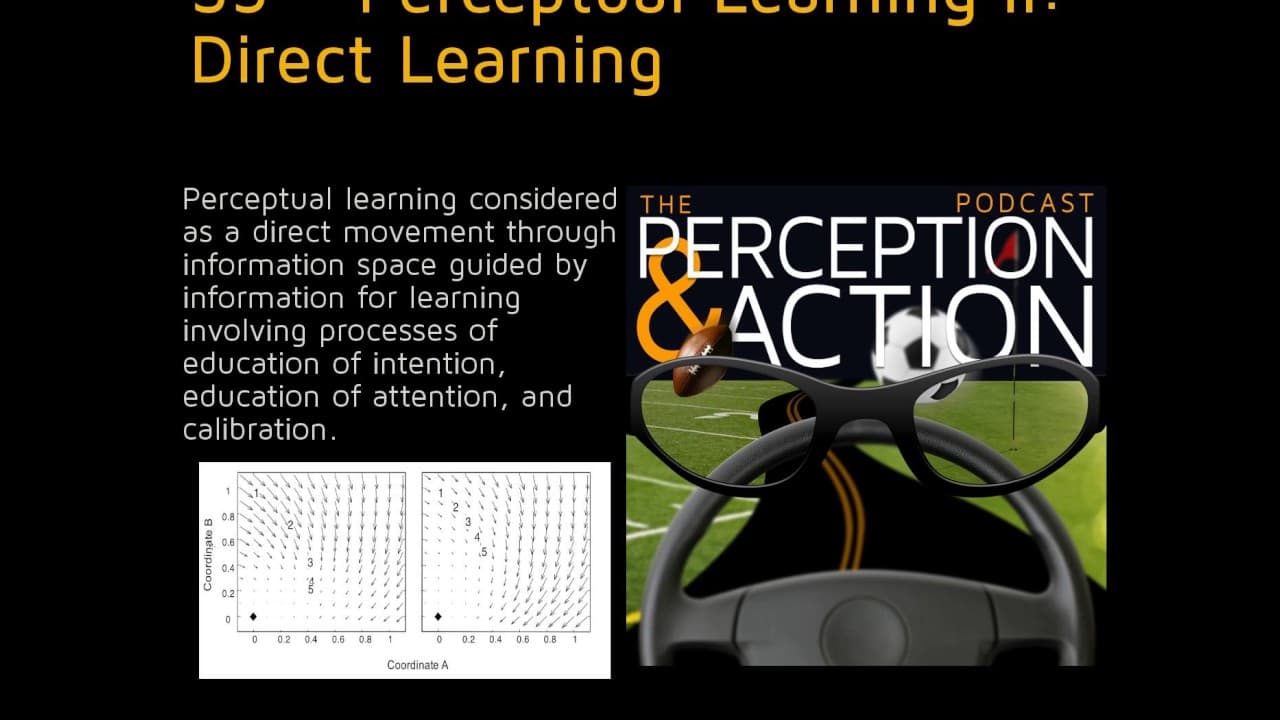
Direct learning is a theory suggesting that perceptual learning occurs through direct movement in information space, guided by available environmental information. It involves processes such as education of intention, education of attention, and calibration, without the need for cognitive enrichment or inference. This approach emphasizes the role of constraints and the environment in shaping perceptual learning.
Transcript
today on the perception and action podcast a look at the theory of direct learning considering perceptual learning as a direct movement through information space Guided by information for learning so it's time for a call to action hi everyone this is Rob Gray from Arizona State University and perception action.com welcome to the perception and acti... Read More
Key Insights
- Direct learning theory posits that perceptual learning is a direct process guided by environmental information.
- The theory emphasizes the role of constraints in shaping perceptual learning, both universal and local.
- Education of intention involves changing the action a learner intends to perform, altering perceptual information needs.
- Education of attention involves focusing on more useful informational variables without changing the intended action.
- Calibration involves changing the relationship between perceptual information and action, such as adjusting swing timing in baseball.
- Information space is a conceptual tool where learning involves moving through a space of perceptual variables.
- Information for learning is the perceptual information that indicates how nonoptimal performance can be reduced.
- Restricting conditions in practice can impair learning by making non-specified variables appear useful.
Install to Summarize YouTube Videos and Get Transcripts
Explore YouTube Video Summarizer or Get YouTube Transcript Extractor
Questions & Answers
Q: What is direct learning in perceptual learning?
Direct learning in perceptual learning is a theory suggesting that learning occurs through a direct movement in information space, guided by environmental information. It involves processes such as education of intention, education of attention, and calibration, without requiring cognitive enrichment or inference. This theory emphasizes the role of constraints and the environment in shaping how learners become attuned to optimal perceptual information for a task.
Q: How does education of intention differ from education of attention?
Education of intention involves changing the action a learner intends to perform, which alters the perceptual information needed. For example, a baseball player might change their swing to hit the ball in the air rather than on the ground. Education of attention, on the other hand, involves focusing on more useful informational variables for the same intended action, such as a batter using the rate of expansion of the ball rather than its size.
Q: What is the role of constraints in direct learning?
Constraints play a crucial role in direct learning by shaping the learning process. Universal constraints, like gravity, affect learning on a long-term evolutionary scale, while local constraints, such as task-specific rules, affect learning more immediately. Learning involves adapting to these constraints, which guide the movement through information space and help learners become attuned to useful perceptual variables.
Q: How does information for learning guide perceptual learning?
Information for learning is perceptual information that specifies how nonoptimal performance can be reduced. It indicates the difference between the currently used perceptual variable and the optimal one, guiding learners on the required path through information space. This information helps learners adjust their focus and actions to improve performance, without needing cognitive enrichment or inference.
Q: What is the significance of information space in direct learning?
Information space is a conceptual tool in direct learning theory, representing a space of perceptual variables. Each point in this space combines variables to form higher-order properties. Learning involves moving continuously through this space to find variables with high usefulness for a task. This movement is guided by information for learning and is shaped by constraints, allowing learners to become attuned to optimal perceptual information.
Q: How can practice conditions affect perceptual learning?
Practice conditions can significantly affect perceptual learning. Restricting conditions to make non-specified variables appear useful can impair learning, as learners may not educate their attention to more useful variables. Conversely, making these variables completely useless can enhance learning by highlighting their ineffectiveness. Careful design of practice conditions is crucial to facilitate effective perceptual learning and ensure learners become attuned to the most useful perceptual information.
Q: What are the practical implications of direct learning theory for coaching?
Direct learning theory has important implications for coaching, emphasizing the need to carefully design practice conditions. Coaches should avoid making non-specified variables appear useful by restricting conditions. Instead, they might make these variables even more useless than in reality to enhance learning. This approach helps learners educate their attention to more useful specifying variables, improving their perceptual learning and performance in actual game situations.
Q: How are perception and learning related in direct learning theory?
In direct learning theory, perception and learning are highly related phenomena, occurring on different time scales. Perception involves picking up information directly from the environment, while learning involves moving through information space to become attuned to optimal perceptual variables. Both processes are guided by environmental information and shaped by constraints, suggesting they might be best thought of as a single process with learning as an extension of perception.
Summary & Key Takeaways
-
Direct learning theory, proposed by David Jacobs, suggests that perceptual learning occurs through direct movement in an information space, guided by available environmental information. This process involves education of intention, education of attention, and calibration, emphasizing the role of constraints in shaping learning. The theory challenges the need for cognitive enrichment or inference in perceptual learning.
-
In direct learning, constraints play a crucial role, with universal constraints being long-term and local constraints being task-specific. Learning involves adapting to these constraints and moving through information space to find useful perceptual variables. Errors and nonoptimal performance drive this movement, guided by information for learning.
-
Research shows that restricting practice conditions can impair learning by making non-specified variables appear useful. Conversely, making these variables completely useless can enhance learning. The theory suggests that perception and learning might be highly related, occurring on different time scales, and highlights the importance of designing practice conditions carefully to facilitate effective perceptual learning.
Read in Other Languages (beta)
Share This Summary 📚
Summarize YouTube Videos and Get Video Transcripts with 1-Click
Try YouTube Summary with ChatGPT & Claude or YouTube Transcript Generator
Explore More Summaries from Rob Gray 📚
Summarize YouTube Videos and Get Video Transcripts with 1-Click
Try YouTube Summary with ChatGPT & Claude or YouTube Transcript Generator