How to Apply Biological Motion in Sports
TL;DR
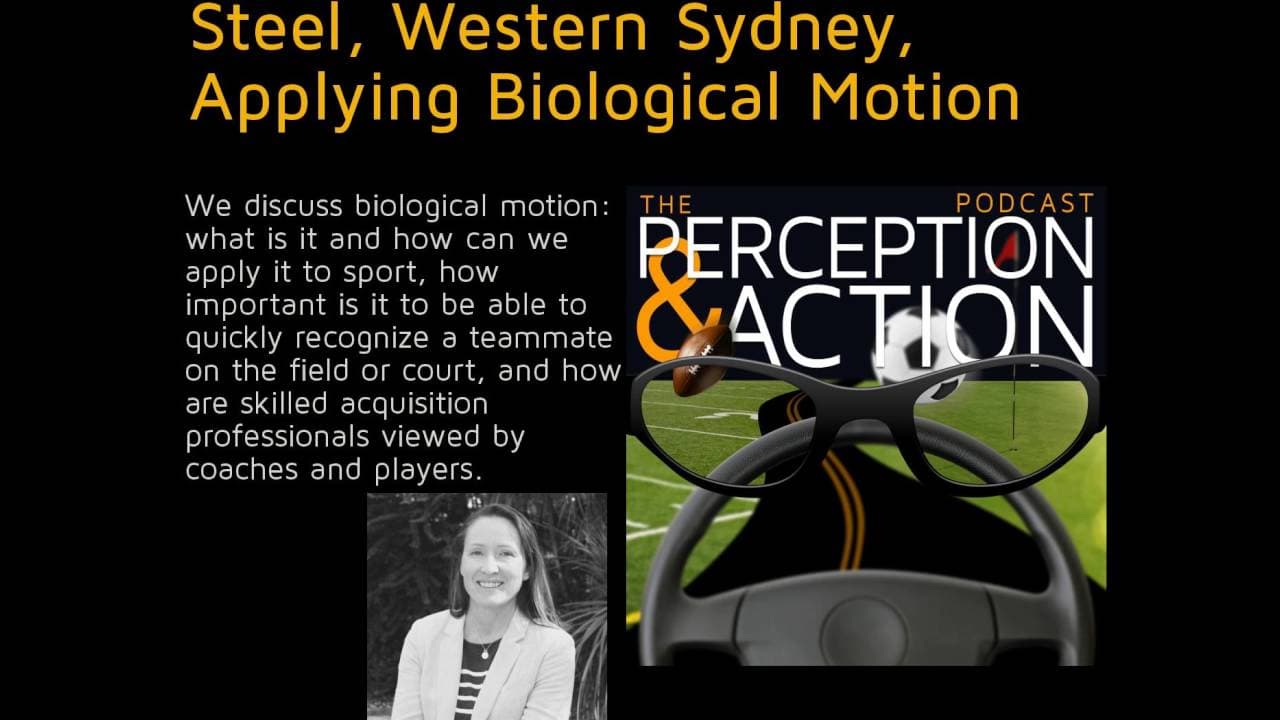
Biological motion refers to the movement patterns of living organisms, particularly humans. Understanding these patterns can help athletes quickly recognize teammates on the field, improving decision-making and performance. The research also explores the effectiveness of compression garments in enhancing athletic skills and how skill acquisition specialists are perceived in sports settings.
Transcript
this is Rob Gray from ASU and perception action.com today on the perception and action podcast my interview with Kylie steel senior lecturer in the school of science and health at Western Sydney University in Australia hi everyone welcome to the perception and action podcast where I discuss how psychological research can be applied to improving per... Read More
Key Insights
- Biological motion is the movement of living organisms and provides extensive information about identity, intention, and emotion.
- Athletes can recognize teammates based on motion patterns, even without uniforms, aiding quick decision-making in sports.
- Compression garments may enhance performance by providing proprioceptive feedback, though their effectiveness varies by fit and athlete experience.
- Skill acquisition specialists are often misunderstood as skills coaches, leading to potential conflicts with traditional coaching roles.
- Training athletes to recognize biological motion patterns can improve their ability to make quick decisions in high-pressure situations.
- Video self-modeling can be an effective, non-invasive method for improving motor skills in rehabilitation settings.
- Perceptual cognitive tests could enhance talent identification by assessing learning capacity and decision-making under pressure.
- The effectiveness of compression garments might depend on the specific movements and the fit of the garment.
Install to Summarize YouTube Videos and Get Transcripts
Explore YouTube Video Summarizer or Get YouTube Transcript Extractor
Questions & Answers
Q: What is biological motion and how is it applied in sports?
Biological motion refers to the movement patterns of living organisms, particularly humans. In sports, understanding these patterns helps athletes quickly identify teammates based on motion alone, improving decision-making and reducing errors like passing to the wrong team. Training can enhance this ability, making it a valuable skill for high-pressure situations.
Q: How do compression garments affect athletic performance?
Compression garments can enhance athletic performance by providing proprioceptive feedback, which helps athletes sense their body position and movement. Proper fit is crucial, as garments that are too loose may not provide the same benefits. Research indicates they may improve balance and certain skills, though effects can vary based on the athlete's experience and the specific movement.
Q: What challenges do skill acquisition specialists face in sports?
Skill acquisition specialists often face challenges due to misunderstandings about their role. They are sometimes confused with skills coaches, leading to potential conflicts with traditional coaching roles. Their work focuses on improving athletes' learning and decision-making abilities, but integrating their expertise into teams can be difficult without clear communication about their distinct contributions.
Q: Can athletes be trained to recognize biological motion patterns?
Yes, athletes can be trained to recognize biological motion patterns, which can improve their ability to make quick decisions in sports. Training involves exposing athletes to motion patterns repeatedly, allowing them to identify teammates based on movement alone. This skill is particularly valuable in fast-paced sports where quick decision-making is crucial.
Q: What is video self-modeling and how is it used in rehabilitation?
Video self-modeling involves recording an individual's best performance of a task and having them watch the video to improve their skills. In rehabilitation, this technique can enhance motor skills by providing a visual model of successful performance. It's a non-invasive, easily accessible method that can be used with minimal training, making it ideal for various therapeutic settings.
Q: How are perceptual cognitive tests used in talent identification?
Perceptual cognitive tests assess an individual's ability to learn skills and make decisions under pressure, providing a more comprehensive evaluation of talent than physical attributes alone. These tests can predict an athlete's potential for skill acquisition and adaptability, offering a new dimension to talent identification processes in sports.
Q: What role do compression garments play in skill learning?
Compression garments may aid skill learning by providing additional sensory feedback, which can enhance proprioception and movement awareness. This feedback could be particularly beneficial for novices who are still developing their motor skills. However, for experienced athletes, the additional information might sometimes be overwhelming, potentially hindering performance.
Q: What future research is being conducted on biological motion?
Future research on biological motion includes exploring its applications in military settings to reduce friendly fire incidents and further training studies to enhance athletes' recognition abilities. Researchers are also investigating the potential of using perceptual cognitive tests for talent identification and the effectiveness of video self-modeling in various rehabilitation contexts.
Summary & Key Takeaways
-
Biological motion involves understanding the movement patterns of living organisms, which can convey information about identity and intent. Athletes who can recognize these patterns may make quicker decisions in sports. Research also examines the role of compression garments in enhancing performance.
-
Skill acquisition specialists focus on improving athletes' learning and decision-making skills, but their roles are often misunderstood as overlapping with traditional coaching duties. This misunderstanding can hinder their integration into sports teams.
-
Video self-modeling is a promising technique for improving motor skills in rehabilitation, offering a simple, non-invasive approach. Perceptual cognitive tests could revolutionize talent identification by focusing on cognitive and learning abilities rather than physical attributes alone.
Read in Other Languages (beta)
Share This Summary 📚
Summarize YouTube Videos and Get Video Transcripts with 1-Click
Try YouTube Summary with ChatGPT & Claude or YouTube Transcript Generator
Explore More Summaries from Rob Gray 📚
Summarize YouTube Videos and Get Video Transcripts with 1-Click
Try YouTube Summary with ChatGPT & Claude or YouTube Transcript Generator