How to Use Tau in Sports Movement Control
TL;DR
Tau and tau-dot are key variables in controlling movement in sports. They help athletes determine time to contact and adjust their speed accordingly without needing to estimate distances or velocities. Understanding and applying these concepts can improve athletic performance by enabling precise movement control.
Transcript
hi everyone this is rob gray from asu in the perception action podcast um in this little video what i want to do is do start something that is going to be a little bit of a series i think from videos in the podcast and that is talking about information what is specifying information and more particularly how do we know what the specifying informati... Read More
Key Insights
- Tau is a variable representing time to contact, derived from visual angles rather than distance or speed.
- Tau-dot is the rate of change of tau, indicating how quickly time to contact is decreasing.
- Athletes use tau and tau-dot to control their movement speed without explicit calculations.
- Direct perception theory suggests that the brain directly detects these variables, not through explicit cognitive processes.
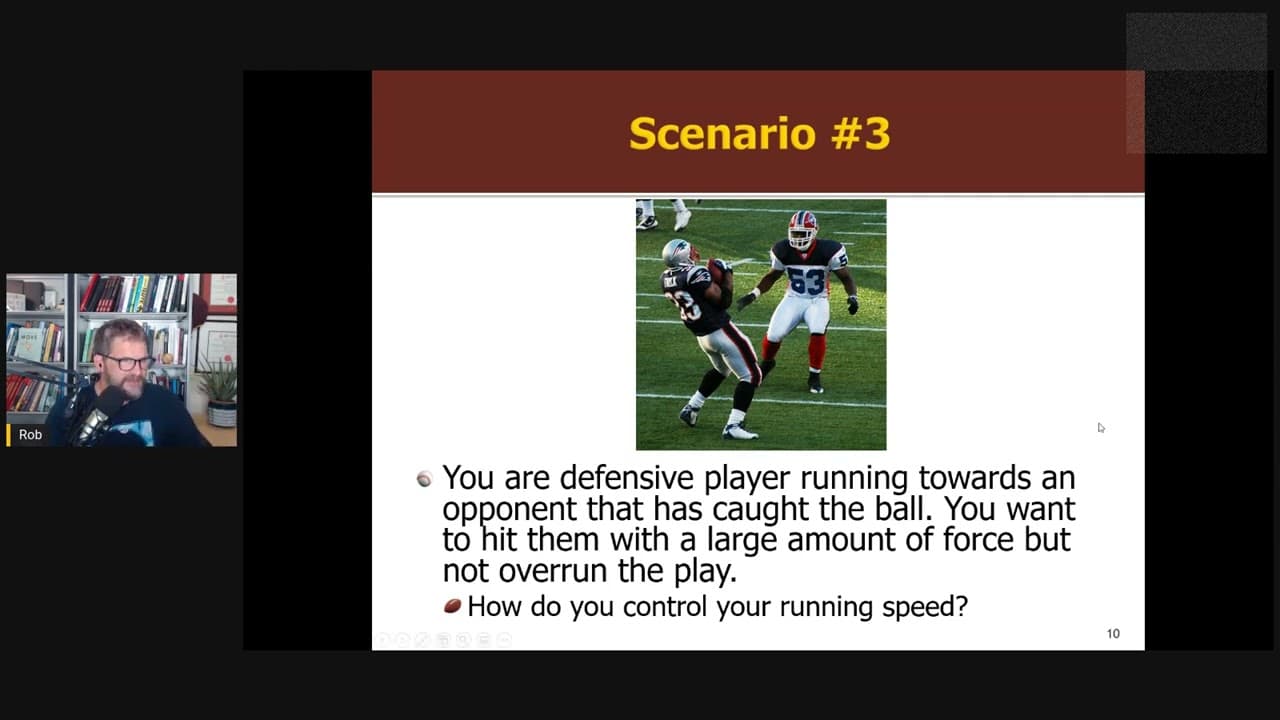
- Control laws based on tau-dot help athletes achieve specific goals, like stopping before contact or delivering force.
- Experience and environmental context can adjust tau-dot values to refine movement strategies.
- Specifying information, like tau, is critical for effective coaching and practice design.
- Coaches should create variable practice environments to help athletes attune to specifying information.
Install to Summarize YouTube Videos and Get Transcripts
Explore YouTube Video Summarizer or Get YouTube Transcript Extractor
Questions & Answers
Q: How do athletes use tau to control movement?
Athletes use tau, a variable representing time to contact, to control their movement by determining how much time they have before making contact with an object or opponent. This allows them to adjust their speed and strategy without needing explicit measurements of distance or speed, relying instead on visual angles.
Q: What is tau-dot in sports movement?
Tau-dot is the rate of change of tau, indicating how quickly the time to contact is decreasing. It helps athletes adjust their speed to achieve specific goals, such as stopping before contact or delivering force. By coupling their velocity with tau-dot, athletes can fine-tune their movements based on the desired outcome.
Q: Why is specifying information important for athletes?
Specifying information, like tau and tau-dot, is crucial for athletes because it provides the necessary data to control movements effectively. These variables allow athletes to make real-time adjustments without relying on explicit cognitive processes, leading to improved performance and decision-making in dynamic sports environments.
Q: How can coaches help athletes attune to specifying information?
Coaches can help athletes attune to specifying information by creating practice environments that incorporate variability and constraints. This encourages athletes to develop transferable control laws and avoid non-transferable strategies. By focusing on tau and tau-dot, athletes can learn to adjust their movements based on real-time information.
Q: What role does experience play in using tau and tau-dot?
Experience plays a significant role in using tau and tau-dot, as it allows athletes to refine their control laws based on past encounters and environmental context. By adjusting tau-dot values, athletes can optimize their movement strategies, such as deciding when to deliver force or when to stop before contact.
Q: Can tau and tau-dot be explicitly taught to athletes?
Tau and tau-dot cannot be explicitly taught to athletes in a cognitive sense. Instead, athletes learn to use these variables through experience and practice, developing an implicit understanding of how to couple their movements with specifying information to achieve desired outcomes in sports.
Q: What is the relationship between tau and visual perception?
Tau is closely related to visual perception, as it is derived from visual angles rather than explicit measurements of distance or speed. This aligns with the theory of direct perception, which posits that the brain detects specifying information like tau directly, enabling athletes to make real-time adjustments in their movements.
Q: How does tau-dot influence athletic performance?
Tau-dot influences athletic performance by providing a measure of how quickly the time to contact is decreasing, allowing athletes to adjust their speed and strategy accordingly. By coupling their velocity with tau-dot, athletes can achieve precise outcomes, such as stopping before contact or delivering impactful hits, enhancing their overall performance.
Summary & Key Takeaways
-
Tau and tau-dot are essential for athletes to control movement by determining time to contact. Athletes rely on these variables to adjust speed and achieve goals without needing explicit distance or speed measurements. This approach aligns with direct perception theory, suggesting the brain detects these variables directly.
-
Coaches can enhance athlete performance by designing practice environments that encourage attunement to specifying information like tau. This involves using variability and constraints to develop transferable control laws, avoiding overly restricted practice scenarios.
-
Understanding and applying tau and tau-dot in sports can lead to improved movement control and decision-making. By coupling movement speed with tau-dot, athletes can achieve precise outcomes, such as stopping before contact or delivering impactful hits, based on their goals and experience.
Read in Other Languages (beta)
Share This Summary 📚
Summarize YouTube Videos and Get Video Transcripts with 1-Click
Try YouTube Summary with ChatGPT & Claude or YouTube Transcript Generator
Explore More Summaries from Rob Gray 📚
Summarize YouTube Videos and Get Video Transcripts with 1-Click
Try YouTube Summary with ChatGPT & Claude or YouTube Transcript Generator