How Does Peripheral Immune Tolerance Work?
TL;DR
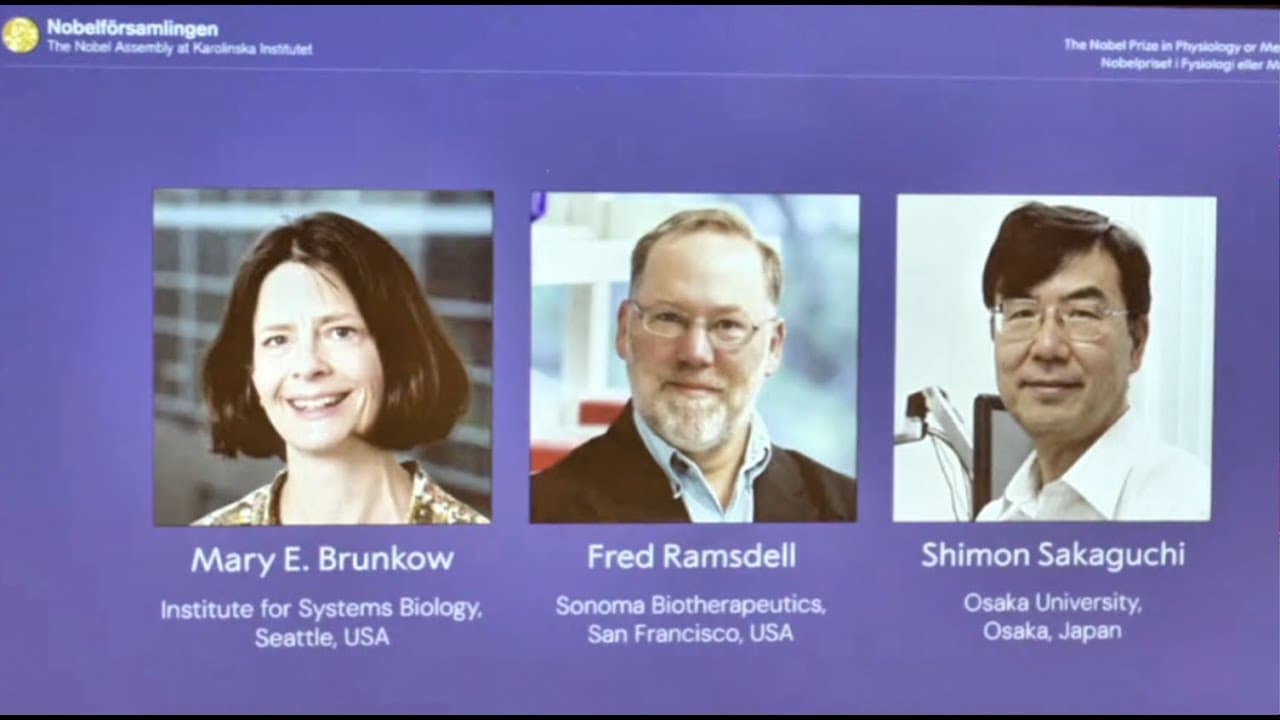
Peripheral immune tolerance is maintained by FOXP3-dependent regulatory T cells, which restrain harmful self-reactive T cells that escape elimination in the thymus. The discoveries of Mary E. Brunkow, Fred Ramsdell, and Shimon Sakaguchi established this mechanism and opened paths toward treatments that increase regulatory T-cell activity in autoimmune disease and transplantation or reduce it in cancer.
Transcript
ladies and gentlemen good morning and you're so welcome for the announcement of this year's Nobel Prize in physiology or medicine my name is Thomas Perlman and I'm the secretary general of the Nobel Assembly I will first read the announcement in Swedish followed by English we will then as usual present some background to the prize and open up for q... Read More
Key Insights
- Peripheral immune tolerance is the process that keeps potentially harmful self-reactive T cells under control after they escape elimination in the thymus. It complements central tolerance and helps the immune system fight microbes without causing autoimmune diseases such as type 1 diabetes, multiple sclerosis, and rheumatoid arthritis.
- T-cell receptor diversity is necessary for recognizing existing and future microbes, but it also makes self-reactivity unavoidable. Among the billions of receptors with different shapes, some recognize proteins and structures in the body, creating cells that can become harmful if they are not adequately controlled.
- Central tolerance is a test conducted in the thymus that eliminates harmful self-reactive T cells generated early in life. This process was once believed to provide all self-tolerance, but some potentially dangerous self-reactive cells survive and enter circulation, requiring an additional regulatory mechanism.
- Regulatory T cells were identified through experiments showing that T cells from healthy mice could prevent autoimmune disease after early thymus removal. Protection disappeared when CD25-positive cells were depleted from the transferred population and returned when those cells were injected, demonstrating their regulatory role.
- FOXP3 is the gene that Brunkow and Ramsdell linked to the severe autoimmune condition of scurfy mice. After mapping a region in the middle of the X chromosome, they examined 20 potential genes and found the responsible mutation in the twentieth and final gene tested.
- FOXP3 mutations are connected to human autoimmune disease because Brunkow and Ramsdell found mutations in this gene in samples from children with IPEX. Their result supported the proposal that the rare X-linked human disease was a counterpart of the autoimmune disorder observed in scurfy mice.
- FOXP3 is essential for the development of regulatory T cells, as Sakaguchi was first to demonstrate. This result connected his identification of CD25-positive regulatory cells with the genetic findings of Brunkow and Ramsdell, establishing a central mechanism of peripheral immune tolerance.
- Regulatory T-cell therapies are being investigated in more than 200 clinical trials. Current approaches include stimulating or multiplying these cells to suppress unwanted immune reactions in autoimmune disease and transplantation, while cancer strategies seek to reduce or destroy them so immunity can attack malignant cells.
Install to Summarize YouTube Videos and Get Transcripts
Explore YouTube Video Summarizer or Get YouTube Transcript Extractor
Questions & Answers
Q: What is peripheral immune tolerance?
Peripheral immune tolerance is the mechanism that controls potentially harmful self-reactive T cells after they have entered circulation. Some of these cells escape the thymus, where central tolerance normally eliminates harmful self-reactive cells. FOXP3-dependent regulatory T cells restrain the escaped cells through direct cell-to-cell contact and soluble molecules, helping prevent autoimmune disease without deleting too many T cells needed for protection against microbes.
Q: Why are regulatory T cells necessary for immune control?
Regulatory T cells are necessary because the immune system produces billions of differently shaped T-cell receptors to recognize many varieties of microbes. Some receptors inevitably recognize the body's own proteins and structures. Central tolerance removes many dangerous cells in the thymus, but some escape. Regulatory T cells control these remaining self-reactive cells so the immune system can defend against infection while avoiding damaging autoimmune reactions.
Q: How did Shimon Sakaguchi discover regulatory T cells?
Shimon Sakaguchi studied why removing the thymus from mice three days after birth caused an overactive immune system and autoimmune disease. T cells transferred from healthy mice prevented that disease. He later found that protection disappeared when cells carrying the surface protein CD25 were removed from the transferred population, while adding those CD25-positive cells restored protection. He named them regulatory T cells.
Q: How were the FOXP3 gene and scurfy mice connected?
Mary E. Brunkow and Fred Ramsdell investigated scurfy mice, which had scaly skin as part of a severe autoimmune disease. Earlier work placed the responsible mutation near the middle of the X chromosome. They mapped that region, identified 20 possible genes, and examined them sequentially. The mutation appeared in the twentieth and final gene, a previously unknown gene they named FOXP3 because of its similarity to forkhead box genes.
Q: What evidence connected FOXP3 to human autoimmune disease?
Brunkow and Ramsdell suspected that IPEX, a rare autoimmune disease linked to the X chromosome, could be the human counterpart of the disorder found in scurfy mice. They analyzed samples from children with IPEX and identified mutations in the FOXP3 gene. This finding connected FOXP3 to autoimmune disease in humans as well as to the severe autoimmune condition already observed in mice.
Q: How do regulatory T cells suppress self-reactive T cells?
Regulatory T cells act when autoreactive T cells become activated. Subsequent research described in the announcement showed that they control these cells through direct cell-to-cell contacts and through soluble molecules. This regulation maintains immune tolerance without eliminating too many T cells, preserving cells that might still be required to protect the body against microbes encountered now or in the future.
Q: How could regulatory T cells treat autoimmune disease or support transplantation?
Clinical trials are testing ways to increase regulatory T-cell numbers so they can suppress unwanted immune reactions in autoimmune disease or after organ transplantation. The approaches described include injecting growth factors that stimulate regulatory T cells and multiplying the cells in laboratories before giving them to patients. Early work also includes stimulating the IL2 receptor, which is CD25 and is abundant on regulatory T cells.
Q: Why might cancer treatments reduce regulatory T cells?
Cancer cells can use regulatory T cells to avoid immune reactions that might otherwise destroy them. For this reason, cancer trials take the opposite approach from strategies being studied for autoimmune disease and transplantation. Instead of expanding regulatory T cells, researchers seek to reduce or destroy them, allowing the immune system to act more strongly against malignant cells. The announcement emphasizes that these treatment studies remain at an early stage.
Summary & Key Takeaways
-
The immune system creates billions of T-cell receptors to recognize diverse microbes, but some inevitably recognize the body's own structures. Although central tolerance eliminates many self-reactive T cells in the thymus, potentially harmful cells can escape into circulation. Peripheral immune tolerance controls those escaped cells and helps prevent autoimmune disease.
-
Shimon Sakaguchi found that CD25-positive regulatory T cells could prevent autoimmune disease in mice with overactive immune systems. Mary E. Brunkow and Fred Ramsdell later identified mutations in the previously unknown FOXP3 gene in scurfy mice and children with IPEX, connecting that gene to severe autoimmune disease in mice and humans.
-
Sakaguchi subsequently showed that FOXP3 is essential for regulatory T-cell development and peripheral immune tolerance. These discoveries created a new field in immunology and inspired clinical trials that seek to increase regulatory T cells in autoimmune disease and transplantation, or decrease them so immune responses can act against cancer cells.
Read in Other Languages (beta)
Share This Summary 📚
Summarize YouTube Videos and Get Video Transcripts with 1-Click
Try YouTube Summary with ChatGPT & Claude or YouTube Transcript Generator
Explore More Summaries from New SciTech 新科技 📚






Summarize YouTube Videos and Get Video Transcripts with 1-Click
Try YouTube Summary with ChatGPT & Claude or YouTube Transcript Generator