Why Is Bitcoin's Volatility Decreasing Over Time?
TL;DR
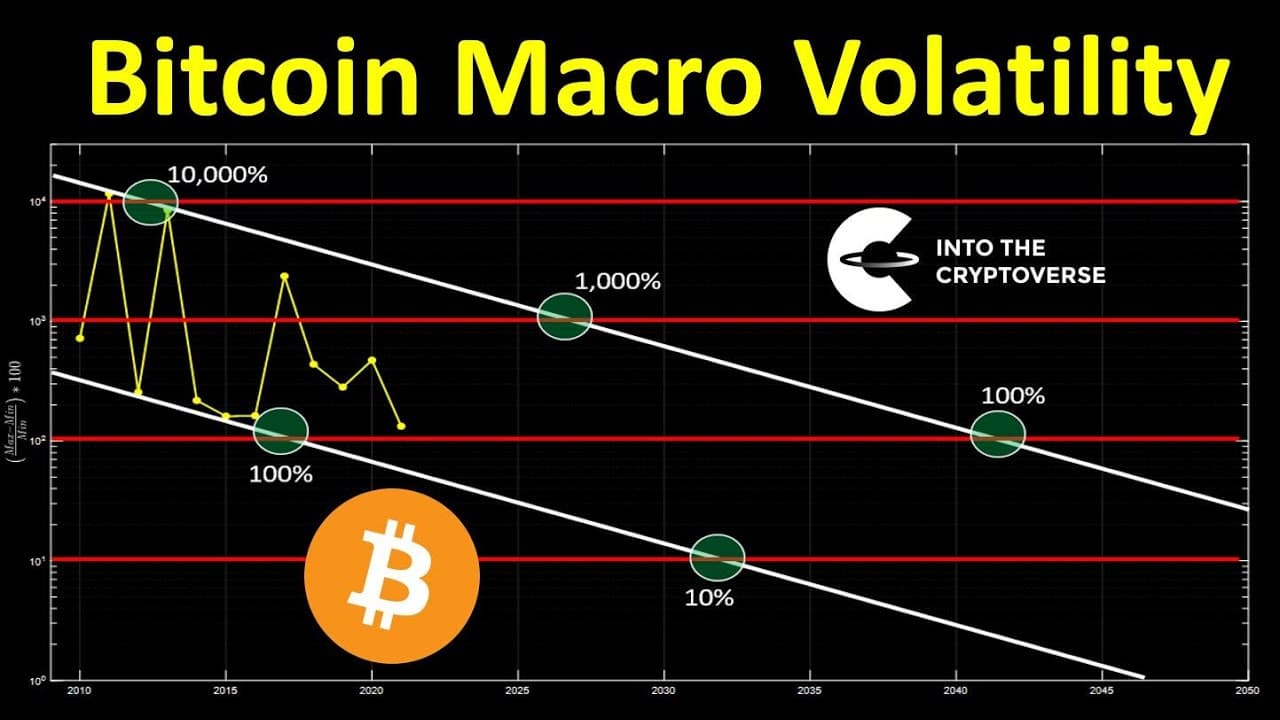
Bitcoin’s volatility is decreasing over time because the annual percentage gap between its maximum and minimum prices shows a general downtrend as the asset matures. After 11 years of price discovery, diminishing returns are bringing market-cycle ROI closer to the x-axis, although sharp short-term drops such as the 55% decline in 2021 can still occur. Read on to understand the measurement, its limitations, and what it suggests about future cycles.
Transcript
hey everyone thanks for jumping back into the cryptoverse today we're gonna talk about bitcoin macro level volatility if you guys like the content make sure you subscribe to the channel give the video a thumbs up and also check out the telegram channel which you can find a link to in the description below we also do have the black friday sale on th... Read More
Key Insights
- Macro-level volatility is the key to understanding both Bitcoin's short-term price limitations and where the asset is headed over the long run, because it reveals the broad direction of the entire asset class.
- Bitcoin has been in a long price discovery mode lasting many years, and eventually prices are expected to stabilize until one market cycle becomes almost indistinguishable from the next.
- The annualized percent difference between Bitcoin's yearly maximum and minimum price shows a general downtrend, even though individual data points are scattered, which aligns with the idea of diminishing returns.
- Diminishing returns is not a scary concept but simply the way the world works, illustrated by the analogy of adding more monitors to a desk until each extra screen adds less value.
- Bitcoin is the cryptocurrency most likely to withstand the test of time, and the speaker argues Ethereum sits right up there with it as a durable asset.
- Market cycle ROI has been diminishing with each successive cycle, moving closer to the x-axis, and future cycles may eventually make the very concept of a cycle subjective.
- Extreme parabolic predictions repeatedly failed to materialize because reaching such valuations in a single year would require hitting the top of the downtrend line, which has not been touched in a long time.
- A key advantage of diminishing returns is that the downside typically is not as severe, making Bitcoin a relatively safe long-term investment despite periods of sharp short-term depreciation.
Install to Summarize YouTube Videos and Get Transcripts
Explore YouTube Video Summarizer or Get YouTube Transcript Extractor
Questions & Answers
Q: Why is Bitcoin's volatility decreasing over time?
Bitcoin’s annual percentage difference between its maximum and minimum prices shows a general downward trend. The speaker connects this decline to diminishing returns, which are expected as an investment matures after a long period of price discovery.
Q: What is Bitcoin macro-level volatility?
Macro-level volatility describes Bitcoin’s broad price variation over longer periods rather than its daily fluctuations. The speaker measures it using the percentage difference between Bitcoin’s maximum and minimum price for each calendar year.
Q: How is Bitcoin's annual volatility measured?
The measurement takes the percentage difference between Bitcoin’s highest and lowest prices, discretized annually. It is displayed on a logarithmic scale with reference levels of 10%, 100%, 1,000%, and 10,000%.
Q: Can Bitcoin still experience sharp drops as macro volatility declines?
Yes. Bitcoin dropped 55% within a few weeks earlier in 2021, showing that severe short-term declines can still happen even while macro-level volatility trends downward. The long-term pattern does not eliminate volatility within an individual year.
Q: How do diminishing returns affect Bitcoin's market cycles?
Each successive market-cycle ROI moves closer to the x-axis as returns diminish. If that continues and cycles also lengthen, the distinction between one cycle and another may eventually become subjective, although the speaker still expects bear markets and considers cycles relevant for now.
Q: Why did the speaker reject a $300,000 Bitcoin target for that year?
Reaching $300,000 within that year would have required Bitcoin to approach the top of its volatility downtrend line. The speaker considered that unlikely because Bitcoin had not reached that boundary in a long time and noted that earlier September and November–December predictions had not materialized.
Q: Does 1,000% growth mean Bitcoin increased tenfold?
No. The speaker explains that 100% represents 2x, 200% represents 3x, and 900% represents 10x. Therefore, a 1,000% increase represents 11x.
Q: What does declining volatility suggest about Bitcoin's long-term future?
The speaker expects Bitcoin’s prices to stabilize more as its 11-year price-discovery period continues. Bitcoin may not rise 1,000x in a year, but it will likely continue trending upward over time, with future cycles becoming longer and progressively less distinct.
Summary & Key Takeaways
-
Macro-level volatility helps investors understand Bitcoin's current limitations and its long-term trajectory. Bitcoin has spent many years in price discovery mode, and the speaker expects prices to eventually stabilize until market cycles become increasingly similar and eventually hard to distinguish from one another.
-
Measuring the annual percent difference between Bitcoin's highest and lowest price reveals a general downtrend in volatility, consistent with diminishing returns. This is presented not as a scary outcome but as the natural way maturing assets and cycles behave over the macro scale.
-
The speaker dismisses extreme short-term price predictions, noting that reaching such levels in one year is unlikely because it would require touching the top of the downtrend channel. Still, Bitcoin is framed as a relatively safe long-term investment for patient allocators.
Read in Other Languages (beta)
Share This Summary 📚
Summarize YouTube Videos and Get Video Transcripts with 1-Click
Try YouTube Summary with ChatGPT & Claude or YouTube Transcript Generator
Explore More Summaries from Benjamin Cowen 📚






Summarize YouTube Videos and Get Video Transcripts with 1-Click
Try YouTube Summary with ChatGPT & Claude or YouTube Transcript Generator