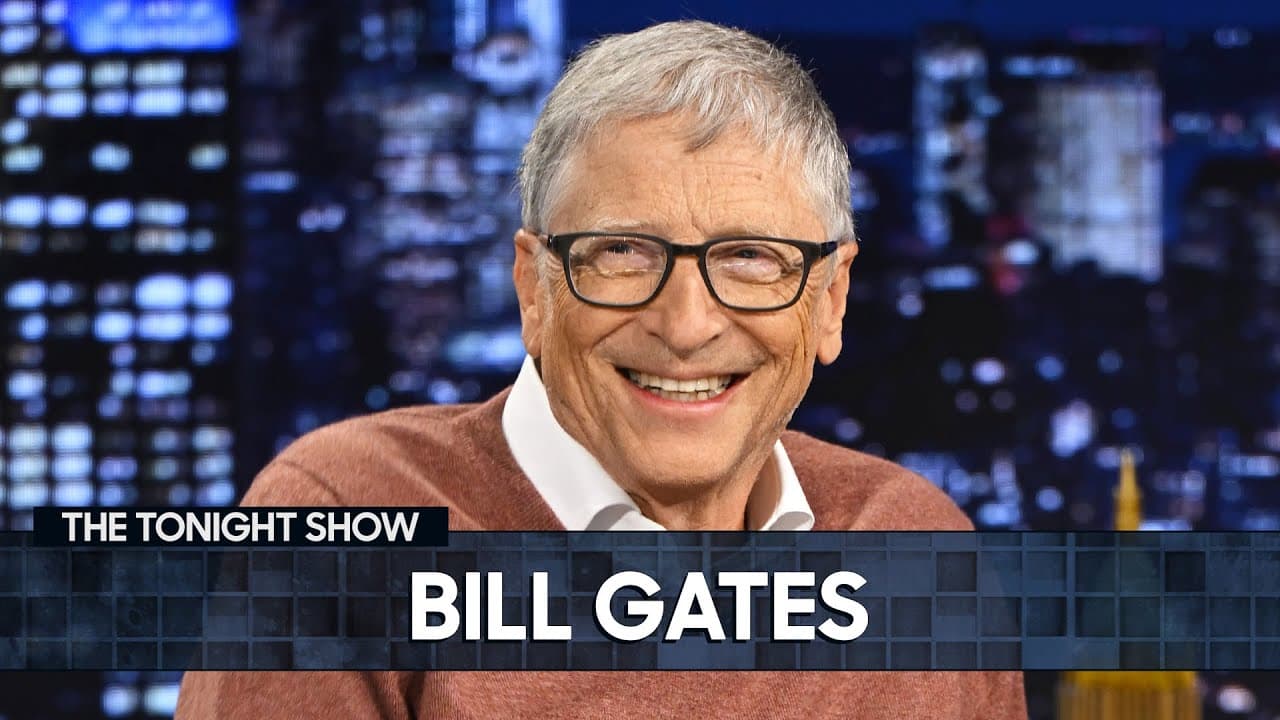
Bill Gates on AI, LSD with Steve Jobs, and Optimism
TL;DR
Bill Gates says the coming decade will make intelligence free and commonplace, so great medical advice and tutoring become widely available, easing shortages of doctors and mental-health professionals. He credits his mother for pushing him, calls dropping out of Harvard a 'leave,' and jokes he took LSD but got the batch 'about code, not about design.'
Transcript
-Bill, welcome back. I always like having you on the show. I actually just thought of this seconds before. I apologize. I... Here, I'll just put this... [ Laughter ] Yeah. [ Rimshot ] -No one -- You didn't see anything. You didn't see anything. Welcome back to the show. I always love having you here. "Source Code" is out today. Congratulations on t... Read More
Key Insights
- Bill Gates wrote his memoir 'Source Code' because he is turning 70 this year, Microsoft turns 50, and his foundation turns 25, prompting him to look back on the luck he had with parents and timing.
- Gates's mother influenced him indirectly, remarking that families whose kids didn't go to college 'must feel terrible,' which he understood as pressure to attend college himself.
- The coming AI era makes intelligence, which used to be rare, become free and commonplace over the next decade, delivering great medical advice and tutoring the way computing itself became cheap.
- AI solves specific shortages like too few doctors and mental-health professionals, but Gates admits it brings unknown change, including questions about future jobs and whether people should work only 2 or 3 days a week.
- Gates joked about Steve Jobs saying he lacked design taste and 'should have taken acid,' replying that he did take acid but got the batch 'about code, not about design.'
- After his LSD experience, Gates worried he had damaged his mind, so he quit risk-taking and resolved to work super hard, taking no weekends or vacations in his 20s.
- Gates stays optimistic about improving health, citing progress on Alzheimer's, malaria, HIV, and polio, which he predicts could become the second disease completely eliminated within 3 or 4 years.
- On climate, Gates argues innovation must make clean products cheaper than dirty ones, because globally people won't reliably pay extra for clean options even if they should.
Install to Summarize YouTube Videos and Get Transcripts
Explore YouTube Video Summarizer or Get YouTube Transcript Extractor
Questions & Answers
Q: Why did Bill Gates write his memoir Source Code?
Gates wrote Source Code because this year he turns 70, Microsoft turns 50, and his foundation turns 25, so it felt like time to look back a little. He wanted to reflect on the incredible luck he had with his parents, his timing, and the many things that set him up for an amazing life. He said it was kind of fun to look back, even though he doesn't do that much normally.
Q: How did Bill Gates's mother influence him?
Gates's mother influenced him mainly by pushing him, often indirectly. When other families visited, she would afterward remark that families whose children didn't go to college 'must feel terrible,' which Gates understood as a signal that he had better go to college. He says he proved himself by exceeding her expectations, and even though he pushed back, that intensity in their relationship helped drive him. Both parents also modeled volunteering and giving back to the community.
Q: What did Bill Gates say about taking LSD with Paul Allen and Steve Jobs?
Gates said his friend Paul Allen, a Hendrix fan who played guitar, got him to experiment with LSD. He recalled it was a little crazy. Later, when Steve Jobs was denigrating him, Jobs said Gates had no design taste and should have taken acid. Gates joked that he did take acid, but he 'got the batch that's about code, not about design,' a very different batch than Jobs got. He does not recommend anyone do it.
Q: Why did Bill Gates stop taking risks like LSD?
After his LSD experience, Gates said it turned out to be all kind of fake, where you think you've solved the problems of the world but you really haven't. He liked when his mind worked well and worried afterward that he might have messed up his mind or erased his knowledge. So even though he had been a big risk-taker, he decided on no more of that and resolved to just work super hard, taking no weekends or vacations in his 20s.
Q: What does Bill Gates think AI will do over the next decade?
Gates frames the coming era as one where intelligence, which used to be rare like a great doctor or great teacher, becomes free and commonplace over the next decade, much as computing itself became essentially free. He expects great medical advice and great tutoring to become widely available. He says this is profound because it solves specific problems like shortages of doctors and mental-health professionals, though it also brings large, somewhat unknown changes.
Q: Will AI still need humans according to Bill Gates?
Gates said that for most things AI will not need humans, though people will decide what to reserve for themselves. He gave examples like baseball, since people won't want to watch computers play, and jokingly agreed hosting a talk show might remain human. Over time, however, he expects making things, moving things, and growing food to become basically solved problems handled without human labor, which is why solving other problems matters.
Q: What keeps Bill Gates optimistic about the future?
Gates stays optimistic mainly about improving health, including tough diseases like Alzheimer's and diseases still prevalent in developing countries such as malaria and HIV. He is especially hopeful about polio, saying with luck in the next 3 or 4 years it could become the second disease completely eliminated. He is also optimistic about climate, believing innovation can produce very cheap green products, and he sees an encouraging innovation pipeline that others don't get to witness.
Q: How does Bill Gates think we should solve climate change?
Gates argues the key to solving climate is innovation that makes clean products cheaper than dirty ones. He says people should pay extra for clean products, but across the whole globe they probably won't do it, so relying on people paying a premium won't work. Instead, the way to get there is to innovate so the clean option is actually cheaper than the dirty option. He said a lot of great stuff is coming along and he's more optimistic than people who can't see that innovation pipeline.
Summary & Key Takeaways
-
Gates released his memoir 'Source Code' as he turns 70, with Microsoft turning 50 and his foundation 25. He reflects on his mother's indirect pushing toward college, his father's calm example, and their emphasis on volunteering, which is why the book's proceeds go to United Way Worldwide.
-
Gates recalls the birth of personal computing when machines were huge and expensive and IBM dominated. By age 18 he had done a lot of software, saw the miracle of the chip, and with Paul Allen believed everyone would own a computer, a claim people initially laughed at.
-
Gates says AI will make rare intelligence free within a decade, providing medical advice and tutoring while raising questions about jobs and human roles. He stays optimistic about curing diseases like polio and about climate innovation making clean products cheaper than dirty ones.
Read in Other Languages (beta)
Share This Summary 📚
Summarize YouTube Videos and Get Video Transcripts with 1-Click
Try YouTube Summary with ChatGPT & Claude or YouTube Transcript Generator
Explore More Summaries from The Tonight Show Starring Jimmy Fallon 📚





Summarize YouTube Videos and Get Video Transcripts with 1-Click
Try YouTube Summary with ChatGPT & Claude or YouTube Transcript Generator