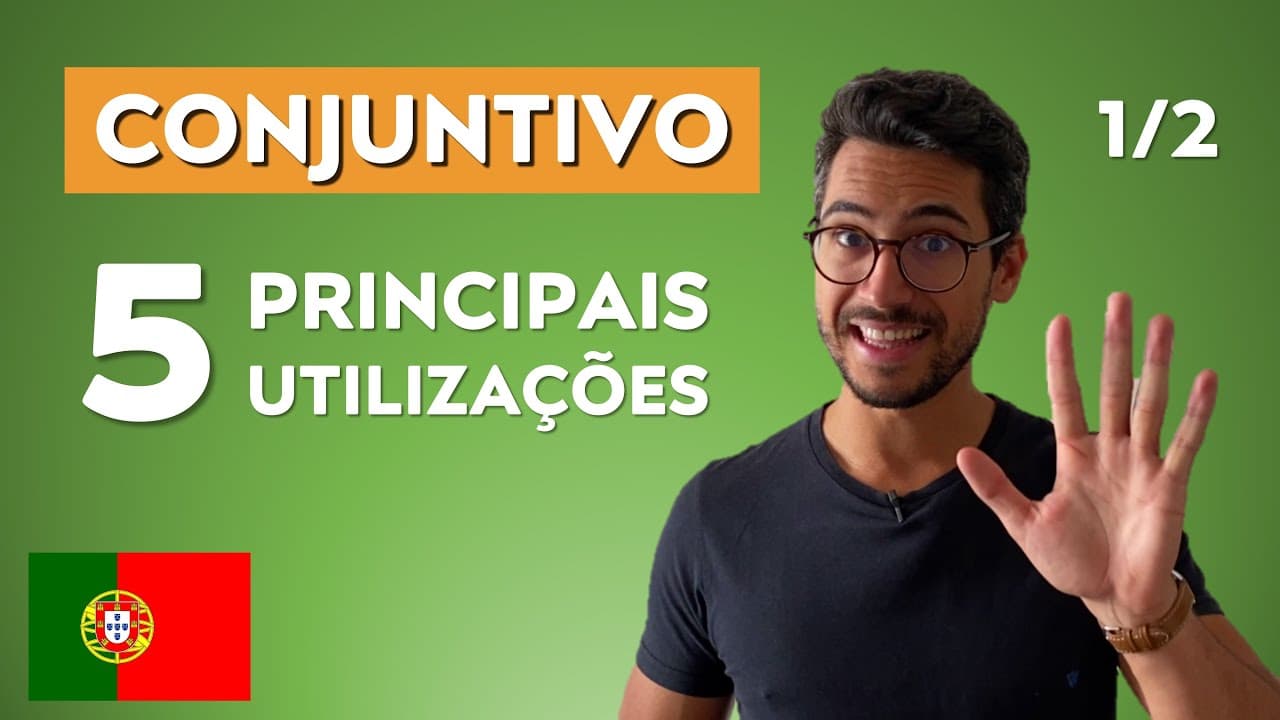
How to use the SUBJUNCTIVE in Portuguese - Part 1/2 // Learn European Portuguese
TL;DR
The video explains the subjunctive mood in Portuguese and its main uses.
Transcript
Hi everyone and welcome back to Portuguese With Leo and another quick Portuguese lesson! Today we are going to talk about a very important verb mood that I know is the cause of much pain to those learning Portuguese. We are going to talk about the subjunctive! Ah, if you're not familiar with the word "conjuntivo", it is because perhaps you know thi... Read More
Key Insights
- The subjunctive mood in Portuguese expresses uncertainty, doubt, desire, or hypothetical situations, unlike the indicative mood, which conveys certainty.
- The subjunctive is used in five main situations: to express desire, uncertainty, psychological states, impersonal expressions, and concessive phrases.
- In expressing desires, verbs like 'wish', 'hope', and 'want' are commonly used with the subjunctive mood.
- Uncertainty or doubt is expressed using words like 'maybe', 'I doubt', and negative expressions such as 'I don't think'.
- Psychological states are conveyed using the subjunctive to express feelings about certain events, such as fear or happiness.
- Impersonal sentences use the subjunctive with phrases like 'It's important', 'It's necessary', and 'It's possible'.
- Concessive phrases with conjunctions like 'although', 'even though', and 'despite' are used with the subjunctive to indicate hindrances.
- Learning the subjunctive involves practice and understanding its usage in various contexts, as it is complex even for native speakers.
Install to Summarize YouTube Videos and Get Transcripts
Explore YouTube Video Summarizer or Get YouTube Transcript Extractor
Questions & Answers
Q: What is the main focus of this video?
The main focus of the video is to provide an overview of the subjunctive mood in Portuguese, particularly its use in the present tense. The video explains the key situations where the subjunctive is applicable, such as expressing desires, uncertainty, psychological states, impersonal expressions, and concessive phrases.
Q: Why is the subjunctive mood considered challenging for learners?
The subjunctive mood is challenging because it requires understanding the speaker's attitude or intention rather than just the timing of an action. It is used to express uncertainty, doubt, desire, or hypothetical situations, which can be difficult for learners to grasp and apply correctly in different contexts.
Q: How does the subjunctive mood differ from the indicative mood?
The subjunctive mood differs from the indicative mood in that it expresses uncertainty, doubt, desire, or hypothetical situations, while the indicative mood conveys certainty and factual statements. The indicative is used when the speaker is sure of the action, whereas the subjunctive is used when there is some level of uncertainty or subjectivity.
Q: What are impersonal sentences, and how do they relate to the subjunctive?
Impersonal sentences use the subjunctive mood to express general statements or opinions without a specific subject. These sentences typically involve the verb 'to be' followed by an adjective, such as 'It's important', 'It's necessary', or 'It's possible', and are used to convey a general truth or necessity.
Q: Can you provide examples of concessive phrases using the subjunctive?
Concessive phrases using the subjunctive include sentences like 'Although the water is cold, I'm going to take a dip', 'Even though it's late, I'm going to walk my dog', and 'Even if we don't agree with each other, we like to debate ideas'. These phrases introduce a hindrance but suggest that the action will still occur.
Q: What advice is given for learning the subjunctive mood?
The video advises that learning the subjunctive mood requires practice and patience, as it is complex even for native speakers. Understanding its usage in various contexts and practicing through speaking and writing can help learners become more comfortable with this aspect of Portuguese.
Q: What will be covered in the next part of the mini-series on the subjunctive?
The next part of the mini-series will cover the different verb tenses within the subjunctive mood and the various situations in which each tense is used. This will include a discussion on the future subjunctive tense, which is unique to Portuguese, and its application in different contexts.
Q: Why is the future subjunctive tense notable in Portuguese?
The future subjunctive tense is notable in Portuguese because it is a unique feature of the language, not commonly found in other languages. It is used to express actions that are uncertain but expected to occur in the future, adding another layer of complexity to the subjunctive mood.
Summary & Key Takeaways
-
The video introduces the subjunctive mood in Portuguese and highlights its complexity, explaining that it reflects uncertainty, desire, or hypothetical situations rather than certainty. The content is divided into two parts, with the first focusing on the present tense.
-
The presenter describes five main uses of the subjunctive: expressing desires, uncertainty, psychological states, impersonal expressions, and concessive phrases. Examples are provided for each situation to illustrate the usage of the subjunctive.
-
The video emphasizes the importance of practice in mastering the subjunctive, noting that it is a challenging aspect of Portuguese even for native speakers. The next video will cover different verb tenses within the subjunctive.
Read in Other Languages (beta)
Share This Summary 📚
Summarize YouTube Videos and Get Video Transcripts with 1-Click
Try YouTube Summary with ChatGPT & Claude or YouTube Transcript Generator
Explore More Summaries from Portuguese With Leo 📚






Summarize YouTube Videos and Get Video Transcripts with 1-Click
Try YouTube Summary with ChatGPT & Claude or YouTube Transcript Generator