Strange Stars | Space Time | PBS Digital Studios
TL;DR
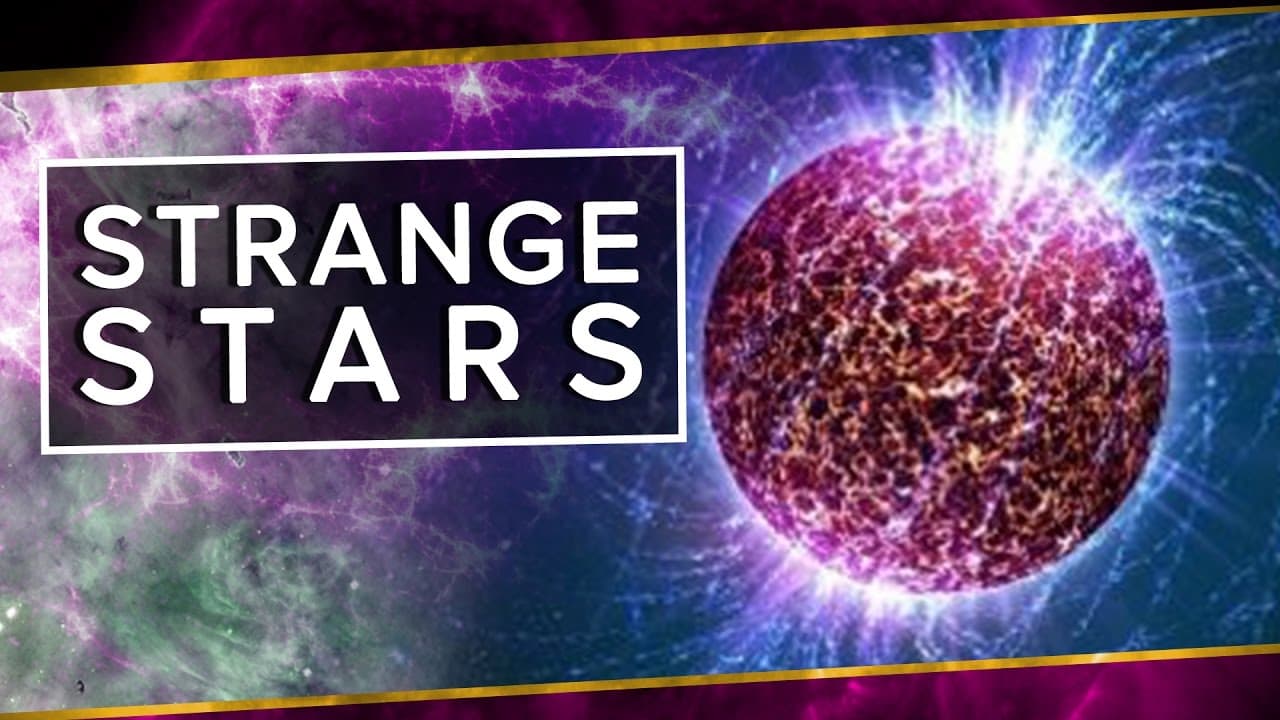
Exploration of strange stars, potential stellar remnants beyond neutron stars.
Transcript
[MUSIC PLAYING] As if black holes and neutron stars aren't weird enough, physicists have very good reason to believe that there are even stranger stellar remnants out there, stars made entirely of quarks. [MUSIC PLAYING] The mathematics of modern physics that emerged through the 20th century explained so much about our universe. But the same mathem... Read More
Key Insights
- Strange stars are theorized to be stellar remnants composed entirely of quark matter, potentially more stable than neutron stars.
- Neutron stars, formed from massive stellar cores, contain neutronium, the densest known substance, which may break down into quark matter under extreme pressure.
- Quark matter, possibly existing in neutron stars, is a superfluid denser than neutronium and may evolve into strange matter with strange quarks.
- Strange matter, with three quark types, could be the most stable form of matter, potentially forming stable stars known as strange stars.
- Theoretical physicists propose that neutron stars might contain electroweak cores, where quarks burn, potentially preventing collapse into black holes.
- Observations of pulsars like 3C58 suggest anomalies that could indicate the presence of quark or strange matter at their cores.
- Some supernovae exhibit unusual brightness and duration, possibly due to secondary explosions as neutron stars transition to quark stars.
- The existence of strange stars remains unconfirmed, but they represent an exciting frontier in understanding extreme states of matter in the universe.
Install to Summarize YouTube Videos and Get Transcripts
Explore YouTube Video Summarizer or Get YouTube Transcript Extractor
Questions & Answers
Q: What are strange stars?
Strange stars are theoretical stellar remnants composed entirely of quark matter, potentially more stable than neutron stars. They are formed when neutronium, the dense substance in neutron stars, breaks down further under extreme pressure, possibly evolving into strange matter. This makes strange stars a fascinating frontier in astrophysics.
Q: How do neutron stars form?
Neutron stars form from the collapse of massive stellar cores after they exhaust their fusion fuel. In this process, electrons and protons combine to form neutrons, creating neutronium, the densest known substance. This collapse is halted at a certain density, resulting in a neutron star, which may spin rapidly and emit pulsar signals.
Q: What is quark matter?
Quark matter is a state of matter theorized to exist in the cores of neutron stars, formed under extreme pressure. It is a superfluid denser than neutronium and may consist of quarks, the fundamental constituents of protons and neutrons. Quark matter could evolve into strange matter, featuring strange quarks, and potentially form strange stars.
Q: What are the characteristics of strange matter?
Strange matter is a type of quark matter that includes strange quarks in addition to up and down quarks. This composition allows it to occupy the lowest quantum energy states, potentially making it the most stable form of matter in the universe. If strange matter forms a star, it could be incredibly stable and long-lasting.
Q: What anomalies suggest the existence of strange stars?
Anomalies in pulsars, such as unusual surface temperatures and unexpected mass-to-size ratios, suggest the presence of quark or strange matter. Additionally, some supernovae exhibit excessive brightness and duration, possibly due to secondary explosions as neutron stars transition to quark stars, indicating the potential existence of strange stars.
Q: What is the significance of the pulsar 3C58 in the study of strange stars?
The pulsar 3C58, observed by Chinese and Japanese astronomers in 1181, exhibits an unusually cool surface temperature for its age, suggesting the presence of a quark matter core. This anomaly could indicate that the neutron star is transitioning into a strange star, providing a potential real-world example of these theoretical stellar remnants.
Q: How might strange stars impact our understanding of the universe?
Strange stars, if confirmed, could revolutionize our understanding of matter under extreme conditions, challenging existing models of stellar evolution and stability. They represent a new frontier in astrophysics, potentially revealing new laws of physics and insights into the early universe's conditions, expanding our knowledge of cosmic phenomena.
Q: What future research could confirm the existence of strange stars?
Future research could focus on detailed observations of pulsars and supernovae, seeking anomalies indicative of quark or strange matter. Advances in particle physics and astrophysics, including simulations and experiments, may provide insights into the conditions required for strange star formation, ultimately confirming their existence through observational evidence.
Summary & Key Takeaways
-
Strange stars are theorized stellar remnants potentially composed entirely of quark matter, existing just shy of black holes. These stars could be more stable than neutron stars, which are formed from massive stellar cores and contain neutronium, the densest known substance.
-
Neutron stars may contain quark matter, a superfluid denser than neutronium, which could evolve into strange matter under extreme pressure. Strange matter, with three quark types, might be the most stable form of matter, forming stable stars known as strange stars.
-
Theoretical physicists propose that neutron stars might have electroweak cores where quarks burn, possibly preventing collapse into black holes. Observational anomalies in pulsars and supernovae suggest the presence of quark or strange matter, though confirmation remains elusive.
Read in Other Languages (beta)
Share This Summary 📚
Summarize YouTube Videos and Get Video Transcripts with 1-Click
Try YouTube Summary with ChatGPT & Claude or YouTube Transcript Generator
Explore More Summaries from PBS Space Time 📚
Summarize YouTube Videos and Get Video Transcripts with 1-Click
Try YouTube Summary with ChatGPT & Claude or YouTube Transcript Generator