How Has 21st Century Warfare Evolved? Game Theory #22: Twilight of the Nation-State
TL;DR
21st century warfare uses civilian populations against their governments by creating discord and dissent through economic sabotage and economic strangulation. Unlike traditional wars focused on killing soldiers, or 20th-century wars targeting civilians and manufacturing capacity, this model seeks to weaken the state from within. The US-Iran war is presented as the first example, making the historical evolution of this strategy worth exploring.
Transcript
There is a ceasefire now between Iran and United States. But most analysts expect that this war will resume in a week, two weeks, a month. But it will it will resume because it is impossible for the United States and Iran to come to a mutually beneficial and satisfying um arrangement. So today I want to look at how this war will evolve. And my argu... Read More
Key Insights
- 21st-century warfare uses civilians as a tool to destabilize governments by creating internal dissent.
- Economic strangulation and infrastructure destruction are key tactics to weaken a nation without direct confrontation.
- Traditional battlefield engagements are less effective due to the decentralization of military and leadership structures.
- Ethnic tensions are exploited to create internal conflicts and divert resources from external threats.
- The rise of nation-states was driven by the need for population growth and citizen involvement in warfare.
- Rousseau's social contract theory emphasized liberty and population growth as measures of a successful state.
- Nationalism in the 19th century was fueled by language and cultural identity, leading to militaristic expansion.
- Modern conflicts, like the US-Iran tensions, illustrate the shift to 21st-century strategies focusing on economic and social disruption.
Install to Summarize YouTube Videos and Get Transcripts
Explore YouTube Video Summarizer or Get YouTube Transcript Extractor
Questions & Answers
Q: How does 21st century warfare use civilians against the state?
21st century warfare seeks to turn civilians against their government by sowing discord and dissent within society. The stated methods are economic sabotage and economic strangulation, which use the population to weaken the state from within.
Q: How is 21st century warfare different from traditional warfare?
Traditional warfare aimed to destroy a state's fighting capacity by killing soldiers and winning decisive battlefield engagements. In the 21st century, the goal described is to use the population against the state rather than trying to kill everyone.
Q: How did warfare change during the 20th century?
Nation-states could field and replenish forces numbering in the millions, so defeating soldiers on a battlefield was no longer enough. Warfare therefore shifted toward destroying a state's capacity to produce and manufacture, with World War II given as the main example.
Q: Why does the speaker say killing everyone is impossible in 21st century warfare?
The speaker says there are too many people and nuclear weapons make mass destruction mutually dangerous. If one side uses nuclear weapons, others can use nuclear weapons against it.
Q: Why is the US-Iran war described as the first war of the 21st century?
The speaker argues that the US-Iran war represents a new model of warfare centered on turning civilians against their government. He expects the war to resume because he considers a mutually beneficial and satisfying arrangement between the United States and Iran impossible.
Q: What role does economic strangulation play in modern warfare?
Economic strangulation is presented as a way to sow discord and dissent within society. Its purpose is to turn the civilian population against the government and weaken the state internally.
Q: How does the nation-state relate to the world's population of 8 billion?
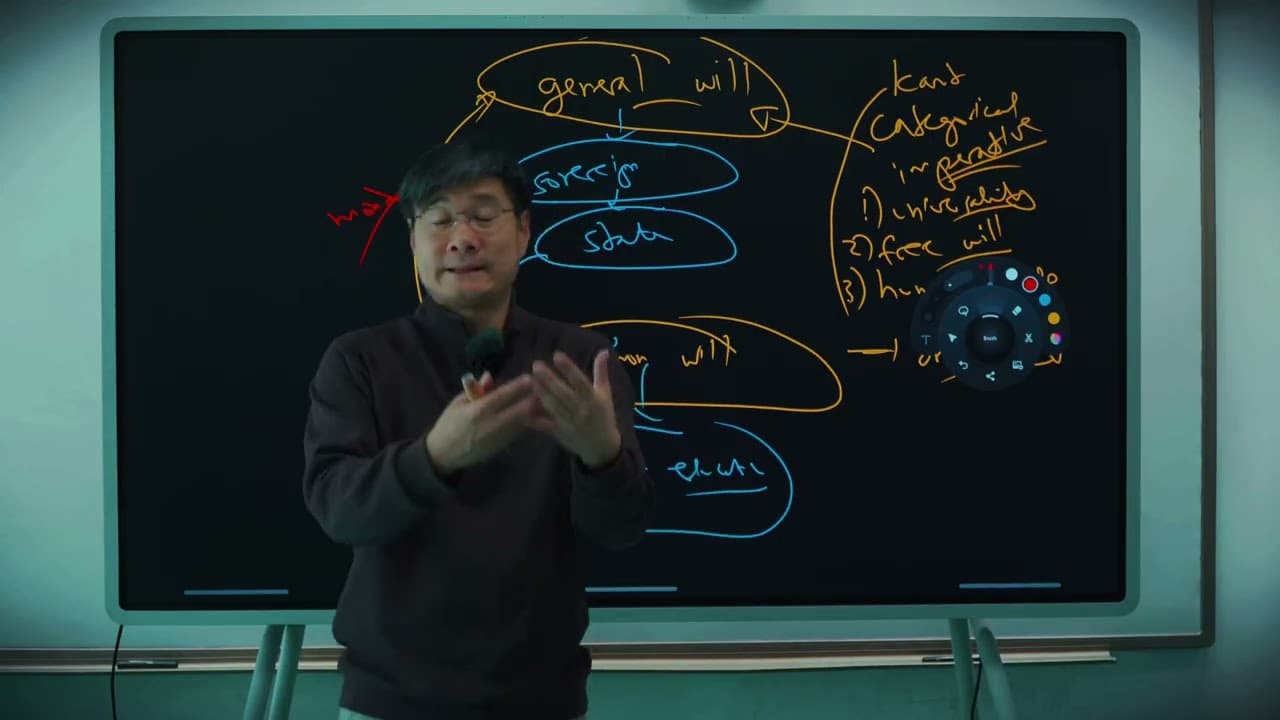
The speaker attributes the rise to 8 billion people to the nation-state and calls it a political revolution associated with the French Revolution. He contrasts this explanation with the view that technological and scientific progress produced the population increase.
Q: What is Jean-Jacques Rousseau's social contract theory in this discussion?
Rousseau is presented as the thinker whose social contract theory underpinned the French Revolution. The theory says people are born free and join society to become more free, creating a common will that leads to the sovereign, the state, citizenship, laws, culture, and education.
Summary & Key Takeaways
-
21st-century warfare emphasizes destabilizing nations by turning their civilian populations against them. Economic sabotage, ethnic tension, and infrastructure destruction are employed to incite unrest. This represents a shift from traditional military engagements to psychological and economic tactics aimed at weakening state control.
-
The evolution of warfare reflects historical shifts in political and social structures, from the rise of nation-states to modern global power dynamics. Strategies now focus on exploiting internal divisions and economic dependencies to achieve military objectives without direct confrontation.
-
The shift in warfare tactics is influenced by historical developments in nation-state formation, nationalism, and global economic systems. Modern conflicts highlight the use of indirect strategies to destabilize opponents by leveraging civilian discontent and economic vulnerabilities.
Read in Other Languages (beta)
Share This Summary 📚
Summarize YouTube Videos and Get Video Transcripts with 1-Click
Try YouTube Summary with ChatGPT & Claude or YouTube Transcript Generator
Explore More Summaries from Predictive History 📚



Summarize YouTube Videos and Get Video Transcripts with 1-Click
Try YouTube Summary with ChatGPT & Claude or YouTube Transcript Generator