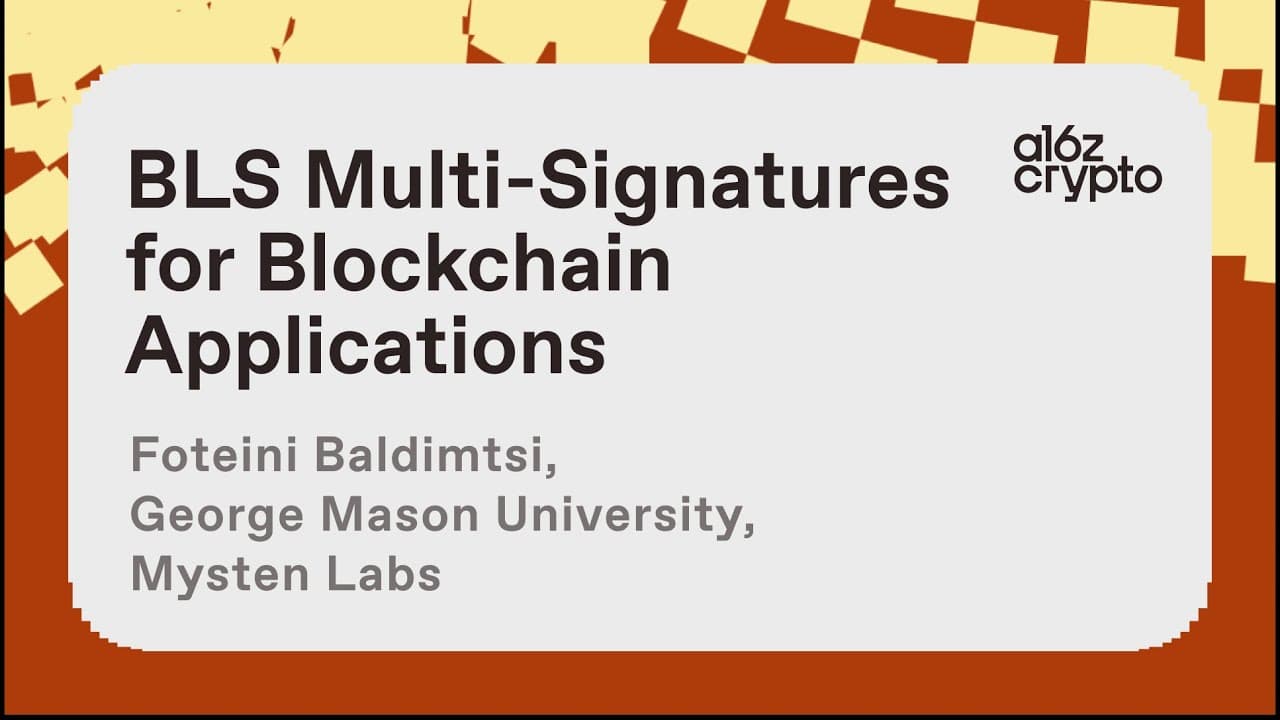
BLS Multi-Signatures for Blockchain Applications with Foteini Baldimitsi | a16z crypto research
TL;DR
BLS multi-signatures offer flexible key aggregation for decentralized credentials and proof-of-stake protocols, optimizing signing efficiency.
Transcript
good morning everyone uh welcome to today's a16z crypto research seminar very happy to introduce fattini baldimski who we know well she was a faculty fellow with us last summer summer 2022 so it's great to have her back talking about something which is very relevant for us BLS multi-6 so 15. uh thank you so much Tim thanks everyone for being here I... Read More
Key Insights
- 🙈 Blind BLS multi-signatures offer flexibility in key aggregation for decentralized credentials without interactive signer coordination.
- 🤩 Subset multi-signing scheme in proof-of-stake improves signing efficiency by pre-randomizing keys for subsets of validators.
- 🤩 Protocol optimization in proof-of-stake settings minimizes signing costs through one-time key randomization at epoch start.
- ❓ Efficient verification in both decentralized credential issuance and proof-of-stake protocols enhances overall system performance.
- 🈸 Implementation results demonstrate cost savings and performance improvement in signature aggregation for diverse cryptographic applications.
- 🧑💼 Trade-offs between verification costs and efficiency in signing processes impact protocol design for cryptographic primitives.
- 👊 Security proofs in cryptographic protocols leverage innovative techniques to ensure resiliency against attacks and maintain trust in the system.
Install to Summarize YouTube Videos and Get Transcripts
Explore YouTube Video Summarizer or Get YouTube Transcript Extractor
Questions & Answers
Q: How do blind BLS multi-signatures enhance decentralized credentials?
Blind BLS multi-signatures enable flexible ad hoc signing processes without interactive key aggregation among signers, optimizing efficiency.
Q: What is the key advantage of the multi-signing scheme in proof-of-stake settings?
The multi-signing scheme in proof-of-stake allows one-time key randomization at epoch start, reducing signing costs and improving efficiency.
Q: How does the protocol prevent double use of credentials in decentralized applications?
By monitoring and verifying all issued credentials on the blockchain, double-use of credentials can be prevented through observation and verification.
Q: How does the protocol handle subsets of validators in proof-of-stake environments?
The protocol allows subsets of validators to sign blocks efficiently by pre-randomizing keys with the full committee at epoch start, reducing signing costs.
Summary & Key Takeaways
-
BLS multi-signatures combine flexibility and efficiency for key aggregation in decentralized credentials and proof-of-stake settings.
-
Blind BLS multi-signatures allow ad hoc signing processes without interactive coordination among signers.
-
Subset multi-signing scheme in proof-of-stake optimizes signing costs through a one-time key randomization process at epoch start.
Read in Other Languages (beta)
Share This Summary 📚
Summarize YouTube Videos and Get Video Transcripts with 1-Click
Try YouTube Summary with ChatGPT & Claude or YouTube Transcript Generator
Explore More Summaries from a16z crypto 📚


Summarize YouTube Videos and Get Video Transcripts with 1-Click
Try YouTube Summary with ChatGPT & Claude or YouTube Transcript Generator