What Is Quantum Entanglement and Why Is It Significant?
TL;DR
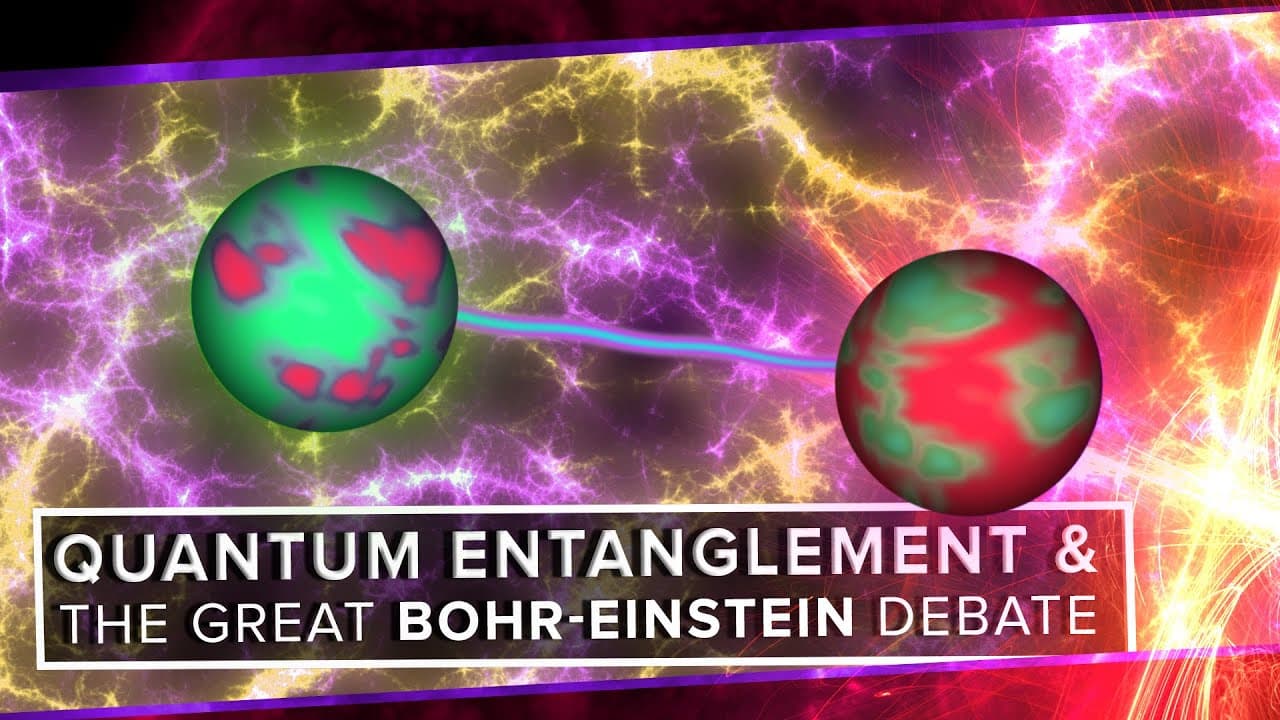
Quantum entanglement suggests that particles can instantaneously influence each other, challenging classical assumptions of realism and locality. Niels Bohr’s Copenhagen interpretation claims quantum systems exist in superposition until measured, while Einstein advocated for an underlying reality with hidden variables. Experiments by John Stewart Bell and Alain Aspect confirmed violations of Bell inequalities, supporting non-locality without contradicting the principles of relativity.
Transcript
[MUSIC PLAYING] Is there a hidden physical reality that underlies the strange behavior of the quantum world? Or is that reality an illusion in the eye of the observer? The weird phenomenon of quantum entanglement gives us quite startling clues to the answer. [MUSIC PLAYING] Babies may suck at math. But they're actually surprisingly good at quantu... Read More
Key Insights
- Quantum entanglement challenges traditional notions of realism and locality, suggesting that particles can influence each other instantaneously across distances.
- Niels Bohr's Copenhagen interpretation posits that quantum systems exist in a superposition of states until measured, collapsing into a definite state upon observation.
- Albert Einstein argued for hidden variables, suggesting that quantum mechanics is incomplete without an underlying reality independent of observation.
- John Stewart Bell's experiments in the 1960s provided a way to test the validity of hidden variables versus the Copenhagen interpretation through Bell inequalities.
- Alain Aspect's experiments in the 1980s confirmed that entangled particles violate Bell inequalities, supporting non-locality and challenging Einstein's locality principle.
- The violation of Bell inequalities implies that either realism or locality must be abandoned, with many interpretations exploring these implications.
- Non-locality does not necessarily violate relativity, as no information is transmitted faster than light, preserving causality.
- Alternative interpretations, like the many worlds theory, offer explanations that retain both realism and locality without contradicting quantum observations.
Install to Summarize YouTube Videos and Get Transcripts
Explore YouTube Video Summarizer or Get YouTube Transcript Extractor
Questions & Answers
Q: What is the central debate between Bohr and Einstein regarding quantum mechanics?
The central debate between Bohr and Einstein revolves around the nature of reality in quantum mechanics. Bohr's Copenhagen interpretation suggests that quantum systems exist in a superposition of states until observed, collapsing into a definite state upon measurement. In contrast, Einstein argued for an objective reality independent of observation, proposing hidden variables to account for quantum phenomena.
Q: How did John Stewart Bell contribute to resolving the Bohr-Einstein debate?
John Stewart Bell contributed by proposing experiments to test the existence of hidden variables versus the Copenhagen interpretation. His Bell inequalities provided a framework to determine whether quantum mechanics requires hidden variables. Experiments violating these inequalities, such as those conducted by Alain Aspect, suggested that entangled particles exhibit non-local behavior, supporting Bohr's interpretation over Einstein's.
Q: What were the findings of Alain Aspect's experiments on quantum entanglement?
Alain Aspect's experiments in the 1980s demonstrated that entangled particles violate Bell inequalities, indicating non-local behavior. His work showed that the correlation between entangled particles' states could not be explained by local hidden variables, supporting the idea that quantum mechanics allows instantaneous influence across distances, challenging Einstein's concepts of locality and realism.
Q: How does non-locality in quantum mechanics relate to Einstein's theory of relativity?
Non-locality in quantum mechanics, while seemingly contradicting relativity, does not violate it because it does not involve transmitting information faster than light. Relativity's causality is preserved since the influence between entangled particles only becomes apparent after measurements are compared, avoiding faster-than-light communication or time-travel paradoxes.
Q: What are some alternative interpretations of quantum mechanics that address the entanglement issue?
Alternative interpretations addressing entanglement include the many worlds theory, which posits that all possible outcomes occur in separate, branching universes, preserving realism and locality. The De Broglie-Bohm Pilot Wave Theory assumes non-local hidden variables, while the idea of Einstein-Rosen bridges suggests entangled particles are connected by wormholes, allowing instantaneous contact without violating relativity.
Q: What implications do the findings on quantum entanglement have for our understanding of reality?
The findings on quantum entanglement challenge traditional views of reality, suggesting that particles can influence each other instantaneously, defying classical physics' assumptions of realism and locality. This has led to reevaluations of the nature of reality, with interpretations like the Copenhagen interpretation and many worlds theory offering different perspectives on how quantum systems behave.
Q: How do Bell inequalities help in understanding quantum mechanics?
Bell inequalities provide a way to test whether quantum mechanics requires hidden variables or supports the Copenhagen interpretation. By establishing expected correlations between entangled particles, Bell's framework allows experiments to determine if quantum mechanics violates local realism. Violations of Bell inequalities, as observed in experiments, suggest that quantum mechanics inherently includes non-local behavior.
Q: What role do hidden variables play in the debate over quantum mechanics?
Hidden variables are central to Einstein's argument that quantum mechanics is incomplete, suggesting an underlying reality with definite properties independent of observation. The debate over their existence challenges the Copenhagen interpretation, which posits that quantum systems exist in superposition until measured. Experiments violating Bell inequalities suggest that hidden variables, at least local ones, are not necessary to explain quantum phenomena.
Summary & Key Takeaways
-
Quantum entanglement challenges classical physics by suggesting particles can influence each other instantaneously, defying traditional notions of realism and locality. Niels Bohr's Copenhagen interpretation posits that quantum systems exist in superposition until observed, while Einstein argued for hidden variables, implying an incomplete quantum theory.
-
John Stewart Bell proposed experiments to test these ideas, leading to Alain Aspect's 1980s experiments confirming that entangled particles violate Bell inequalities. This supports non-locality, challenging Einstein's locality principle and suggesting that either realism or locality must be abandoned.
-
Non-locality does not necessarily violate relativity, as it preserves causality by not transmitting information faster than light. Alternative interpretations, like the many worlds theory, offer explanations retaining both realism and locality, aligning with quantum observations without contradicting established physics.
Read in Other Languages (beta)
Share This Summary 📚
Summarize YouTube Videos and Get Video Transcripts with 1-Click
Try YouTube Summary with ChatGPT & Claude or YouTube Transcript Generator
Explore More Summaries from PBS Space Time 📚





Summarize YouTube Videos and Get Video Transcripts with 1-Click
Try YouTube Summary with ChatGPT & Claude or YouTube Transcript Generator