What Is Planck's Constant and Its Quantum Role?
TL;DR
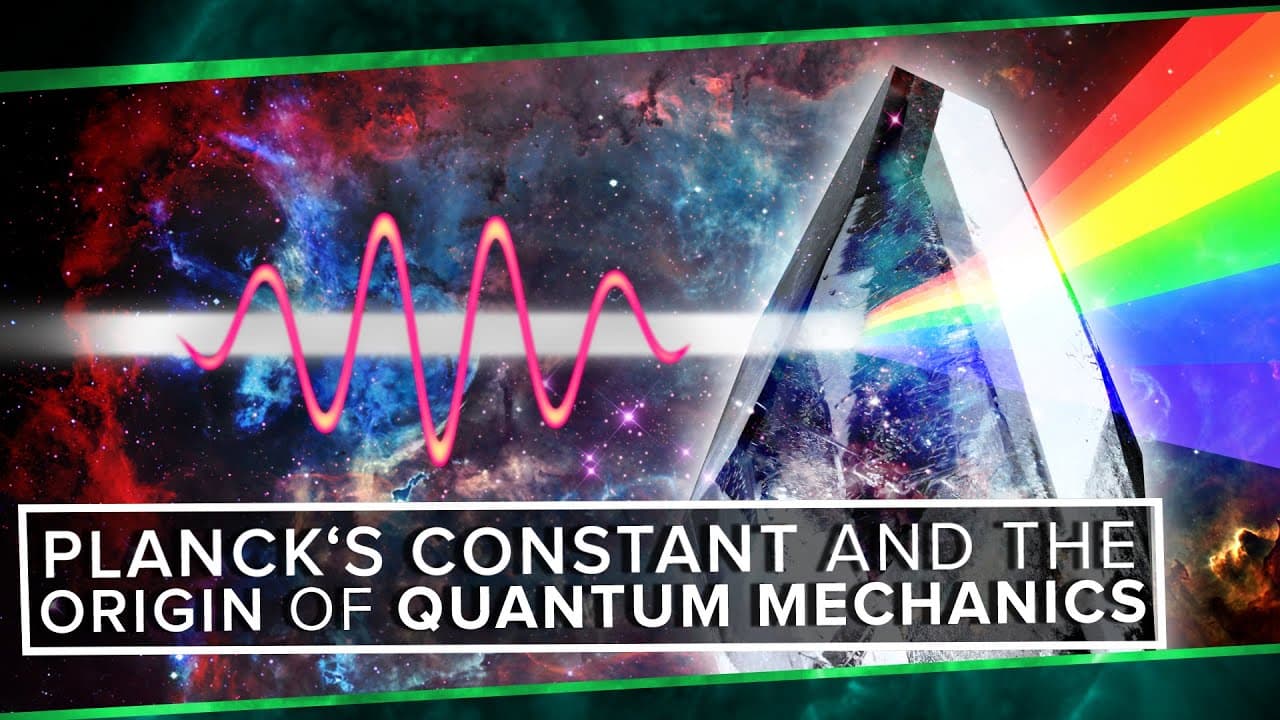
Planck's constant is a fundamental constant that defines the scale of quantum effects. It plays a crucial role in quantum mechanics, appearing in many equations, including those for blackbody radiation and the photoelectric effect. Understanding Planck's constant helps explain phenomena such as the color of sunlight and the quantization of energy.
Transcript
This episode is supported by "The Great Courses Plus." The Planck constant defines the size scale at which the familiar physics of our macroscopic reality gives way to the weirdness of the quantum world. You might not expect the quantum behavior of the microscopic to be observable on all scales of the universe, but it is. In fact, you can see the e... Read More
Key Insights
- Planck's constant is a fundamental constant in quantum mechanics, approximately 6.63 x 10^-34 joule seconds.
- It defines the scale at which quantum effects become significant, acting as a 'pixel scale' for reality.
- Planck's constant appears in key quantum equations, such as the Heisenberg uncertainty principle and the Schrödinger equation.
- The constant is crucial for understanding blackbody radiation, explaining why objects glow at certain colors based on their temperature.
- Max Planck introduced the concept of quantized energy levels to resolve the ultraviolet catastrophe in blackbody radiation.
- Albert Einstein used Planck's constant to develop the concept of the photon, leading to the understanding that light is quantized.
- The color of sunlight and stars is influenced by Planck's constant, as it determines the energy and frequency of emitted photons.
- Planck's constant is central to the quantum revolution, influencing theories and experiments in modern physics.
Install to Summarize YouTube Videos and Get Transcripts
Explore YouTube Video Summarizer or Get YouTube Transcript Extractor
Questions & Answers
Q: What is Planck's constant and why is it important?
Planck's constant is a fundamental constant in quantum mechanics, approximately 6.63 x 10^-34 joule seconds. It defines the scale at which quantum effects become significant, essentially setting a 'pixel scale' for reality. This constant is crucial for understanding phenomena like blackbody radiation and the quantization of energy, influencing modern physics and the development of quantum mechanics.
Q: How did Planck's constant resolve the ultraviolet catastrophe?
The ultraviolet catastrophe was a problem in classical physics where the predicted intensity of blackbody radiation at high frequencies approached infinity. Max Planck resolved this by introducing the concept of quantized energy levels, allowing particles to vibrate only with energies that are multiples of a minimum value. This approach limited the energy at high frequencies, aligning predictions with observed spectra and leading to Planck's law.
Q: How does Planck's constant relate to the color of sunlight?
Planck's constant influences the energy and frequency of photons emitted by objects, including the sun. The sun's color results from its surface temperature and Planck's constant, which together determine the distribution of photon frequencies. This relationship explains why the sun appears yellow, as its surface emits more photons in the green-yellow part of the spectrum.
Q: What role did Albert Einstein play in understanding Planck's constant?
Albert Einstein expanded on Planck's work by using Planck's constant to develop the concept of the photon, demonstrating that light is quantized. He showed that energy is transferred in discrete packets, or quanta, leading to the photoelectric effect. This work was pivotal in the development of quantum theory and earned Einstein the Nobel Prize in Physics in 1921.
Q: What is the significance of quantized energy levels in quantum mechanics?
Quantized energy levels mean that particles can only exist in specific energy states, rather than any arbitrary amount of energy. This concept is fundamental to quantum mechanics, as it explains phenomena such as atomic orbitals, blackbody radiation, and the photoelectric effect. Quantization helps resolve issues in classical physics, like the ultraviolet catastrophe, and is central to understanding the behavior of matter at microscopic scales.
Q: Why was the ultraviolet catastrophe considered a problem in classical physics?
The ultraviolet catastrophe was a problem because classical physics predicted that the intensity of blackbody radiation at high frequencies would become infinite, which contradicted experimental observations. This discrepancy highlighted a fundamental flaw in classical theories, as they assumed energy could be infinitely divided. The resolution of this problem through quantization marked a significant shift towards quantum mechanics.
Q: How does Planck's constant affect the behavior of photons?
Planck's constant determines the energy of photons, as each photon carries a quantum of energy equal to its frequency multiplied by Planck's constant. This relationship is key to understanding how light interacts with matter, influencing processes like absorption, emission, and the photoelectric effect. The quantization of light energy is a cornerstone of quantum mechanics, shaping our understanding of electromagnetic radiation.
Q: What impact did Planck's constant have on the quantum revolution?
Planck's constant was instrumental in the quantum revolution, as it introduced the idea of quantized energy levels, leading to a new understanding of atomic and subatomic processes. It influenced key developments in quantum theory, including the formulation of the Schrödinger equation and the concept of wave-particle duality. This shift from classical to quantum physics transformed our understanding of the universe and paved the way for modern technologies.
Summary & Key Takeaways
-
Planck's constant is a key quantum mechanics constant, defining the scale where quantum effects occur. It appears in many quantum equations and is essential for understanding phenomena like blackbody radiation. Max Planck introduced quantized energy levels to solve the ultraviolet catastrophe, leading to the discovery of the photon and the quantum revolution.
-
The constant helps explain why objects emit light at specific colors, determined by their temperature. For instance, the sun's color results from its surface temperature and Planck's constant. This insight into blackbody radiation was pivotal in the development of quantum mechanics, influencing modern physics theories.
-
Albert Einstein furthered Planck's work by demonstrating that light is quantized, leading to the concept of photons. This discovery was crucial for the photoelectric effect and earned Einstein a Nobel Prize. Planck's constant remains fundamental to our understanding of the quantum world, influencing everything from atomic structures to cosmic phenomena.
Read in Other Languages (beta)
Share This Summary 📚
Summarize YouTube Videos and Get Video Transcripts with 1-Click
Try YouTube Summary with ChatGPT & Claude or YouTube Transcript Generator
Explore More Summaries from PBS Space Time 📚




Summarize YouTube Videos and Get Video Transcripts with 1-Click
Try YouTube Summary with ChatGPT & Claude or YouTube Transcript Generator