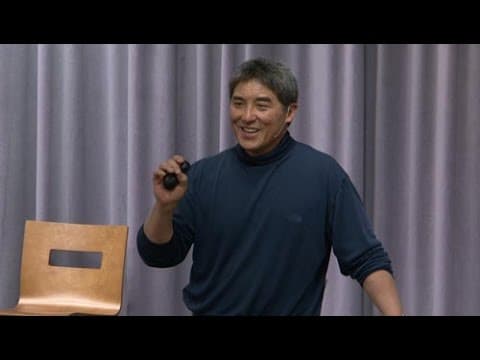
Shirzad Chamine: Confront Your Inner Judge

TL;DR
Negative emotions are useful only long enough to signal a problem and prompt corrective action. When shame, guilt, anger, disappointment, or stress persists, the inner Judge has taken control and begins harming performance. Weaken it by identifying its criticism as sabotage, acknowledging that the message has already been received, and shifting away from repeated self-punishment toward positive energy.
Transcript
- Now of these saboteurs, all of them, every single one of them basically come into your life as you try to answer the following question, "To survive and succeed, I should ..." Saboteurs come into your life and take hold in your brain and become neural pathways in your brain in automatic reactions to things as you try to answer "To Survive and Suc... Read More
Key Insights
- Saboteurs are automatic neural reactions formed while children determine what they believe they must do to survive and succeed. Because every child has different wiring and challenges, people develop different combinations of these patterns, although everyone acquires at least some of them.
- The Judge is the universal saboteur, and it extends beyond the voice commonly called the inner critic. It repeatedly identifies personal shortcomings, attacks mistakes, finds faults in other people, and creates stress and unhappiness while presenting its judgments as necessary or truthful.
- Self-criticism can masquerade as ambition because people may learn that achievement requires being relentlessly hard on themselves. The Judge uses this belief to justify repeated punishment, even after a mistake has been recognized and its practical lesson has already been understood.
- Judging other people can function as emotional self-protection when the Judge has already declared the self defective. Finding flaws in colleagues, executives, or other people reduces the feeling of being the only failure, but it also damages relationships and constructive problem solving.
- Negative emotions are useful signals when something has gone wrong. Anger, shame, guilt, disappointment, and stress can capture attention and motivate corrective action, just as physical pain warns someone to remove a hand immediately from a dangerously hot surface.
- Persistent negative emotion is evidence of saboteur hijacking rather than productive reflection. Once the problem has been recognized, continuing to feel bad no longer improves the response. Instead, the prolonged reaction disrupts performance and keeps attention trapped in criticism or blame.
- Positive energy is the path to highest performance, according to Chamine's framework. Negative feelings should provide a brief alert, but they should not become the continuing source of motivation because sustained distress allows destructive mental patterns to control behavior.
- The Judge can be weakened by exposing its repeated criticism as sabotage. A person can acknowledge that the warning was received, state that further punishment is no longer useful, and reject the Judge's claim that continued self-attack will improve performance.
Install to Summarize YouTube Videos and Get Transcripts
Explore YouTube Video Summarizer or Get YouTube Transcript Extractor
Questions & Answers
Q: What is the inner Judge saboteur?
The inner Judge is a universal saboteur that criticizes the self, identifies faults in other people, and reacts harshly when circumstances go wrong. It is broader than the inner critic because its judgments target both personal shortcomings and everyone nearby. Although it may claim to support survival, ambition, or improvement, its repeated attacks produce stress, unhappiness, and poorer performance.
Q: How do mental saboteurs develop during childhood?
Mental saboteurs develop as children try to determine what they must do to survive and succeed. Each child answers that question differently because each has different wiring and faces different challenges. Their answers become neural pathways and automatic reactions. These patterns may initially address physical or emotional survival, but they can become destructive when they continue controlling thoughts and behavior in adulthood.
Q: Why does the Judge criticize both yourself and others?
The Judge attacks the self because it presents harsh criticism as necessary for improvement, ambition, or survival. It then identifies faults in others as a form of emotional protection. If the Judge has labeled someone a failure, seeing everyone else as flawed makes that person feel less isolated. This response may reduce immediate emotional discomfort, but it promotes blame and remains destructive.
Q: Are negative emotions useful for improving performance?
Negative emotions are useful when they briefly signal that something is wrong and direct attention toward corrective action. Anger, shame, guilt, disappointment, or stress can prevent someone from ignoring a failure or repeating harmful behavior. Their usefulness ends once the message is understood. Prolonged negative emotion indicates that a saboteur has taken control and is interfering with performance rather than improving it.
Q: How long should negative emotions last after a mistake?
Negative emotions should last only long enough to reveal the problem and initiate corrective action, described in the talk as a split second or a few seconds. The comparison is physical pain from touching a hot stove: pain is valuable because it triggers immediate withdrawal, but continuing to experience it after responding provides no additional benefit. Extended distress signals saboteur hijacking.
Q: Why is repeated self-punishment harmful after failure?
Repeated self-punishment is harmful because it continues after the failure has already delivered its useful information. Once a person recognizes the mistake and understands that corrective action is needed, further criticism does not add insight. Instead, the Judge keeps the person trapped in shame, guilt, or stress, consumes useful energy, and interferes with the positive state associated with highest performance.
Q: How can you weaken the inner Judge?
The inner Judge can be weakened by noticing its voice, exposing its claims as sabotage, and directly challenging repeated criticism. A person can acknowledge that the mistake has been recognized and that the lesson has already been received. They can then state that continued self-attack is no longer useful. This separates a valid warning from the destructive punishment that follows it.
Q: How did the Judge contribute to an entrepreneurial meltdown?
During problems at Chamine's company, the Judge attacked him for making mistakes despite his training and promises. At the same time, it identified faults in executives, the company president, and the board. Because he believed what this voice said, self-criticism and blame ran unchecked. The pattern increased destructive negative energy instead of supporting clear correction and stronger performance.
Summary
In this video, the speaker talks about the concept of saboteurs, which are negative voices in our heads that come into our lives as we try to answer the question, "To survive and succeed, I should..." One universal saboteur is The Judge, which goes beyond just being an inner critic and constantly finds faults in ourselves and others. The speaker shares how The Judge played a role in their entrepreneurial meltdown and how they believed every word of this destructive character. The speaker also addresses the question of whether negative emotions, like those caused by The Judge, are actually good for us. They explain that while negative emotions can be useful in signaling a problem, staying in them for too long allows the saboteurs to hijack our performance. The strategy they propose is to expose and weaken the Judge saboteur by recognizing its destructive nature and not allowing it to continue sabotaging us.
Questions & Answers
Q: What is the role of saboteurs in our lives?
Saboteurs come into our lives as we try to answer the question, "To survive and succeed, I should..." They become neural pathways in our brains and automatic reactions to things. Each person answers this question differently based on their wiring and challenges, resulting in the development of different saboteurs.
Q: What is The Judge saboteur?
The Judge is a universal saboteur that goes beyond just being an inner critic. It constantly beats us up and finds faults in ourselves and others. The speaker shares how The Judge played a significant role in their entrepreneurial meltdown, as it constantly berated them for their mistakes and found faults with everyone else involved in their company.
Q: Why did the speaker believe every word of The Judge?
The speaker believed every word of The Judge because they had been raised to believe that being hard on oneself and constantly pushing oneself is necessary for ambition and achievement. The Judge was seen as a good thing for their survival, and they had also learned to judge others to avoid feeling like the only loser in the world.
Q: Are negative emotions, like those caused by The Judge, actually good for us?
Negative emotions, including anger, shame, guilt, and disappointment, can be useful in signaling a problem and motivating us to improve. However, the key is to not stay in these emotions for too long. If we remain in negative emotions for more than a few seconds, we become hijacked by our saboteurs, which affects our performance.
Q: How does staying in negative emotions for too long impact our performance?
Staying in negative emotions for too long allows our saboteurs to hijack our performance. Our path to highest performance is through positive energy, so any time we are in negative emotion for more than a few seconds, it hinders our ability to perform at our best.
Q: What strategy does the speaker suggest to weaken the Judge saboteur?
The speaker suggests exposing and weakening the Judge saboteur by recognizing its destructive nature. By calling out the negative self-talk and telling it that it is no longer serving us, we can prevent it from continuing to sabotage us.
Q: How can we weaken our saboteurs?
We can weaken our saboteurs by consciously recognizing their presence and challenging their negative beliefs. By questioning their validity and intentionally choosing more empowering thoughts and actions, we can diminish their influence over us.
Q: How can we prevent our saboteurs from hijacking our performance?
One way to prevent our saboteurs from hijacking our performance is by developing self-awareness. By being mindful of our emotional state and recognizing when we are being influenced by negative voices, we can take corrective action and shift our focus towards positive energy.
Q: Why is positive energy important for our performance?
Positive energy is important for our performance because it enables us to approach challenges with a clear and focused mindset. It allows us to tap into our strengths and resources, leading to more effective problem-solving and overall better performance.
Q: Can we completely eliminate our saboteurs?
It is unlikely that we can completely eliminate our saboteurs, as they are deeply ingrained neural pathways in our brains. However, we can weaken their influence and learn to manage them more effectively through self-awareness and intentional mindset shifts.
Takeaways
The key takeaway from this video is that our saboteurs, particularly The Judge saboteur, can have a detrimental impact on our performance if we allow negative emotions to linger for too long. While negative emotions can be useful in signaling problems, they should only be experienced for a split second before we take corrective action. Recognizing the destructive nature of our saboteurs and consciously challenging their negative beliefs is essential in weakening their influence. By cultivating positive energy and focusing on empowering thoughts, we can unlock our full potential and achieve higher levels of performance.
Summary & Key Takeaways
-
Saboteurs develop as automatic mental reactions to childhood attempts to answer how one must behave to survive and succeed. Different wiring and challenges produce different saboteurs, but everyone develops some. The Judge is universal, operating as a neural pattern that criticizes the self, condemns other people, and magnifies problems during difficult situations.
-
Chamine describes how his Judge contributed to an entrepreneurial meltdown by attacking him for mistakes while blaming executives, his company president, and the board. He had learned that ambition required relentless self-criticism. Judging others then provided emotional protection by making him feel that he was not the only flawed person.
-
Negative emotions serve a useful signaling function, much like pain prompts someone to remove a hand from a hot stove. Their benefit ends after they draw attention to a problem and encourage corrective action. Remaining distressed afterward indicates saboteur hijacking, which interferes with performance and blocks access to positive energy.
Read in Other Languages (beta)
Share This Summary 📚
Summarize YouTube Videos and Get Video Transcripts with 1-Click
Try YouTube Summary with ChatGPT & Claude or YouTube Transcript Generator
Explore More Summaries from Stanford eCorner 📚

![Building the Cryptocurrency Ecosystem [Entire Talk] thumbnail](/_next/image?url=https%3A%2F%2Fi.ytimg.com%2Fvi%2FMMMowIomsww%2Fhqdefault.jpg&w=750&q=75)

![Debbie Sterling: Disrupting the Pink Aisle [Entire Talk] thumbnail](/_next/image?url=https%3A%2F%2Fi.ytimg.com%2Fvi%2Fpptovj4UczY%2Fhqdefault.jpg&w=750&q=75)

Summarize YouTube Videos and Get Video Transcripts with 1-Click
Try YouTube Summary with ChatGPT & Claude or YouTube Transcript Generator