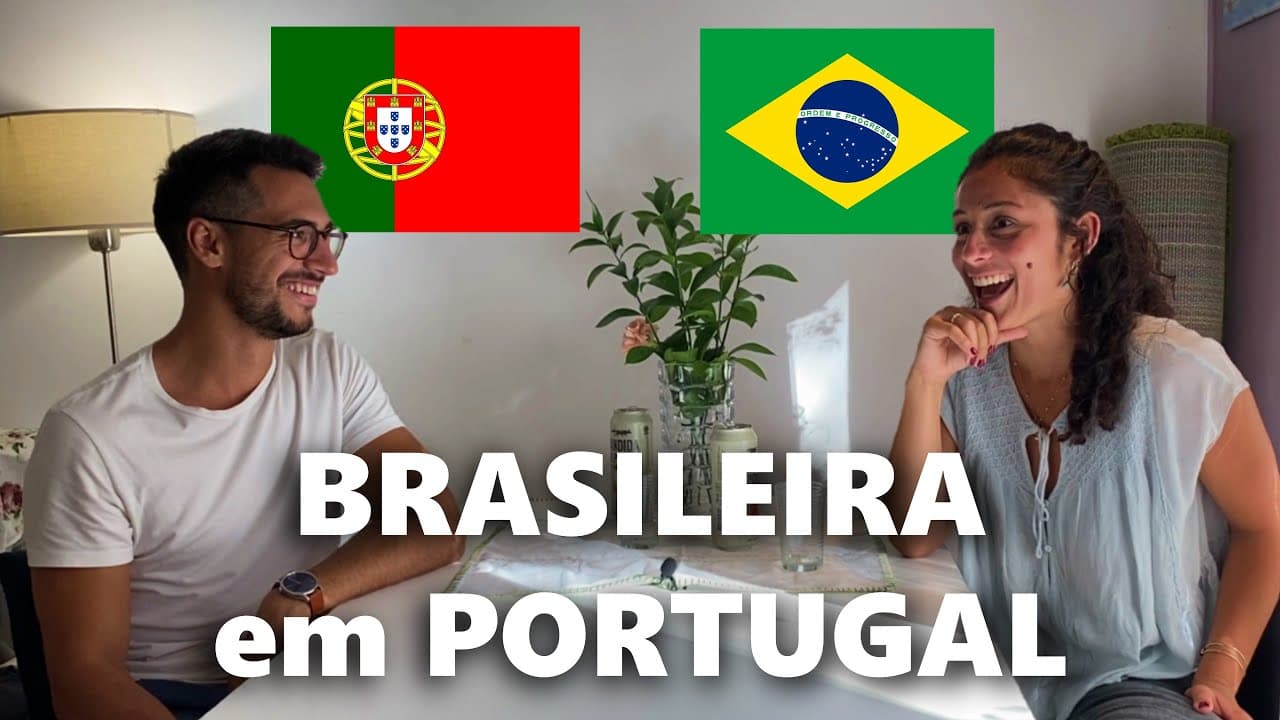
Uma brasileira que cresceu em Portugal e fala como portuguesa
TL;DR
Camila, a Brazilian, navigates dual Portuguese accents in Portugal.
Transcript
Hi everyone and welcome back to Portuguese With Leo. Today we have a very special video because I have my friend Camila here. Hello. Who's from... Brazil. Brazil. However, when we talk to each other, you speak with that accent that's... Very Portuguese. Very Portuguese. And that's precisely what we're going to see in today's video. Camila speaks ... Read More
Key Insights
- Camila, originally from Brazil, moved to Portugal at age seven due to an economic crisis in Brazil, impacting her linguistic development.
- Growing up in Portugal, Camila adapted to speaking European Portuguese at school and Brazilian Portuguese at home, leading to a unique bilingual identity.
- Camila's ability to switch between Brazilian and European Portuguese is influenced by the social context, showcasing her linguistic adaptability.
- The video discusses the challenges and nuances of growing up bilingual, including identity crises and the blending of languages.
- Camila's story highlights the cultural and emotional aspects of immigration, particularly for those who move at a young age.
- The linguistic differences between Brazilian and European Portuguese, such as vocabulary and pronunciation, are explored in the video.
- Camila's experience underscores the importance of language in forming personal and cultural identity in a new country.
- The video ends with an invitation to viewers to suggest future topics, indicating an interactive and community-focused approach.
Install to Summarize YouTube Videos and Get Transcripts
Explore YouTube Video Summarizer or Get YouTube Transcript Extractor
Questions & Answers
Q: How did Camila end up in Portugal?
Camila moved to Portugal with her family when she was seven years old due to an economic crisis in Brazil. Her mother, a programmer, found better job opportunities in Portugal, which prompted the family's relocation. This move significantly influenced Camila's linguistic and cultural identity as she grew up.
Q: What linguistic challenges did Camila face growing up?
Camila faced the challenge of switching between Brazilian and European Portuguese depending on the social context. At school and in public, she spoke European Portuguese, while at home, she maintained Brazilian Portuguese. This duality sometimes led to confusion and identity crises as she navigated two versions of the same language.
Q: How does Camila handle speaking different accents?
Camila adjusts her accent based on her interlocutor. When speaking with Brazilians, she adopts a Brazilian accent, but with Europeans, she uses a European Portuguese accent. This adaptability is rooted in her desire to be understood and accepted in different social settings, reflecting her bilingual proficiency.
Q: What cultural differences did Camila notice between Brazil and Portugal?
Camila noted several cultural differences, particularly in language usage and social interactions. For instance, certain words have different meanings in each country, which sometimes led to misunderstandings. Additionally, she experienced a cultural shift in social norms and expectations, which influenced her adaptation process.
Q: What role did language play in Camila's identity?
Language played a crucial role in shaping Camila's identity. Growing up bilingual, she developed a unique sense of self that encompassed both Brazilian and Portuguese cultural elements. This bilingualism allowed her to navigate different social environments effectively, but also led to moments of identity confusion and introspection.
Q: How did Camila's family influence her language development?
Camila's family maintained Brazilian cultural and linguistic practices at home, which helped her retain her Brazilian Portuguese. This familial environment provided a sense of cultural continuity amidst the broader Portuguese-speaking society, allowing her to develop a strong bilingual identity that embraced both cultures.
Q: What were some linguistic misunderstandings Camila encountered?
Camila encountered misunderstandings due to vocabulary differences between Brazilian and European Portuguese. Words like "sítio" and "bico" have different meanings in each dialect, leading to confusion in conversations. These experiences highlighted the importance of context and adaptability in her bilingual journey.
Q: How does Camila view her bilingualism now?
As she has matured, Camila views her bilingualism as an integral part of her identity. She has become more comfortable with the dual aspects of her language skills, embracing both Brazilian and European Portuguese as part of her cultural heritage. This acceptance reflects her growth and adaptability as an immigrant.
Summary & Key Takeaways
-
Camila, a Brazilian who moved to Portugal as a child, shares her experiences navigating between Brazilian and European Portuguese, highlighting the linguistic and cultural challenges she faced.
-
The video explores how Camila adapted to speaking European Portuguese in public settings while maintaining Brazilian Portuguese at home, leading to a unique bilingual identity.
-
Camila's story illustrates the complexities of growing up as an immigrant, dealing with identity crises, and the emotional aspects of adapting to a new language and culture.
Read in Other Languages (beta)
Share This Summary 📚
Summarize YouTube Videos and Get Video Transcripts with 1-Click
Try YouTube Summary with ChatGPT & Claude or YouTube Transcript Generator
Explore More Summaries from Portuguese With Leo 📚
Summarize YouTube Videos and Get Video Transcripts with 1-Click
Try YouTube Summary with ChatGPT & Claude or YouTube Transcript Generator