1st Order Circuits
TL;DR
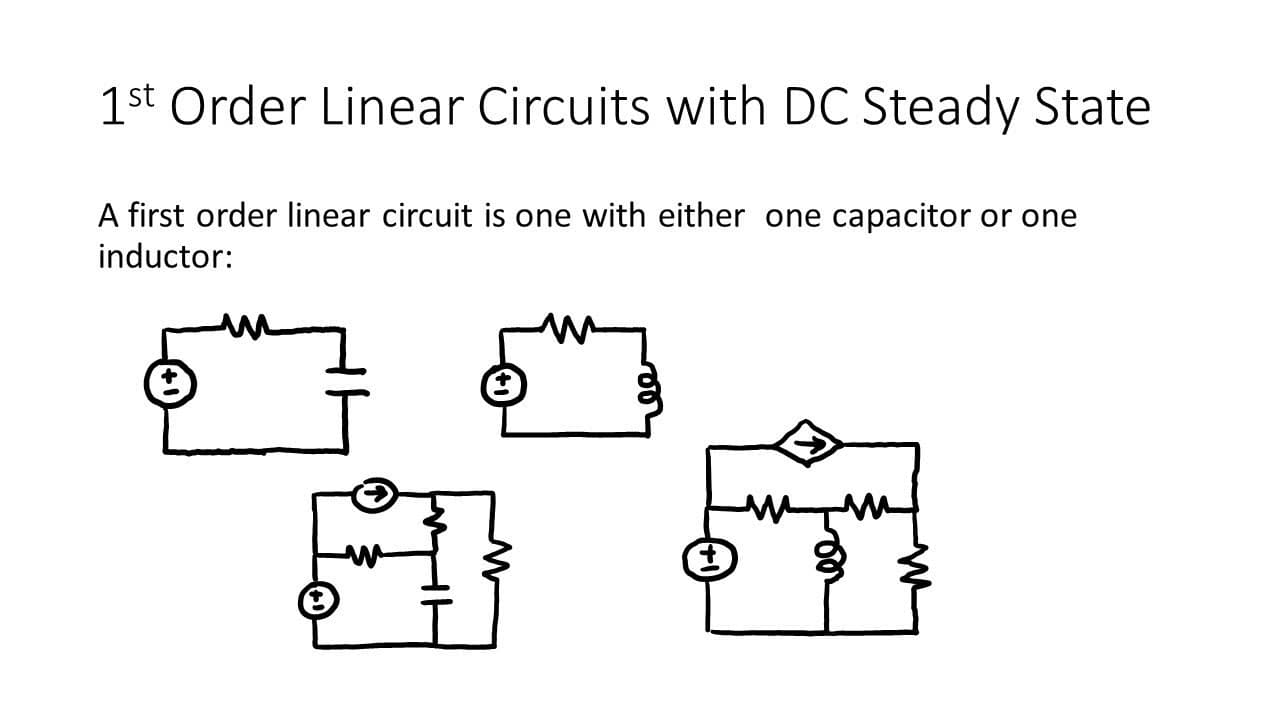
This video provides a method to solve first-order linear circuits with a DC steady state using differential equations.
Transcript
this is a quick overview on solving first order linear circuits that have a DC steady state these are circuits that are composed of either one capacitor or one inductor and also have other linear elements such as resistors and sources sometimes a circuit with two or more capacitors or with two or more inductors is also a first-order circuit that wi... Read More
Key Insights
- 🪈 First-order circuits include one capacitor or one inductor, linear elements, and satisfy the DC steady state.
- 0️⃣ The homogeneous equation for solving the circuit can be obtained by reducing the circuit and zeroing out the independent sources.
- 🍆 The parameter tau (τ) is essential for solving the differential equation and can be obtained from the coefficient on X in the homogeneous equation.
- 🍆 The solution to the first-order circuit is an exponential decay function that depends on the initial condition, DC steady state, and tau.
Install to Summarize YouTube Videos and Get Transcripts
Explore YouTube Video Summarizer or Get YouTube Transcript Extractor
Questions & Answers
Q: What are first-order circuits composed of?
First-order circuits are composed of linear elements like resistors, sources, and either one capacitor or one inductor.
Q: Why is the DC steady state solution important?
The DC steady state solution is important because it satisfies all the circuit laws and serves as one of the solutions to the differential equation.
Q: How can the circuit be simplified for solving the homogeneous equation?
The circuit can be simplified by zeroing out the independent sources and reducing it, combining elements as needed.
Q: What are the two possible first-order circuits that can be obtained?
The two possible first-order circuits are an RC circuit (resistor and capacitor) and an RL circuit (resistor and inductor).
Summary & Key Takeaways
-
First-order circuits include circuits with one capacitor or one inductor, as well as linear elements like resistors and sources.
-
The differential equation for solving the circuit involves the circuit laws, and the DC steady state solution is one of the solutions.
-
By zeroing out the independent sources and reducing the circuit, the homogeneous equation can be obtained, leading to the solution.
Read in Other Languages (beta)
Share This Summary 📚
Summarize YouTube Videos and Get Video Transcripts with 1-Click
Try YouTube Summary with ChatGPT & Claude or YouTube Transcript Generator
Explore More Summaries from Michelle Zheng 📚
Summarize YouTube Videos and Get Video Transcripts with 1-Click
Try YouTube Summary with ChatGPT & Claude or YouTube Transcript Generator