1st Order initial conditions in switched circuits
TL;DR
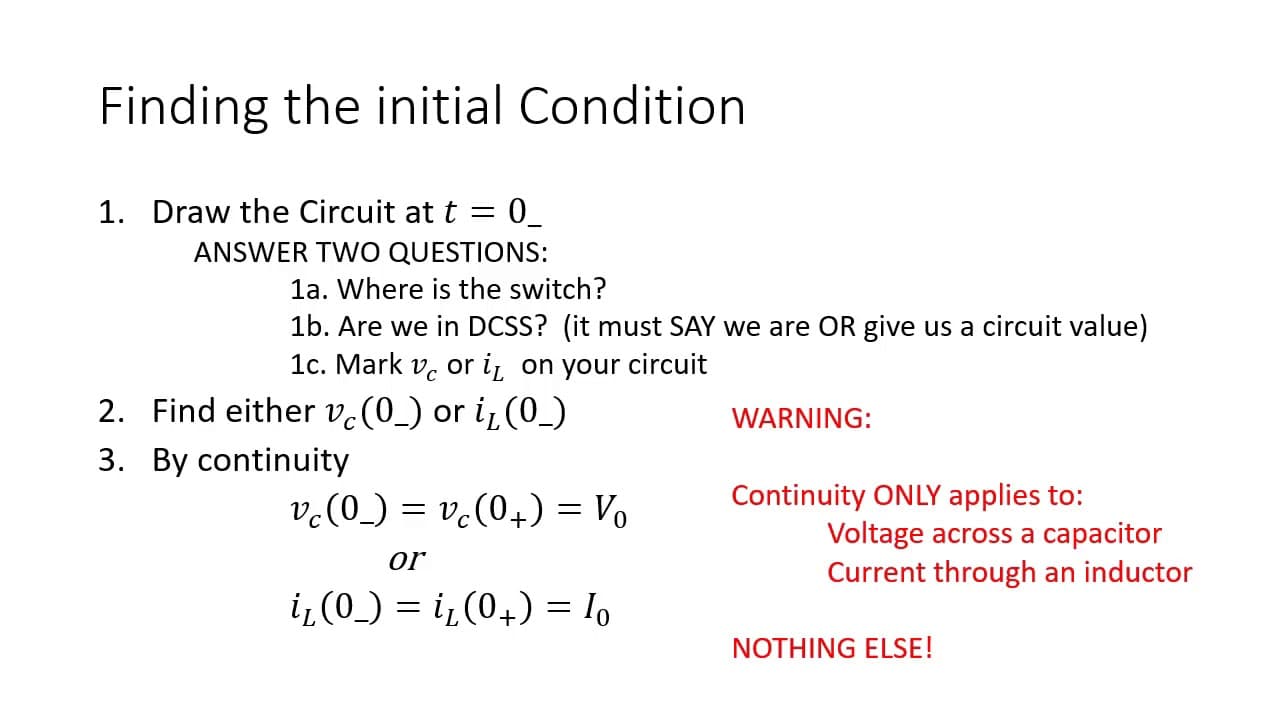
This content explains how to find the initial value for a first-order switch DC circuit solution, which requires considering the circuit before and after the switch moves at time T=0.
Transcript
capacitors and inductors have memory so in order to solve a circuit with either a capacitor and an inductor in it you will always need to have an initial value we'll talk about how to find the initial value for a first-order switched DC circuit solutions for a first-order circuit are exponential and involve three elements an initial value a final v... Read More
Key Insights
- 🔑 Capacitors and inductors have memory, so finding the initial value is crucial for solving circuits with them. Exponential solutions for first-order circuits involve an initial value, final value, or a DC value, and the time constant tau.
- 🛠️ Switch circuits involve two different circuits: one for T less than zero and one for T greater than zero. Continuity between the two circuits is essential for finding initial conditions at T equals zero plus.
- 🔌 When solving switch circuits, continuity only applies to the voltage across a capacitor and current through an inductor. Other voltages and currents can change as soon as the switch moves.
- ➡️ To find the initial condition at T equals zero plus, start at T equals zero minus, draw the circuit in that state, determine the switch position, and check if the circuit is in DC steady state.
- 🔍 If the circuit is in DC steady state, replace the capacitor with an open circuit. Mark VC on the circuit and solve for VC at T equals zero minus using nodal voltages.
- 🔄 For circuits not in DC steady state, continuity should be established by providing an initial value at T equals zero minus for voltage or current.
- 💡 Solve for the initial condition V0 by setting VC at T equals zero minus equal to VC at T equals zero plus.
- 🧪 Example 1: If the circuit is in DC steady state at T equals zero minus, replace the capacitor with an open circuit. Solve for VC at T equals zero minus and use continuity to find V0.
Install to Summarize YouTube Videos and Get Transcripts
Explore YouTube Video Summarizer or Get YouTube Transcript Extractor
Questions & Answers
Q: How do you find the initial value for a switched DC circuit?
To find the initial value for a switched DC circuit, start by drawing the circuit at T=0- and consider the position of the switch and if the circuit is in DC steady state. Use continuity to equate the voltage or current at T=0- to the corresponding value at T=0+.
Q: What are the two circuits involved in a switched DC circuit?
A switched DC circuit involves two circuits: one before the switch moves at T<0 and another after the switch moves at T>0.
Q: What is the initial condition for the circuit after the switch moves?
The initial condition for the circuit after the switch moves is the voltage across a capacitor or the current through an inductor at time T=0+.
Q: How can you determine the initial condition of a switched DC circuit?
To determine the initial condition of a switched DC circuit, draw the circuit at T=0- and consider the switch position and the presence of DC steady state. Use continuity to equate the voltage or current at T=0- to the respective value at T=0+.
Summary & Key Takeaways
-
Switched DC circuits involve two circuits: one before the switch moves at T<0 and one after the switch moves at T>0.
-
The initial condition for the circuit after the switch moves is the voltage across a capacitor or the current through an inductor at time T=0+.
-
To find the initial condition, start by drawing the circuit at T=0- and consider the position of the switch and whether the circuit is in DC steady state.
-
Use continuity to determine the initial condition by equating the voltage or current at T=0- to the corresponding value at T=0+.
Read in Other Languages (beta)
Share This Summary 📚
Summarize YouTube Videos and Get Video Transcripts with 1-Click
Try YouTube Summary with ChatGPT & Claude or YouTube Transcript Generator
Explore More Summaries from Michelle Zheng 📚
Summarize YouTube Videos and Get Video Transcripts with 1-Click
Try YouTube Summary with ChatGPT & Claude or YouTube Transcript Generator