Mesh Analysis and supermeshes
TL;DR
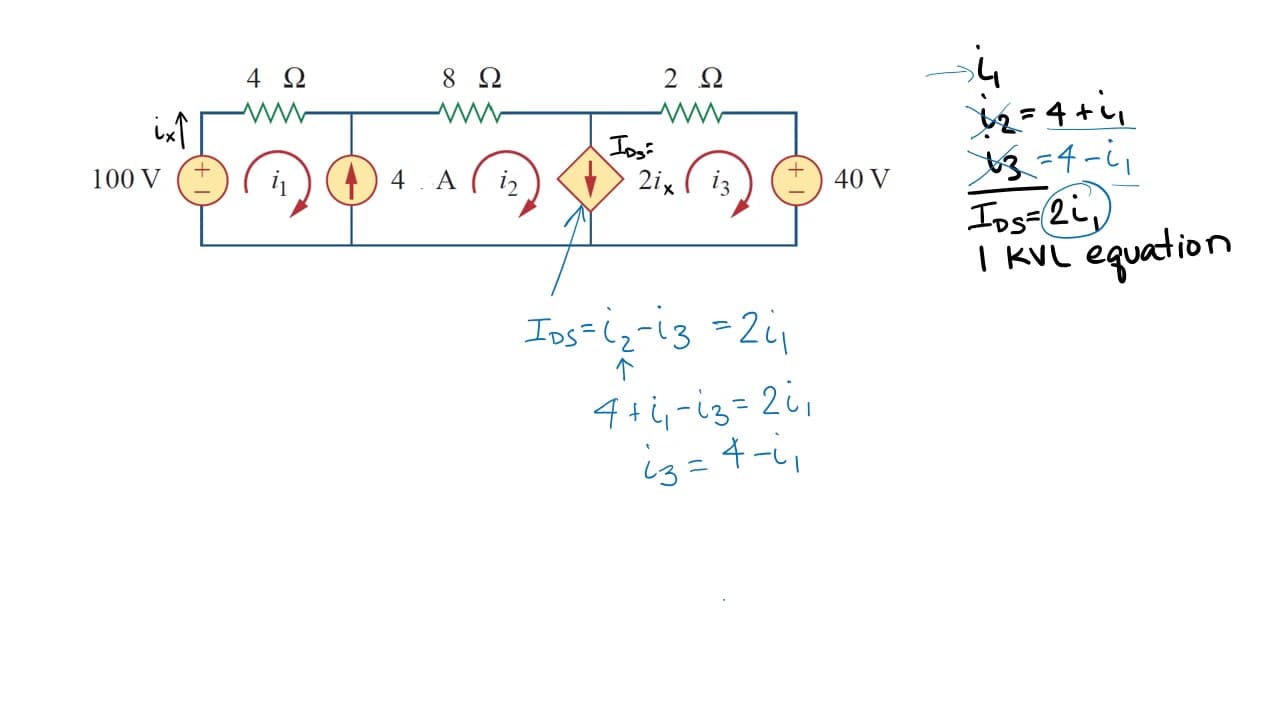
This video explains how to use mesh analysis to solve a circuit with a super mesh and indirectly solved mesh currents.
Transcript
this video is going to show an example of using mesh analysis on a circuit that requires a super mesh and one that requires you to solve for mesh currents indirectly the first step in mesh analysis is to label the mesh currents in the circuit this circuit has three meshes so it has three mesh currents we want to label them all going the same direct... Read More
Key Insights
- 😑 Mesh currents need to be labeled and expressed in terms of dependent sources in mesh analysis.
- #️⃣ The number of KVL equations required depends on the number of meshes and current sources in the circuit.
- 🦸 Super meshes can be used to write KVL equations in circuits even if there are no suitable mesh loops.
- ℹ️ Indirectly solved mesh currents can be calculated using current sources in the circuit.
Install to Summarize YouTube Videos and Get Transcripts
Explore YouTube Video Summarizer or Get YouTube Transcript Extractor
Questions & Answers
Q: How do you label mesh currents in a circuit for mesh analysis?
To label mesh currents, choose a consistent direction for all currents and label them accordingly. In this video, the mesh currents are labeled as i1, i2, and i3.
Q: How do you express dependent sources in terms of mesh currents?
Dependent sources can be expressed in terms of mesh currents by analyzing the particular branch or element they are connected to. In this video, the dependent current controlled current source is expressed as ix = i1.
Q: How many KVL equations are required for a circuit in mesh analysis?
The number of KVL equations needed is determined by subtracting the number of current sources from the number of meshes in the circuit. In this video, since there are three meshes and two current sources, only one KVL equation is needed.
Q: Can KVL equations be written anywhere in the circuit?
KVL equations can be written around any closed loop in the circuit. In this video, a super mesh loop, which includes all three meshes, is used to write the KVL equation.
Key Insights:
- Mesh currents need to be labeled and expressed in terms of dependent sources in mesh analysis.
- The number of KVL equations required depends on the number of meshes and current sources in the circuit.
- Super meshes can be used to write KVL equations in circuits even if there are no suitable mesh loops.
- Indirectly solved mesh currents can be calculated using current sources in the circuit.
- Power delivered or absorbed by a source in a circuit can be calculated using voltage and current associated with the source.
Summary & Key Takeaways
-
The video demonstrates the steps of mesh analysis, starting with labeling the mesh currents in the circuit and expressing dependent sources in terms of mesh currents.
-
The number of KVL equations needed for the circuit is determined, based on the number of meshes and current sources.
-
The video shows how to solve for mesh currents indirectly using current sources and how to write a KVL equation for a super mesh in the circuit.
Read in Other Languages (beta)
Share This Summary 📚
Summarize YouTube Videos and Get Video Transcripts with 1-Click
Try YouTube Summary with ChatGPT & Claude or YouTube Transcript Generator
Explore More Summaries from Michelle Zheng 📚
Summarize YouTube Videos and Get Video Transcripts with 1-Click
Try YouTube Summary with ChatGPT & Claude or YouTube Transcript Generator