basic nodal analysis
TL;DR
This video provides a step-by-step guide to performing nodal analysis on circuits without dependent sources, including how to set up the circuit, select the ground, solve for unknown nodal voltages, and write the KCL equations.
Transcript
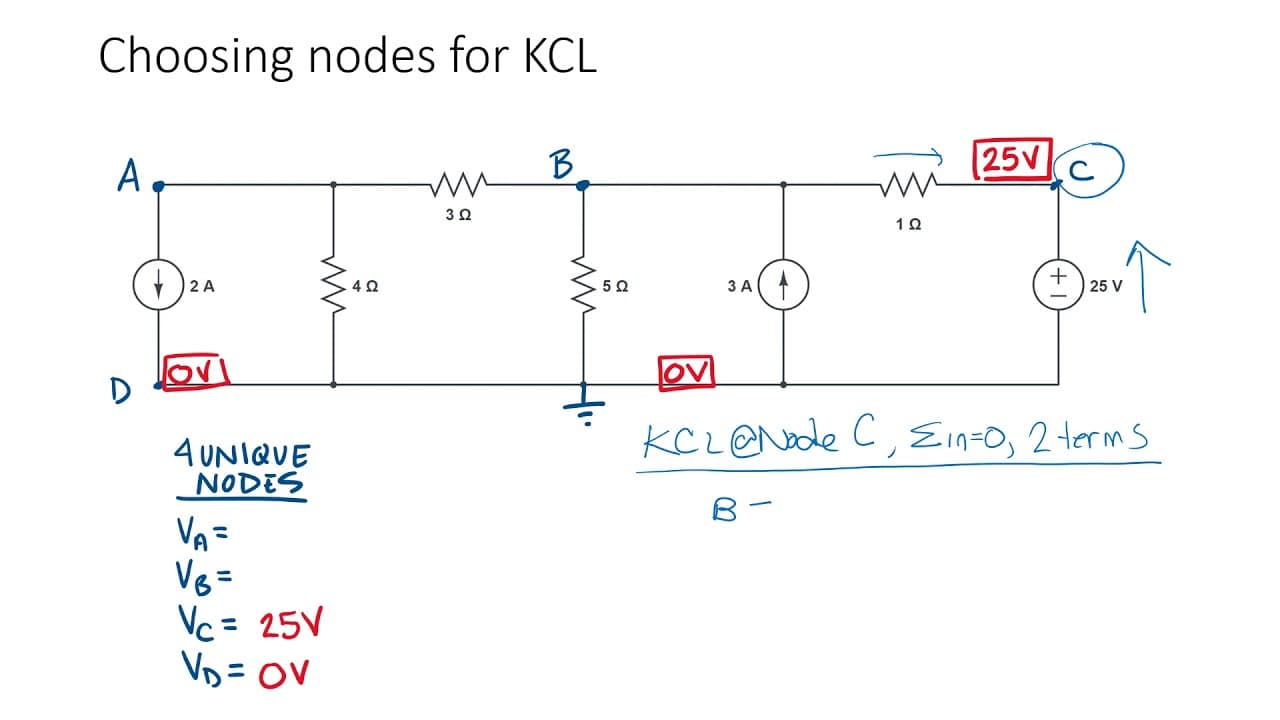
this video covers basic nodal analysis on circuits that do not contain dependent sources for nodal analysis we are going to generate a system of n equations with an unknowns there are two rules about using formal modal analysis to generate this system of equations the first rule is that every variable must be a nodal voltage the second rule is that... Read More
Key Insights
- ℹ️ Nodal analysis is a powerful method for solving circuit problems, especially when there are no dependent sources involved.
- 😫 Properly setting up the circuit by labeling nodes and selecting the ground is crucial for successful nodal analysis.
- ⌛ The minimum number of KCL equations needed can be determined in advance, saving time and effort.
- ⚡ Solving for known nodal voltages first can reduce the number of unknowns and simplify the equations.
- ❓ It is important to choose the nodes carefully for writing the KCL equations to avoid introducing additional variables.
- 🍹 Different methods can be used to write the KCL equations, such as sum of currents in, sum of currents out, or equation of currents equal to zero.
- ✅ Checking the equations for correctness and double-checking the direction of currents is essential.
Install to Summarize YouTube Videos and Get Transcripts
Explore YouTube Video Summarizer or Get YouTube Transcript Extractor
Questions & Answers
Q: What is nodal analysis used for?
Nodal analysis is used to solve for nodal voltages in a circuit without dependent sources by generating a system of equations with unknowns.
Q: How do you determine the minimum number of KCL equations needed for nodal analysis?
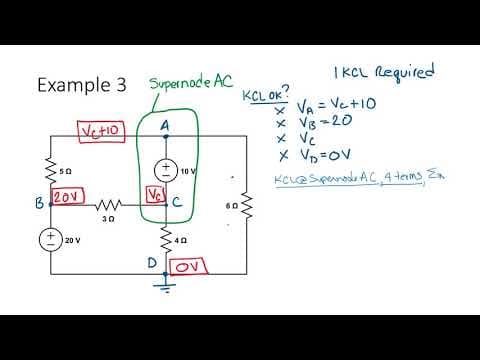
The minimum number of KCL equations can be determined using the formula: number of nodes - number of voltage sources - 1.
Q: Can any node be chosen as the ground for nodal analysis?
Yes, any node can be chosen as the ground as long as it is not connected to an operational amplifier (op amp).
Q: How do you know where to write the KCL equations for nodal analysis?
The KCL equations should be written at the unique nodes in the circuit that do not introduce any additional variables.
Key Insights:
- Nodal analysis is a powerful method for solving circuit problems, especially when there are no dependent sources involved.
- Properly setting up the circuit by labeling nodes and selecting the ground is crucial for successful nodal analysis.
- The minimum number of KCL equations needed can be determined in advance, saving time and effort.
- Solving for known nodal voltages first can reduce the number of unknowns and simplify the equations.
- It is important to choose the nodes carefully for writing the KCL equations to avoid introducing additional variables.
- Different methods can be used to write the KCL equations, such as sum of currents in, sum of currents out, or equation of currents equal to zero.
- Checking the equations for correctness and double-checking the direction of currents is essential.
- Tools like calculators or online solvers can be used to solve the system of equations, but it is important to check the solution by calculating branch currents to ensure accuracy.
Summary & Key Takeaways
-
Nodal analysis involves generating a system of equations with unknowns in order to solve for nodal voltages in a circuit.
-
The circuit should be labeled with unique nodes and a ground chosen.
-
The number of KCL equations needed can be determined by the formula: number of nodes - number of voltage sources - 1.
-
The KCL equations should be written at the nodes that do not introduce additional variables.
-
The nodal voltages that can be solved for with known values should be determined first to reduce the number of unknowns.
Read in Other Languages (beta)
Share This Summary 📚
Summarize YouTube Videos and Get Video Transcripts with 1-Click
Try YouTube Summary with ChatGPT & Claude or YouTube Transcript Generator
Explore More Summaries from Michelle Zheng 📚
Summarize YouTube Videos and Get Video Transcripts with 1-Click
Try YouTube Summary with ChatGPT & Claude or YouTube Transcript Generator