opampnegfeedback
TL;DR
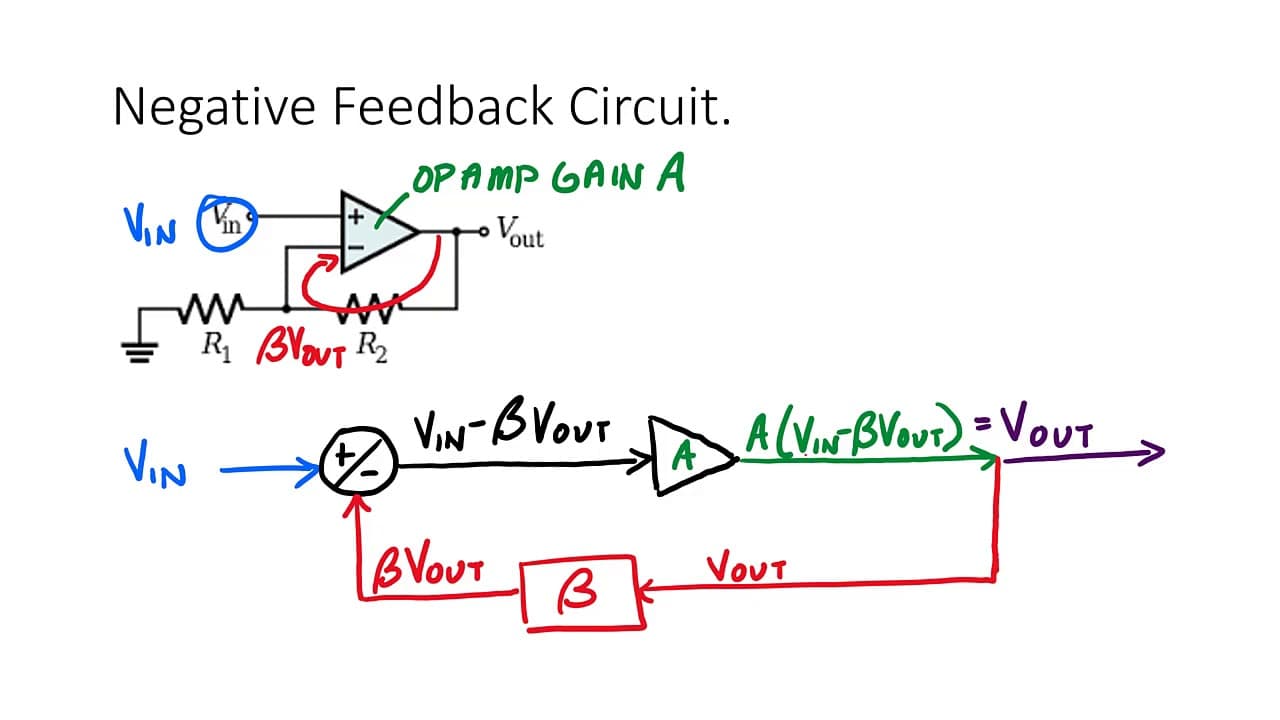
Negative feedback in op-amp circuits helps maintain stability and ensures that the non-inverting input voltage equals the inverting input voltage, allowing the op-amp to operate in its linear range.
Transcript
how did this circuit turn the high-gain unstable op-amp into a friendly well-behaved non-inverting amplifier circuit let's take another look at our circuit and what the nodal voltage v- is we know v- is beta times V out we can use our gain formula to solve for V out and we get V out is equal to 1 over beta times V in substituting for V out we get t... Read More
Key Insights
- 🔌 Op-amp circuits with negative feedback force V Plus to equal V Minus, operating within the op-amp's linear range and exhibiting ideal op-amp properties.
- 🔋 Negative feedback systems, like op-amp circuits, are integral in different fields of engineering and in everyday life, maintaining stability and functionality.
- ⚖️ When analyzing op-amp circuits, the closed-loop gain model can be used, assuming the circuit has negative feedback, simplifying analysis with zero input currents and equal input nodal voltages.
- 📏 Op-amp circuits that lack negative feedback or have paths back to the non-inverting terminal or ground do not exhibit stability or negative feedback.
- 💪 Op amps have the capability to perform a wide range of operations on input voltages, making them highly versatile and useful in various applications.
- 🧪 The closed-loop gain model assumes ideal op-amp limits and requires the circuit to have negative feedback, ensuring V Plus equals V Minus.
- ⚙️ Understanding negative feedback systems and their application in op-amp circuits is crucial for analyzing and designing functional and stable circuits in engineering.
- 💡 By harnessing the benefits of negative feedback, op-amp circuits can be designed to perform complex operations and tasks with relative ease and efficiency.
Install to Summarize YouTube Videos and Get Transcripts
Explore YouTube Video Summarizer or Get YouTube Transcript Extractor
Questions & Answers
Q: How does negative feedback in op-amp circuits help maintain stability?
Negative feedback in op-amp circuits helps maintain stability by forcing the non-inverting input voltage to equal the inverting input voltage, operating the op-amp in its linear range. This narrow window of operation ensures the ideal op-amp properties apply, leading to stable circuit behavior.
Q: What is the difference between negative feedback and positive feedback in op-amp circuits?
Negative feedback occurs when a portion of the output is fed back to the inverting input, subtracted from the input signal. This leads to stability. Positive feedback, on the other hand, amplifies and reinforces the input signal, which can cause instability and oscillation in the circuit.
Q: How can you determine if an op-amp circuit has negative feedback?
To determine if an op-amp circuit has negative feedback, you need to trace the feedback loop. If there is a path from the output back to the inverting input (negative input), which could include resistors and voltage supplies, then the circuit has negative feedback. If the loop goes back to the non-inverting input (positive terminal), it is positive feedback, which can lead to instability.
Q: What are the properties used to simplify the analysis of op-amp circuits with negative feedback?
When analyzing op-amp circuits with negative feedback, you can simplify the analysis by using two properties. First, the input currents are equal to zero. Second, the input nodal voltages are forced to be equal to each other. These properties allow for easier circuit analysis and design.
Q: Why are op amps widely used in various applications?
Op amps are widely used because they can perform a wide range of operations on input voltages. By designing circuits with op amps, it is possible to amplify, filter, integrate, differentiate, and perform many other operations on the input signals. The versatility and flexibility of op amps make them highly useful in electronics.
Summary & Key Takeaways
-
The circuit uses negative feedback to force the op-amp into its linear range, where the non-inverting input voltage is equal to the inverting input voltage.
-
Negative feedback is essential in various fields of engineering and everyday life, as it helps maintain stability and control systems.
-
Op-amp circuits with negative feedback can be easily analyzed using the closed-loop gain model, where the input currents are zero and the input nodal voltages are equal.
Read in Other Languages (beta)
Share This Summary 📚
Summarize YouTube Videos and Get Video Transcripts with 1-Click
Try YouTube Summary with ChatGPT & Claude or YouTube Transcript Generator
Explore More Summaries from Michelle Zheng 📚
Summarize YouTube Videos and Get Video Transcripts with 1-Click
Try YouTube Summary with ChatGPT & Claude or YouTube Transcript Generator