supernodes
TL;DR
This video explains the concept of super nodes in nodal analysis and demonstrates how to apply them in circuit analysis.
Transcript
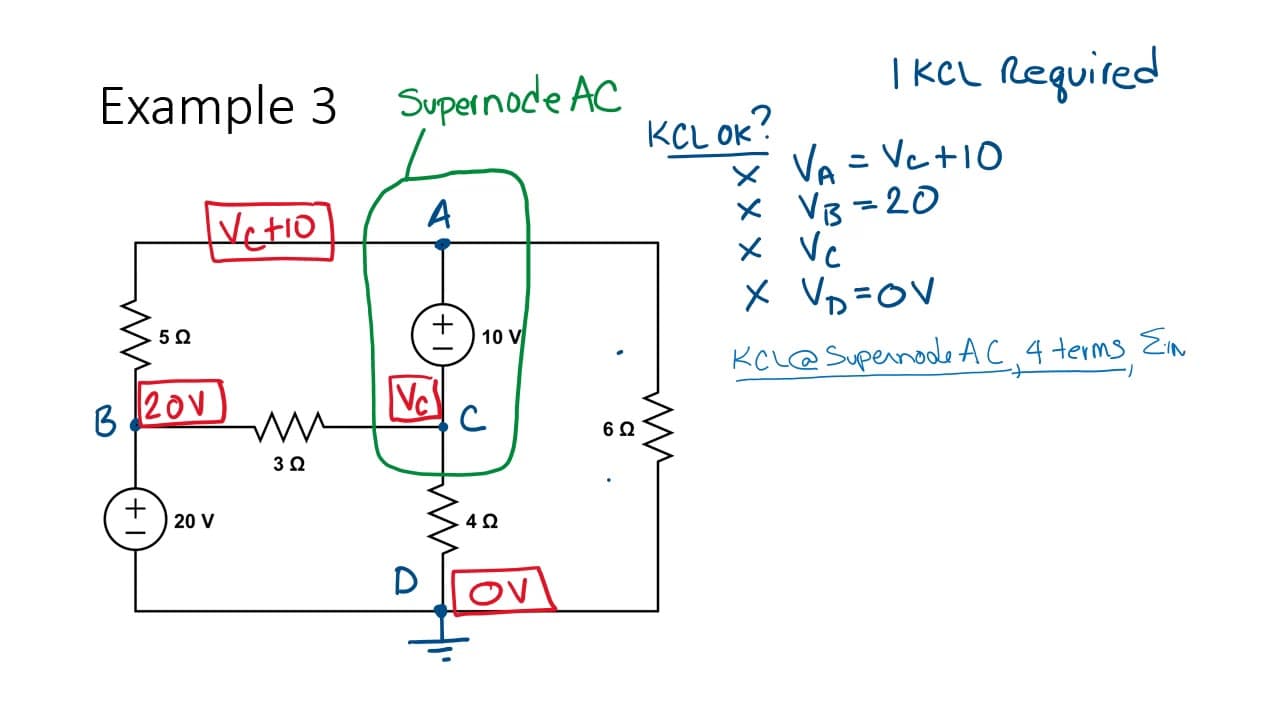
this video covers the use of super nodes in nodal analysis i'm going to set this circuit up for nodal analysis i'll first label the nodes we have load a b c and d i'm going to choose a ground i'm going to list my nodal voltages and then i'm going to calculate how many kcl equations would be required to do nodal analysis and again that's the number ... Read More
Key Insights
- ⚡ Nodal analysis is a powerful method for analyzing circuits and solving for unknown voltages at various nodes.
- #️⃣ The number of KCL equations required for nodal analysis depends on the number of nodes and voltage sources in the circuit.
- ⚡ Super nodes are used when voltage sources are connected to nodes, allowing us to simplify the analysis and solve for multiple unknown voltages using a single equation.
- 😚 Drawing a closed boundary around the circuit, including the voltage sources, helps in identifying and applying KCL equations for the super node.
Install to Summarize YouTube Videos and Get Transcripts
Explore YouTube Video Summarizer or Get YouTube Transcript Extractor
Questions & Answers
Q: What is nodal analysis and how is it set up?
Nodal analysis is a method for solving complex circuits by determining the voltages at different nodes. It is set up by labeling the nodes in the circuit and connecting them with resistors and voltage/current sources.
Q: How do you calculate the number of KCL equations required for nodal analysis?
The number of KCL equations required is equal to the number of nodes minus the number of voltage sources minus one. This is because Kirchhoff's current law (KCL) applies at each node, and each equation gives us information about one unknown voltage.
Q: What is a super node and when is it used in nodal analysis?
A super node is a combination of nodes in a circuit that allows us to solve for multiple unknown voltages using a single KCL equation. It is used when one or more nodes are connected to voltage sources, and we need to account for the currents flowing through those sources.
Q: How do you determine if a super node can be used in nodal analysis?
To determine if a super node can be used, check that all elements connected to the super node are either resistors or current sources. If there are any voltage sources connected to the super node, a super node cannot be formed.
Key Insights:
- Nodal analysis is a powerful method for analyzing circuits and solving for unknown voltages at various nodes.
- The number of KCL equations required for nodal analysis depends on the number of nodes and voltage sources in the circuit.
- Super nodes are used when voltage sources are connected to nodes, allowing us to simplify the analysis and solve for multiple unknown voltages using a single equation.
- Drawing a closed boundary around the circuit, including the voltage sources, helps in identifying and applying KCL equations for the super node.
- The choice of super node depends on the specific circuit configuration and can be determined by considering which nodes are connected to voltage sources.
Summary & Key Takeaways
-
The video introduces the concept of nodal analysis and explains how to set up a circuit for nodal analysis using labelled nodes.
-
It demonstrates how to calculate the number of Kirchhoff's current law (KCL) equations required for nodal analysis, based on the number of nodes and voltage sources.
-
The video then shows how to solve for nodal voltages using super nodes, where a closed boundary is drawn around the circuit to include voltage sources, and KCL equations are applied to the super node.
Read in Other Languages (beta)
Share This Summary 📚
Summarize YouTube Videos and Get Video Transcripts with 1-Click
Try YouTube Summary with ChatGPT & Claude or YouTube Transcript Generator
Explore More Summaries from Michelle Zheng 📚

Summarize YouTube Videos and Get Video Transcripts with 1-Click
Try YouTube Summary with ChatGPT & Claude or YouTube Transcript Generator